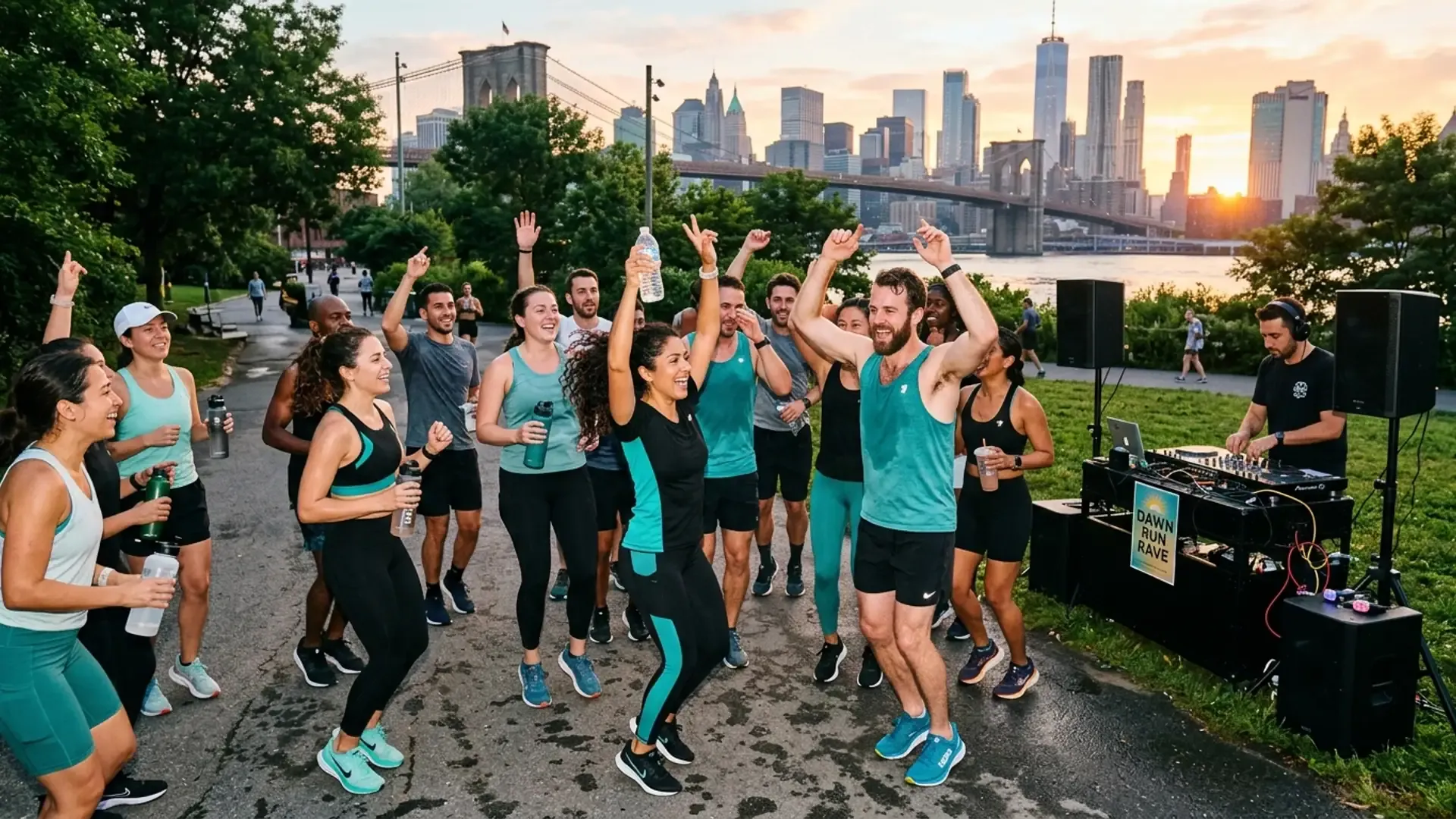
Soft Clubbing is the biggest nightlife pivot of 2025-2026: morning + music + no alcohol + movement + real connection, inverting the traditional club's formula of "alcohol + darkness + match anxiety + hangover regret." Lisbon's @limitless_clubb runs an outdoor 5K through city streets ending in a DJ after-party with protein smoothies — the visuals went viral on IG/TikTok in 2024 and became soft clubbing's most-recognized image. But the actual founders aren't @limitless_clubb; both London's Morning Gloryville (2013) and NYC's Daybreaker (also 2013) are the two pioneer brands, both re-exploding in Gen Z circles 2024-2025.
Eventbrite's 2026 Inaugural Social Study delivered hard numbers: coffee clubbing grew +478% year-over-year, and the "sober-curious" cohort grew +92% (Eventbrite newsroom). Axios reported in the same window: singles events on Eventbrite doubled between 2022 and 2025 (Axios). This guide decodes: (1) the 5 variants of soft clubbing (coffee rave / run rave / day-rave / wellness rave / sober rave), (2) the global scene, (3) the 3 psychological mechanisms making Gen Z choose this over traditional clubs, and (4) how to find or host one.
What Is Soft Clubbing? (And How It Differs from Traditional Nightlife)
Soft clubbing isn't one specific event — it's an umbrella category covering any social format that combines "morning or daytime + music + no alcohol + emphasis on connection over hookup." Compare to the traditional club formula: 11 PM start, alcohol-centered, dark + loud, designed for one-night hookups. Soft clubbing flips every variable.
Traditional Club vs. Soft Clubbing:
• Time: 11 PM start vs. 7-11 AM
• Core substance: alcohol vs. coffee / movement / protein
• Lighting: dark + lasers vs. natural light / morning sun
• Purpose: random hookup / match anxiety vs. real connection / shared experience
• Next day: hangover + regret vs. completion feeling + shareable photos
The point isn't "rejecting music and party energy" — it's relocating music, energy, and social time from night to morning, and swapping the central substance from alcohol to coffee or movement. Gen Z isn't giving up nightlife pleasure; they're moving it to a time slot that doesn't cost them health or amplify their anxiety.
Top 5 Soft Clubbing Variants Ranked & Compared (2026)
Soft clubbing isn't one activity. Five distinct formats fall under the umbrella:
1. Coffee Rave / Coffee Clubbing
The largest variant — the +478% growth Eventbrite cites is this format. Setting: Saturday 9 AM, café + DJ + coffee or oat-milk latte + dancing + zero alcohol. NYC's Daybreaker and London's Morning Gloryville (both founded 2013) are the two pioneer brands re-exploding in Gen Z circles 2024-2025. Lisbon's @limitless_clubb is the most viral 2024 standard-bearer (the outdoor 5K + DJ + protein smoothie format), not a founding pioneer — credit there goes to Daybreaker and Morning Gloryville.
(Related: Coffee Run Club: 2026 Post-Run Coffee Movement Decoded)
2. Run Rave / Run Club Party
A run club crossed with a DJ set. Setting: Sunday 6 AM 5K group run, then café or park-side DJ party with breakfast. Lisbon @limitless_clubb is the most visible example — outdoor 5K → DJ after-party + protein smoothies. NYC's Bandit Running, LA's Koreatown Run Club, and similar branded run clubs have run-rave-flavored events. Difference from coffee rave: movement comes first, party after — leans more into running-community identity. Strava's 2025 Year in Sport shows running clubs grew 3.5x year-over-year (Strava press release).
(Related: "Less Tinder, More Strava": Why Gen Z Is Trading Dating Apps for Running | Run Clubs Are the New Dating Apps)
3. Day-Rave / Daytime Disco
Club music, club energy, but in the 2 PM - 7 PM time slot. LA has Day Trip and several daytime techno event series listed on Resident Advisor (specific brands vary — check RA or Eventbrite for current LA versions); NYC, London, and Berlin have independent day techno scenes. Differs from coffee rave: venue is closer to a proper club (not a café), energy is higher, alcohol is optional (not banned) but not the centerpiece. By event volume, day-rave is the second-largest soft clubbing variant after coffee rave — significantly bigger than bakery rave or wellness rave.
4. Wellness Rave
The premium variant — combines cold plunge, sauna, yoga, breathwork. Setting: 7 AM sauna + cold plunge cycle + DJ + breathwork session. Toronto + NYC's Othership (4 locations: Toronto x2, NYC Flatiron, NYC Williamsburg) is the leader; NYC has bathhouse-style venues experimenting with the format. Premium pricing ($40-100/session) but the social density + post-session brunch potential is high.
(Related: The Science of Sweating Together: Exercise & Attraction)
5. Sober Rave / Sober Bar
Pure "no alcohol" — can be night or morning. Setting: typical club environment (evening, DJ, dancing) but drinks are mocktails / kombucha / coffee instead of alcohol. NYC's Listen Bar (2018-founded pop-up sober bar) and London's Club Soda are pioneers. Smaller sub-variants under this umbrella include bakery raves (Paris and Berlin one-off events at bakeries 2024). Eventbrite's "sober-curious +92%" stat captures this whole crowd — people who want the dance floor without the alcohol.
(Related: Sober Dating in LA: 12 No-Alcohol Date Ideas)
Why Soft Clubbing Resonates with Gen Z: Three Psychological Mechanisms
1. Gen Z drinks meaningfully less than Millennials
IWSR's US alcohol report shows Gen Z drinks roughly 20% less per capita than Millennials (Fortune citing IWSR 2025). This isn't a "health trend" — it's a generational consumption preference shift. The traditional club business model centered on alcohol simply doesn't match Gen Z's baseline behavior.
(Related: Sober Dating: Full Guide)
2. The anxious generation rejects hookup culture
Pew Research's 2023 study reports 43% of 18-29 year-olds in relationships first met as friends — double the 21% of the 65+ cohort — and Gen Z's interest in random hookups ranks lowest of any generation surveyed (Pew Research). The traditional club's "dark + alcohol + match anxiety" format is the opposite of what a high-anxiety generation wants. Soft clubbing inverts the framing — "we're here to move, drink coffee, enjoy music; meeting people is optional" — and dissolves the pressure.
(Related: Gen Z's Friendship Revolution: The Most Connected, Most Lonely Generation)
3. Mornings beat nights for time efficiency
A coffee rave from 9 AM-12 leaves your entire afternoon + evening to recover, work, or schedule a second meetup. A traditional club night 11 PM-3 AM kills your whole Sunday. Gen Z notices this trade. The morning version isn't a sacrifice; it's a strict upgrade on what your weekend can hold.
(Related: Touch Grass Dating: Why Gen Z Is Ditching Apps | AI Dating Trends 2026: The Return of Real Connection)
Global Soft Clubbing Scene Snapshot (2026)
Established (10+ years operating):
- London: Morning Gloryville (2013, one of two pioneer brands), Club Soda (alcohol-free pioneer)
- New York: Daybreaker (2013, the other pioneer brand — morning party + yoga), Listen Bar (2018 pop-up sober bar)
Emerging (2023-2025 rapid expansion):
- Lisbon: @limitless_clubb (2024 breakout — outdoor 5K + DJ + protein smoothies, now in Lisbon / Porto / Algarve)
- LA: Day Trip + various daytime techno event series on Resident Advisor (illustrative — check RA / Eventbrite for current LA brands), Listen Bar pop-ups occasionally west of NYC
- Toronto + NYC: Othership (4 locations — Toronto x2 + NYC Flatiron + NYC Williamsburg) leading wellness rave
- Paris + Berlin: bakery rave single events (Lutetia Paris, Berlin bakeries 2024 viral one-offs — not yet recurring)
Pilot (early-stage testing):
- Tokyo: morning rave format appearing in independent Shibuya / Harajuku cafés
- Mid-size US cities: Daybreaker and Morning Gloryville pop-ups appearing in Austin, Nashville, Portland, Minneapolis
Why Soft Clubbing Aligns with Outdoor Dating (And With GRASS)
Soft clubbing's core premise — the activity is the main event, meeting people is the byproduct — is the exact philosophy underneath GRASS and outdoor dating more broadly. A coffee rave won't make you introduce yourself, swap socials before you leave, or explain why you're there. You're there for the coffee + music + people-energy. If you meet someone, it's because you're both genuinely the kind of person who wakes up early to dance sober.
This is why soft clubbing, outdoor dating, coffee run club, run rave, and less-Tinder-more-Strava all share a single root: they're different versions of "real connection via shared activity, not via algorithm or alcohol or anxiety". The full philosophy: The Complete Guide to Outdoor Dating.
GRASS is an outdoor-first activity dating app — the most natural way to plug into soft clubbing on GRASS is to RSVP to weekend coffee runs, morning workouts, sunrise meetups that already exist on the platform. Hosting a recurring soft-clubbing event on GRASS is also high-leverage: every user is already activity-oriented, so the audience overlap is near-100%. Way better hit rate than asking "want to come to a coffee rave?" on Tinder.
How to Host Your Own Soft Clubbing Event
You don't need DJ equipment or venue rent. Minimum viable version requires only:
- 3-5 friends + 1 Spotify playlist: gather 3-5 friends on the same wavelength, pick Saturday 9-11 AM, find a café with open space (or a park), bring a Bluetooth speaker.
- Pick a theme (one of the 5 variants): pure coffee rave, run rave, day-rave, yoga rave, or sober rave — commit to one clear format.
- 1.5 hours is the sweet spot: too short = no atmosphere; too long = exhaustion. 9:00-10:30 or 10:30-12:00 both work.
- Don't force interaction: the whole soft-clubbing ethos is no forced pairing, no forced intros. Let conversations happen naturally; use silence as space for the coffee.
- Close with an extension hook: next week's plan, IG follows, a casual weekday coffee — turn one event into recurring community.
If you'd rather join than host: Browse this week's activities on GRASS — coffee runs, morning workouts, sunrise paddles already exist on the platform. Or read How to Meet People in LA Without Dating Apps for offline-first urban tactics.
Frequently Asked Questions
Is soft clubbing only for people who don't drink?
No. Soft clubbing's premise isn't prohibition — it's "alcohol is no longer the central substance." You can drink, not drink, or have a mocktail. The format is designed so that alcohol isn't required to enjoy yourself, so drinkers also don't feel like they're missing out. Eventbrite's "sober-curious +92%" growth specifically captures people who are curious about non-drinking social formats — not necessarily people quitting alcohol entirely.
What's the difference between a coffee rave and a coffee run club?
Coffee Run Club is "run first, then coffee shop hangout" — the centerpiece is the running community. Coffee Rave is "café + DJ + dancing" — no running required, music + coffee is the centerpiece. Run Rave is the hybrid: run together, then dance afterward. All three live under the soft-clubbing umbrella. Full breakdown of Coffee Run Club: Coffee Run Club: 2026 Post-Run Coffee Movement.
Are there soft-clubbing events in smaller US cities (not NYC/LA)?
Increasingly yes. Daybreaker and Morning Gloryville have hosted pop-ups in Austin, Nashville, Portland, Minneapolis. The format scales down well to mid-size cities because the requirements are low (café + speaker + community). Check Eventbrite + IG hashtags like #softclubbing / #coffeerave / #morningrave for your city.
Can soft clubbing actually feel like a real party without alcohol?
Yes. Caffeine + movement endorphins + DJ music + crowd energy — these four physical + social stimulants produce a different but comparable euphoria to alcohol, without the hangover, blackouts, or regret. Neuroscience calls this "exercise-induced euphoria" — runners are familiar with it, and the same biology applies in a dance + coffee context. Related: The 50-Hour Friendship Rule.
Is soft clubbing only for Gen Z, or do older crowds fit in?
Not exclusive. Millennials (28-43) may actually be the largest hidden audience — you're already tired of hookup culture, want to skip hangovers, prefer early-rise + healthy + real connection. Gen Z created the format; Millennials are filling the rooms. Typical age range at these events is 25-45 — you won't stand out.
How does GRASS work with soft clubbing?
GRASS is an outdoor-activity dating app — the most natural plug-in is browsing or hosting weekend coffee runs, morning workouts, outdoor yoga, sunrise meetups that already live on the platform. Every user is outdoor-oriented and open to in-person activities, which is exactly the soft-clubbing target demographic. Way higher hit rate than asking "want to come to a coffee rave?" on Tinder. Download GRASS free to start — or read the full outdoor dating philosophy first.
Let stories happen naturally.