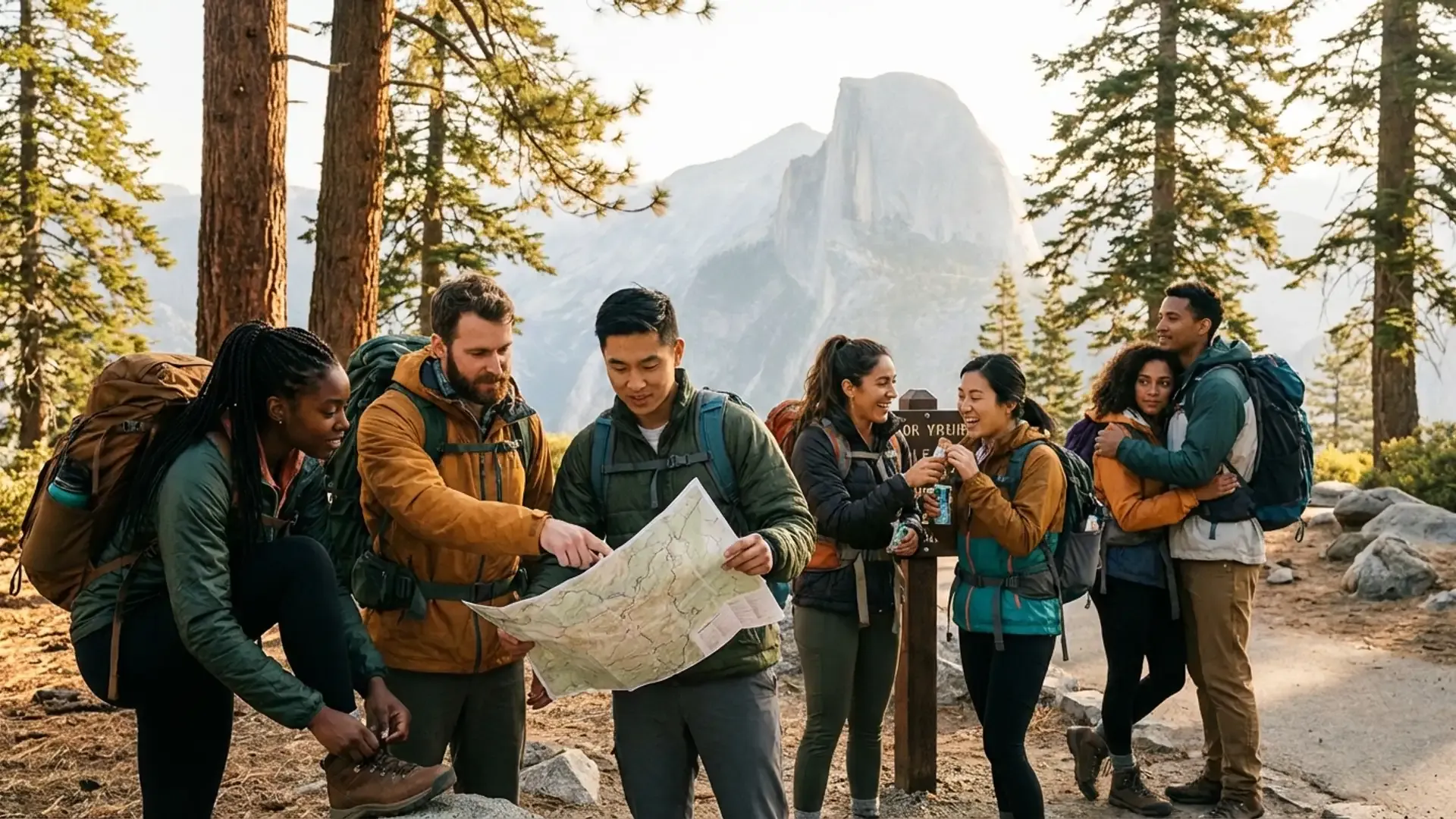
What Is Outdoor Dating? The Movement That’s Replacing Swipe Culture
Outdoor dating is meeting people through shared physical activities instead of swiping through profiles. Instead of evaluating someone’s carefully curated photos, you hike together, run together, climb together — and let the activity itself become the foundation for connection. According to University of Kansas professor Jeffrey Hall, it takes an average of 50 hours of shared time to move from acquaintance to friend (Hall, 2019), and research suggests that shared challenging activities build intimacy significantly faster than passive socializing (Aron et al., 1997).
Why is this movement gaining momentum now? The data tells a stark story. Pew Research Center’s 2023 survey found that 46% of U.S. dating app users describe the experience as exhausting. Hinge’s own research shows that dates involving activities have significantly higher satisfaction rates than traditional sit-down meetings. And a growing cultural backlash — from the "touch grass" movement to the anti-screen-time trend — is pushing people to seek connection in the physical world.
A new generation of social platforms is responding to this shift by designing around activities, not profiles. Instead of asking "who do you want to meet?", they ask "what do you want to do?" — and let the meeting happen organically.
This comprehensive guide covers the science, the activities, the safety considerations, and the practical steps to make outdoor dating work for you — whether you’re an extrovert or introvert, athletic or not.
(Related: Why Outdoor Dating Works Better Than Traditional Methods)
Dating App Fatigue Is Real — And You’re Not Alone
If you’ve ever closed a dating app mid-session thinking "I just can’t do this anymore," you’re experiencing what psychologists call the Paradox of Choice. Columbia University’s Sheena Iyengar demonstrated that when options increase from 6 to 24, purchase rates plummet from 30% to 3% (Iyengar & Lepper, 2000). Dating apps are this experiment at infinite scale.
The numbers paint a troubling picture:
- 46% of dating app users say the experience is exhausting (Pew 2023)
- 63% of men report rarely or never receiving replies after matching
- Only 14% of users believe apps helped them find meaningful relationships
- Users report spending significant daily time on apps with diminishing emotional returns
For men specifically, the math is brutal. With skewed gender ratios on most platforms, the average male user faces extremely low match rates. That’s thousands of rejections — or more accurately, thousands of non-responses — building up over months and years. It’s not personal failure; it’s a broken system.
(Related: The Cure for Dating App Fatigue: 3 Steps Back to Real Connection, Why Men Are Leaving Dating Apps — And Where They’re Going Instead)
But what if there’s a way to meet people that science says actually works better?
The Science Behind Why Outdoor Dating Works
Outdoor dating isn’t just "nicer" — every advantage is backed by peer-reviewed research. Here are the 4 key principles that explain why activity-based connection produces deeper, more lasting relationships:
1. Misattribution of Arousal (The Bridge Study)
Dutton & Aron (1974) found that people met during physically arousing situations are perceived as more attractive. Your brain can’t distinguish "my heart is racing because of the hike" from "my heart is racing because of this person" — so it defaults to the flattering interpretation. Any activity that elevates your heart rate creates a neurological shortcut to attraction.
2. The 50-Hour Rule
Jeffrey Hall (2019) quantified what it takes to build friendship: 50 hours to become casual friends, 200 hours for close friends. Weekly group activities accumulate these hours far more efficiently than occasional coffee dates — and Aron’s research (1997) suggests that shared challenging experiences build intimacy significantly faster than passive socializing.
3. The Shared Ordeal Effect
Aron et al. (1997) demonstrated that completing challenging tasks together accelerates trust and intimacy. The brain simultaneously releases adrenaline (alertness) and oxytocin (bonding), creating a neurochemical cocktail that makes you both like and trust your companion.
4. Group Dynamics
Tajfel & Turner’s Social Identity Theory (1979) shows that group membership automatically generates in-group favorability. An 8-person hiking group creates instant belonging — and lets you observe authentic behavior under low pressure, unlike the performance pressure of a one-on-one date.
For a deep dive into each principle, see our companion piece: The Psychology of Making Friends: 7 Science-Backed Principles. Also recommended: Outdoor Dates vs. Coffee Dates: What Science Says About Where You Meet.
You don’t need to understand all the science — just know this: shared physical activities trigger multiple bonding mechanisms simultaneously, something swiping on a screen structurally cannot do.
Outdoor Dating vs. Online Dating at a Glance:
Choice pool: 6-10 people (focused) vs. unlimited (decision fatigue)
Interaction: Doing things together (actions speak) vs. text chat (self-packaging)
Trust building: Shared experience + adrenaline + oxytocin vs. words and photos only
Time efficiency: 4-hour activity ≈ weeks of online chatting in intimacy building vs. hours spent on matching and openers
Pressure level: Group setting with activity as anchor vs. one-on-one interview pressure
Authenticity: Real behavior and reactions vs. curated profiles
Top 8 Outdoor Activities for Meeting People (2026 Ranking)
Not every outdoor activity is equally suited for socializing. The best activities share three qualities: natural interaction opportunities, moderate intensity that allows conversation, and the ability to participate regularly. Here are 8 top picks ranked by ease of meeting people (with audience fit tags so you can pick the right one):
1. Hiking & Trail Walking
America’s 60,000+ miles of trails are the ultimate social infrastructure. Side-by-side walking produces the most natural, low-pressure conversation (what researchers call the "shoulder-to-shoulder effect"), and a 3-5 hour hike accumulates meaningful shared time. National parks, state parks, and local trails all work — REI Experiences and local hiking groups organize weekly outings in most cities.
Best fit: introverts, social-anxiety types, women-only safety options, first-time outdoor daters
👉 10 Best Hiking Trails for Meeting People in the US | How to Find Trail Running Meetups Near You
2. Trail Running & Run Clubs
The run club renaissance is real. Strava 2025 reports running clubs grew 3.5x year-over-year. From November Project to local Parkrun events, running groups embody the proximity effect perfectly — same time, same route, same people every week. The post-run hangout (coffee, brunch, beer) is where friendships actually solidify.
Best fit: Gen Z anti-swipe crowd, "less Tinder more Strava" believers, people who want fixed weekly cadence
👉 Why Run Clubs Are Replacing Dating Apps in 2026 | Strava Dating: Why Gen Z Replaced Tinder With Kudos | 8 Best Run Clubs in LA for Meeting People
3. Rock Climbing (Indoor + Outdoor)
Climbing requires belayer-climber trust, creating an immediate and literal "I’m trusting you with my life" bond. Indoor climbing gyms are social hubs, and the climbing community is famously welcoming to beginners. The problem-solving aspect (beta spray) gives introverts a natural conversation starter.
Best fit: adventure dating curious, introvert-friendly (problem-solving > small talk), rainy-day backup
4. Kayaking, SUP & Water Sports
Water activities carry inherent adventure (hello, misattribution of arousal) and learning a new skill together creates natural helping moments — the perfect icebreaker. Group paddle trips on rivers or coastal areas combine exercise, scenery, and social bonding.
Best fit: adventure dating high-end, summer-cool options, sober social crowd
5. Cycling (Road + MTB Group Rides)
Road cycling groups and mountain bike crews share the "completing a journey together" achievement factor. Most cities have organized group rides for every skill level, from casual bike path rides to challenging century routes.
Best fit: long 1-on-1 conversation seekers, achievement-driven personalities, E + I types both
6. Camping (Shared Ordeal Effect)
Camping is the shared ordeal effect at its peak. Setting up camp, cooking, building fires, stargazing — every phase requires collaboration, and overnight trips maximize shared time in a single outing. Group camping trips through organizations like REI or local outdoor clubs are ideal entry points.
Best fit: 30+ seeking deeper connections, want to skip early-stage small talk, weekend warriors
7. Group Fitness, Boot Camps & HYROX
CrossFit boxes, outdoor yoga, boot camps in the park, HYROX hybrid races — these structured fitness communities combine regular attendance with shared physical challenge. The "suffering together" factor accelerates bonding, and most have strong post-workout social cultures. HYROX in particular is exploding as a singles meeting ground in 2026 (8K running + 8 functional stations).
Best fit: competitive personalities, HYROX/Spartan/Tough Mudder community, fitness-first daters
8. Walking Dates, Park Meetups & Community Sports Leagues (Low-Barrier)
Not everyone wants intense activities. Walking dates, park picnics, outdoor movie nights, recreational sports leagues (NYC Social Sports Club, ZogSports, local rec leagues) — these low-effort options still trigger group dynamics and shared experience effects. Side-by-side walking is one of the highest-conversion first-date formats per dating coaches.
Best fit: non-athletic, first-time outdoor daters, sober social ("coffee dates without coffee shops")
👉 Why Walking Dates Win: Routes + First-Date Playbook
💡 "Why not just join a running club or REI trip directly?" Fair question. Self-organized groups and established clubs are great options, but they come with friction: finding the right activity takes research, joining a group of total strangers requires a trust leap, and there’s no built-in way to maintain connections after the event ends. GRASS solves these friction points: platform verification builds trust before you show up, activity categories let you find your thing in seconds, and in-app connections keep relationships alive after the hike ends. Try GRASS free.
What Is Adventure Dating? (And How It Differs From Outdoor Dating)
Adventure dating is the high-intensity sibling of outdoor dating: deliberately choosing high-adrenaline, mildly challenging activities for first dates — climbing, surfing, night hikes, SUP, ATV rides, ziplining, canyoneering. The point isn’t to do extreme sports; it’s to engineer the "two people overcoming a small challenge together" atmosphere. The science: high arousal + needing each other’s help + completing the activity together amplifies the misattribution of arousal effect to its maximum. Your brain mistakes "this activity is exciting" for "I have feelings for this person."
Adventure dating vs. general outdoor dating:
• General outdoor dating: walks, picnics, coffee runs, easy hikes — low pressure, slow accumulation
• Adventure dating: climbing, surfing, canyoneering, SUP, night activities — high stimulation, fast trust building
Why adventure dating is having a moment in 2026:
(a) Gen Z’s anti-swipe pushback is at its peak — more people want IRL real experiences over algorithmic matches; (b) #adventuredate TikTok and Reels content has made "two people’s adventure photos" a new love narrative; (c) Compared to weekly coffee dates, a single adventure date can produce trust equivalent to 5-10 coffee dates in just 4-6 hours.
Top adventure dating activities ranked by trust-build speed:
1. Indoor/outdoor rock climbing — fastest trust build (belayer-climber mechanic)
2. SUP / paddleboarding — learn-together skill plus helping moments
3. Night hiking / stargazing — darkness reduces social judgment + shared visual reward
4. Canyoneering / river tubing — strong adrenaline + dependency on partner
5. Trail running / ultra rep — more intense than club runs, faster friendship buildup
Adventure dating isn’t just for adventure-seeking personalities. Introverts may actually benefit more — the activity provides a built-in conversational script, so you don’t have to invent small talk; all the conversation grows naturally out of what you’re doing.
Further reading: The Science of Sweating Together: Exercise & Attraction | Santa Monica & Venice Outdoor Date Ideas | 12 Best Hiking Trails in LA for a Date. Want to find an adventure date partner? Browse this week on GRASS.
Outdoor Singles Community: How to Find Your People
If you’re an outdoor person looking for outdoor singles to date or befriend, dating apps alone won’t cut it — what you actually want isn’t "the next match," it’s an outdoor singles community you can plug into long-term. Here are three ways to find one, with tradeoffs:
Method 1: Join existing run clubs, hiking groups, or climbing meetups
Pros: free or low cost, in-person, already-vetted activity people
Cons: not "singles-oriented" — may take many sessions to find people in your stage of life; most US clubs mix married + single attendees, so filtering takes time
👉 8 Best Run Clubs in LA for Meeting People | 10 Best Hiking Trails for Meeting People
Method 2: Use meetup-style apps for single outdoor events
Pros: high flexibility, try multiple activity types in a week, good for the still-exploring crowd
Cons: trust takes time to build (random group composition); no built-in way to stay connected after the event
👉 How to Find Trail Running Meetups Near You
Method 3: Use an outdoor-first dating app like GRASS to find outdoor singles
Pros: everyone here is outdoor-oriented AND open to meeting new people — highest filtering efficiency; in-app connections keep you in touch after events
Cons: requires building your outdoor passport profile up front (5-10 minutes one-time setup)
👉 How to Use GRASS App: Step-by-Step for People Done with Swiping | 12 Best Dating Apps for Outdoorsy People (2026 Ranking)
How to pick the right outdoor singles community — 4 filtering criteria:
1. Cadence: at least weekly activity (50-hour rule needs repeated exposure)
2. Activity-type alignment: a hiking lover won’t last in a running club — find baseline interest overlap
3. Demographic transparency: organizer / average age / gender ratio visible (avoid joining and finding total mismatch)
4. Safety mechanism: identity verification, public activity reviews, organizer history (especially important for women)
Further reading: Outdoor Dating for Women: Safety Guide | The Death of Third Places (Why Outdoor Dating Matters) | Touch Grass Dating: Gen Z Quitting Apps | The Best US Cities for Outdoorsy Singles. Ready to plug into an outdoor singles community? Browse activities on GRASS this week.
Going Solo vs. Group Activities: Which Is Right for You?
"I’d go, but I don’t have anyone to go with." This single thought stops more potential outdoor daters than any other barrier. But here’s what the research says: going alone actually makes you more likely to connect with new people.
Advantages of going solo:
- You won’t retreat into an existing friend bubble — you’ll naturally engage with strangers
- Research on "openness signals" shows that solo attendees are perceived as more approachable
- You choose activities based purely on your interest, not group compromise
Advantages of group activities:
- Lower pressure — you’re not obligated to talk to everyone
- You can observe authentic behavior in a natural setting
- Even if no individual spark happens, you still had a great time — zero downside
For Americans especially, the disappearance of what sociologist Ray Oldenburg called "third places" — informal social gathering spots that aren’t home or work — has left a social infrastructure void. Outdoor group activities are emerging as the 21st-century replacement for the neighborhood bar, the bowling alley, and the community center.
(Related: The Death of Third Places and the Rise of Outdoor Social Groups)
Outdoor Dating Strategies for Different People
Outdoor dating isn’t just for fit extroverts. Different people can find their entry point with the right approach. Here are 6 audience segments and how each can plug into the outdoor singles community:
Introverts & Social-Anxiety Types
Activities provide built-in behavioral scripts, eliminating the dreaded "what do I say?" pressure. The shoulder-to-shoulder effect of walking makes conversation less confrontational than face-to-face seating. Introverts’ strength — deep one-on-one conversation — happens most naturally on trails. Start with small groups (3-6 people) and low-intensity activities (hiking, walking dates, market strolls) before jumping into 20-person run clubs.
Best activities: light hiking, walking dates, outdoor films, market strolls, climbing gyms (problem-solving gives you talking points)
👉 The Introvert’s Guide to Outdoor Dating | Social Anxiety & Outdoor Activities | The Death of Third Places (Why Outdoor Dating Matters)
Men Leaving Dating Apps
If you’re one of the millions of men frustrated by low match rates and non-responses on traditional dating apps, outdoor activities level the playing field. Here, you’re evaluated on how you show up in real life — your helpfulness, your humor, your calmness under pressure — not your photo or opening line. Pew Research shows 63% of male app users rarely get replies after matching; the outdoor route bypasses that entire bottleneck.
Best activities: run clubs, hiking groups, sports leagues, rock climbing — environments where action speaks louder than profiles
👉 Why Men Are Leaving Dating Apps | Why Run Clubs Are Replacing Dating Apps in 2026
Women Prioritizing Safety
Safety is a non-negotiable priority. Choose established platforms with identity verification, start with group activities in public locations, share your plans with a friend, and maintain transportation independence. Multi-person outdoor meetups are inherently safer than one-on-one dates with strangers. GRASS includes built-in identity verification + public activity reviews + organizer history — more controllable than ad-hoc IG meetups.
Best activities: multi-person group activities (avoid 1-on-1 outdoor), women-led run clubs, daytime activities, organizers with visible history
👉 Outdoor Dating for Women: Safety Guide | Dating App Safety Guide: Scams, Red Flags, How to Stay Safe
The 30+ Crowd (Shrinking Social Circles)
After college, social circles naturally shrink. Career changes, relocations, and life transitions remove the structured social environments that made friendship easy. Outdoor activities recreate that structure — regular schedule, shared interest, repeated contact — without requiring the "classmate" or "coworker" context. The 30+ crowd benefits most from weekly fixed cadence (proximity effect → fast trust) rather than single events.
Best activities: weekly run clubs, monthly hiking groups, seasonal themed events, intentional-dating-app meetups
👉 Making Friends After 30: What Actually Works | Meeting People in LA as a Newcomer: First 6 Weeks Playbook
Sober-Curious & Non-Drinking Social (2026 Trend)
Eventbrite 2026 reports coffee clubbing grew +478% YoY and sober-curious crowd +92% — more people want connection without alcohol. Outdoor activities are inherently sober: you won’t crack a beer at the summit, you won’t pour whiskey mid-run. Adventure dating’s adrenaline alone builds connection faster than alcohol ever could.
Best activities: coffee runs, morning run clubs, walking dates, outdoor yoga, adventure dates (climbing/SUP)
👉 Coffee Run Club: 2026 Post-Run Coffee Movement | Sober Dating in LA: 12 No-Alcohol Date Ideas | Touch Grass Dating: Why Gen Z Is Ditching Apps
Extroverts Who Get App Fatigue Too
Don’t assume extroverts immune to app burnout. Extroverts especially exhaust on "many rounds of small talk before getting to the real connection" — what they want is group energy, not text ping-pong. Outdoor activities let extroverts skip the dial-up phase and dive directly into "doing things with a group of people" — where their social energy actually pays off.
Best activities: large run clubs (20+ people), team beach volleyball, outdoor music festivals, HYROX training groups, sports league watch parties
👉 Sports Dating: 6 Sports × App Comparison Guide | 8 National Parks Where You’ll Actually Make Friends
Whichever segment you fit, GRASS has activities matching your style. Introverts can start with small hiking groups, 30+ folks can find weekly fixed meetups, women can choose multi-person events for peace of mind, sober-curious crowd finds coffee runs, extroverts plug into large run clubs. Browse this week’s activities on GRASS to find your entry point.
Safety First: Outdoor Dating Best Practices
Enjoying outdoor dating starts with staying safe. Regardless of the activity, these 5 principles apply:
- Use verified platforms: Choose apps and groups with identity verification (like GRASS). Avoid anonymous private meetups from unmoderated forums
- Share your plans: Before every outing, send your time, location, and group size to at least one trusted person. Share your live location if possible
- Start in public spaces: For your first few meetups, choose popular trails, parks, or well-trafficked areas. Save the remote backcountry for when you know and trust the group
- Maintain transportation independence: Drive yourself or take public transit. Never depend on someone you just met for your ride home
- Trust your instincts: If any person or situation feels off, leave immediately. Your safety is always more important than social politeness
(Related: The Complete Outdoor Dating Safety Guide)
GRASS is designed with safety at its core: real-person verification, transparent activity details, and a multi-person group format that’s inherently safer than one-on-one blind dates.
How to Start Your Outdoor Dating Journey
Enough theory. Here are 5 actionable steps to start today:
Step 1: Pick an activity you already enjoy
Don’t force yourself into something you hate just to meet people. Like walking? Hike. Like swimming? Try a SUP group. When you’re doing something you genuinely enjoy, you naturally show up as your most authentic, attractive self.
Step 2: Start with group events
Don’t jump straight into one-on-one situations. Join a group of 6-10 people where the pressure is minimal and the exit is graceful. Most outdoor social platforms, including GRASS, are designed around this group-first model.
Step 3: Show up consistently (the proximity effect)
Don’t go once and quit. The 50-hour rule means friendship requires accumulation. Attend the same type of activity weekly, and let repeated contact do the heavy lifting. You don’t need to be the most charismatic person in the group — you just need to be there.
Step 4: Let actions speak
You don’t need a perfect opening line. Offer to help carry gear, point out an interesting trail feature, share a snack. These small actions communicate more about who you are than any bio or pickup line ever could.
Step 5: Follow up naturally
"Are you coming next week?" is the most natural follow-up in the world. Exchange contacts, connect on social media, or add each other on GRASS — keep the connection alive beyond the activity.
(Related: Your First Outdoor Date: The Complete Guide, GRASS Beginner’s Guide: 5 Steps to Finding Your Outdoor Crew, Good Texter, Bad Date: Why Great Online Chat Falls Flat in Person)
Ready to start? Download GRASS free on App Store and Google Play. Replace the swipe with shared experience.
Let stories happen naturally.
If your outdoor thing is cycling, the group-ride version of all of this is here: how to find a group ride near you.
Frequently Asked Questions
How is outdoor dating different from regular dating?
The fundamental difference is the sequence. Traditional dating follows "browse profiles → text chat → maybe meet in person." Outdoor dating follows "choose an activity → show up together → naturally connect." The former has you spending hours evaluating screens; the latter puts you in real-world settings where you observe authentic behavior — how someone handles a steep trail, helps a struggling teammate, or reacts to unexpected rain. Psychology research consistently shows that behavior is more honest than self-presentation.
Do I need to be athletic to try outdoor dating?
Absolutely not. "Outdoor dating" doesn’t mean "extreme sports dating." Picnics in the park, farmers market strolls, stargazing nights, outdoor movie screenings, nature photography walks — these low-exertion activities trigger the same group dynamics and shared experience effects as more athletic options. The key isn’t how much you sweat; it’s that you’re doing something together in the real world. Choose an intensity level that feels comfortable for you.
What should I bring to my first outdoor meetup?
Three essentials: appropriate clothing and footwear (check the activity type), water and a light snack, and an open mindset. You don’t need to prepare conversation topics or an elevator pitch — the activity itself is the icebreaker. If it’s a hiking or water activity, check if the organizer provides a gear list. Most importantly: tell at least one friend where you’re going.
Is outdoor dating safe?
Like any social activity, safety depends on your choices. Use platforms with identity verification (like GRASS), choose group activities, meet in public locations, share your plans with a friend, and maintain your own transportation. Group outdoor meetups are actually safer than one-on-one blind dates because other people are present. Trust your instincts — if something feels wrong, leave.
Is it weird to go alone?
Not at all — in fact, it’s the norm. The majority of people at outdoor meetups and activity groups initially showed up solo. Research on "openness signals" shows that people attending alone are perceived as more approachable and interested in connecting. You’ll also engage more with new people when you’re not retreating into an existing friend group. The first time is the hardest; after that, you’ll realize everyone is there for the same reason.
How long does it take to make real friends through outdoor activities?
Professor Jeffrey Hall’s research (2019) provides a benchmark: 50 hours of shared time to become casual friends, 200 hours for close friends. But quality matters more than quantity — shared challenging experiences are 2-3x more efficient at building bonds than passive socializing. One 4-hour hike may equal 10-12 hours of coffee shop conversation in friendship-building impact. At one activity per week, most people build solid friendships within 2-3 months.
What about bad weather?
Rain doesn’t have to cancel your plans. Indoor climbing gyms, indoor sports courts, cooking classes, board game cafes — these indoor alternatives still trigger the shared experience effect. In fact, adapting to unexpected weather together ("let’s pivot to that climbing gym instead") can itself be a bonding experience. Some of the best connections form when plans go sideways.
How is GRASS different from other dating apps?
The core difference is design philosophy. Traditional dating apps follow a "browse → chat → maybe meet" flow centered on profiles. GRASS follows a "choose an activity → join the group → naturally connect" flow centered on experiences. Your Outdoor Passport showcases your real adventures (not filtered selfies). Find Buddy lets you skip endless texting and go straight to activities. Group Adventure creates low-pressure, multi-person meetups. Every feature is designed around the psychology of how real connections actually form — because we believe doing things together beats talking about doing things.