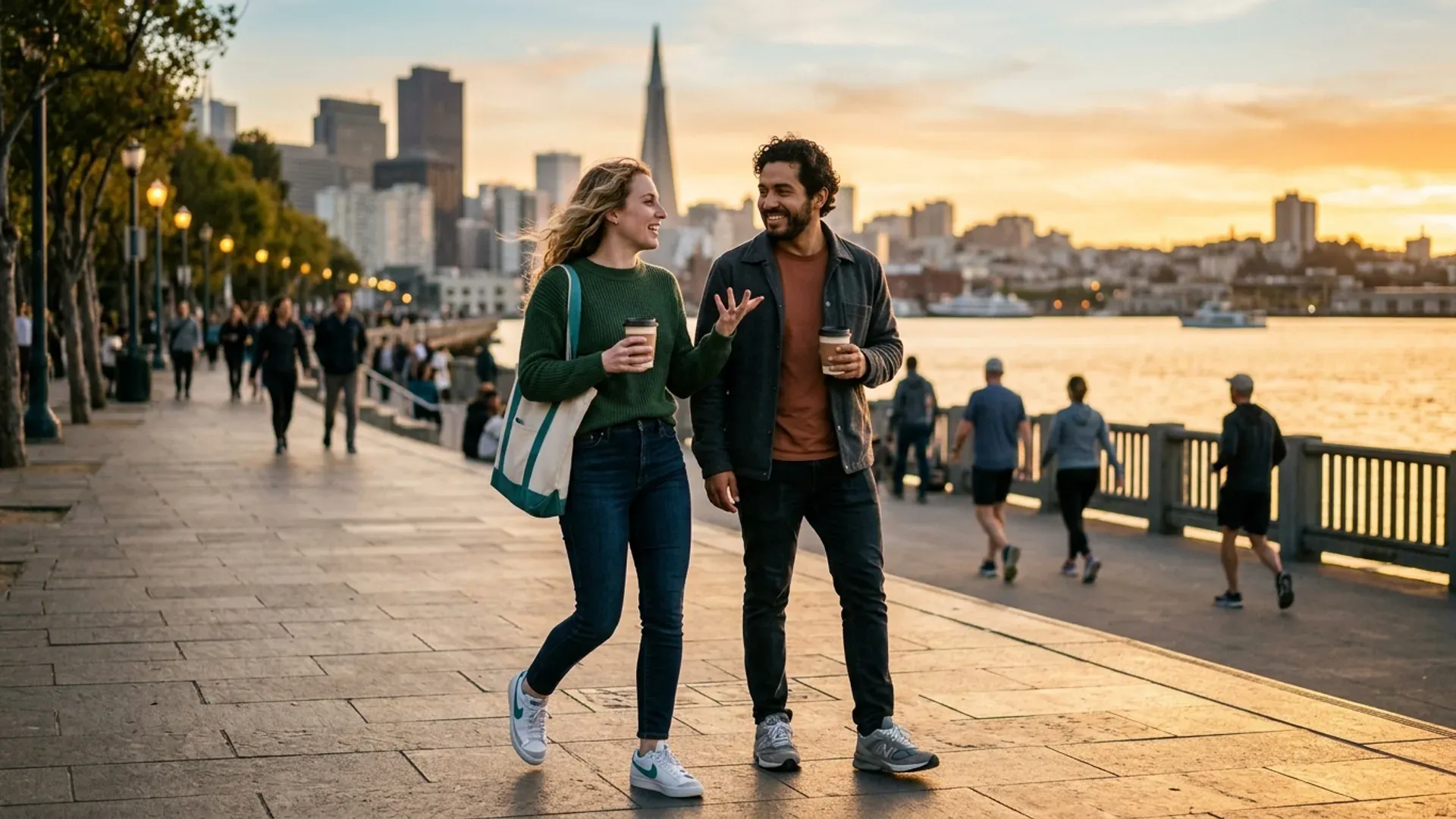
A walking date works because it turns a first meet from an interview into a shared rhythm. You are side by side instead of locked across a table, the route gives you something to notice together, and the plan can be short without feeling abrupt. For people tired of endless swiping, it is one of the easiest ways to move from chat to real life without overbuilding the moment.
The best walking dates are simple: a public route, a clear start and end point, 30 to 60 minutes, and an optional second stop if the chemistry is there. That structure keeps the pressure low while still giving you enough time to notice what actually matters: pace, curiosity, reliability, humor, and whether the conversation feels easier once your phones are away.
Why are walking dates better than coffee dates?
Walking dates reduce first-date pressure because they replace constant eye contact with shared attention. You do not have to perform across a small table. You can comment on the route, pause at a view, laugh about a wrong turn, or let a quiet minute pass without making it awkward.
There is also a real health and mood case for getting outside. A 2019 Scientific Reports study found that spending about 120 minutes a week in nature was associated with better health and well-being. The WHO Europe report on green and blue spaces also summarizes evidence linking parks, water, and urban nature with mental health benefits. A walking date will not magically create compatibility, but it does create a better setting for a human conversation.
That is the core idea behind outdoor dating: do something small together first, then decide whether the connection is worth more time. A walk is the lowest-friction version of that philosophy.
What makes a good walking date route?
A good route is not the most impressive route. It is the route that makes both people feel relaxed, oriented, and free to leave if the vibe is not right. Use the “easy in, easy out” rule: public, well-lit, transit or rideshare nearby, and an obvious endpoint.
- For a first meet: choose a busy park loop, waterfront path, botanical garden, farmers market edge, or neighborhood main street with a calm side path.
- For a second date: choose a longer route with one memorable view, a bookstore stop, a food truck, or a coffee window at the end.
- For an outdoorsy match: choose an easy trail, lake path, beach walk, or urban greenway. Keep it beginner-friendly unless you already know they want a workout.
- For a low-energy weekday: choose a 30-minute sunset loop near both of you. A date does not need to take over the whole evening to be real.
Avoid remote trails, routes with poor phone signal, and plans that depend on one person driving the other. The goal is not to prove you are adventurous. The goal is to make it easy for two people to be present.
How should you ask someone on a walking date?
The best invitation is specific and low-pressure. Instead of “want to hang out sometime?” try: “I’m planning a 40-minute walk around the lake Saturday at 5, then maybe coffee if we’re both feeling it. Want to join?” That sentence answers the four questions most people silently have: where, when, how long, and what happens next.
A walking date invite works especially well when it names the activity before the romantic pressure. You are not asking someone to commit to an entire evening with a stranger. You are asking them to try one small, public plan.
Use these conversation prompts if you do not want the date to feel like a resume review:
- “Are you more of a sunrise walk person or a sunset walk person?”
- “What is the most underrated place in your city to clear your head?”
- “If your weekend had to include one outdoor thing, what would you pick?”
- “Do you like plans with a route, or do you prefer wandering?”
- “What is a small habit that makes your week feel better?”
These questions work because they are anchored in the moment. They invite stories without forcing vulnerability too early.
What safety rules should walking dates follow?
A walking date should feel easy, not risky. Public routes, daylight or early evening, clear boundaries, and independent transportation matter. If someone pushes to change the plan to a secluded place, asks you to get in their car, or ignores the time limit you set, end the date.
- Keep the first walking date between 30 and 60 minutes.
- Meet at a visible landmark, transit stop, cafe, park entrance, or waterfront sign.
- Tell a friend where you are going and when you expect to be done.
- Bring water, a charged phone, and shoes you can actually walk in.
- Choose routes with other people around, especially after dark.
If safety is your main concern, read our Dating App Safety Guide before planning your first meet. Good boundaries do not make dating less romantic. They make it possible to relax.
How does GRASS make walking dates easier to plan?
GRASS is built for activity-first dating. Instead of trying to stretch a text thread until somebody finally asks to meet, you can create a simple plan: walk, run, hike, climb, surf, or join a group activity. The activity gives the connection a shape before it turns into pressure.
For a walking date, write the plan like a route card: “Saturday 5 PM, 40-minute waterfront walk, easy pace, optional coffee after.” That kind of post attracts people who are comfortable with the same pace and expectations. It also filters out the endless-chat pattern that makes dating apps feel like work.
If one-on-one still feels like too much, start with a group walk, casual run, or beginner-friendly outdoor meetup. Our GRASS beginner guide explains how to move from profile setup to your first low-pressure activity.
Download GRASS for free and plan a walk, not another week of small talk.
FAQ: Walking dates
Q: Is a walking date a good first date?
A: Yes. A walking date is short, public, flexible, and low-pressure, which makes it ideal for a first meet. Choose a route with people around and an easy exit point.
Q: How long should a walking date be?
A: Plan for 30 to 60 minutes. That gives you enough time to settle into conversation without trapping either person in a long date. Add coffee or food only if both people want to continue.
Q: What should I wear on a walking date?
A: Wear clean, comfortable shoes and clothes that match the route. You do not need hiking gear for a city walk, but you should be able to move without thinking about your outfit.
Q: What if the conversation gets quiet?
A: Quiet moments are normal on walking dates. Comment on something in the environment, ask a route-based question, or simply let the pause breathe. Side-by-side dates do not require constant talking.
Q: What is the safest walking date plan?
A: The safest plan is a daytime or early-evening walk in a public place with transit nearby, a clear time limit, and independent transportation for both people.