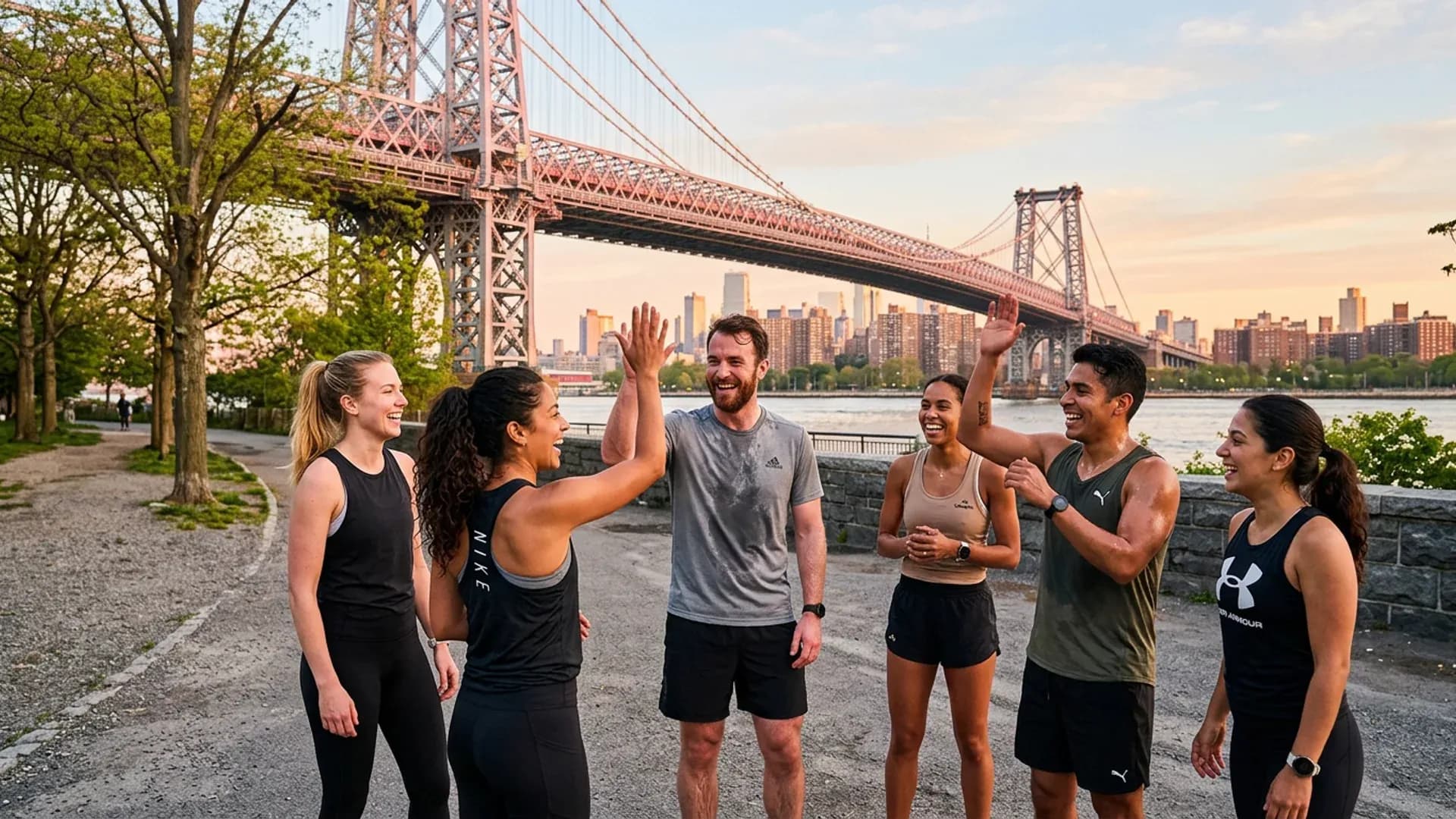
Run clubs are replacing dating apps as the most effective way to meet people in 2026. According to Strava's 2024 Year in Sport report, global run club membership surged by 59%, with new clubs increasing 3.5x. The most striking statistic: one in five runners has gone on a date with someone they met at a run club. Meanwhile, Match Group reported declining paid users, and Bumble's stock has fallen sharply from its post-IPO peak. The parks and trails of the world are becoming the biggest singles scenes — and it's backed by data, not hype.
This isn't just a New York or London phenomenon. From Brooklyn's Williamsburg Bridge runs to Berlin's Tiergarten dawn crews to Tokyo's brand-sponsored group jogs, the shift is global. What started as a fitness trend has become a full-blown cultural movement — one that's reshaping how an entire generation finds connection.
The Numbers: Run Clubs Are Exploding While Dating Apps Decline
The data tells a clear story of two trends crossing in opposite directions. Here's what's happening:
- Strava Year in Sport 2024: Run club membership grew 59% globally. Gen Z was 39% more likely than Gen X to use fitness to "meet people who share their interests." New running clubs on the platform increased 3.5x (source)
- Social motivation dominates: 72% of Gen Z members say they joined a run club primarily to meet new people, not for fitness goals (VICE)
- Dating conversion: A Thortful survey found 18% of under-35s are actively hoping to meet a partner at run clubs. One in five Gen Z and millennials have chosen workouts as first dates (Bumble research)
- Dating app decline: Match Group reported declining paid users in Q4 2023. Bumble stock has fallen sharply from its post-IPO peak. Strava's CEO cited this cultural shift as a key reason for the company going public
- The preference shift: Nearly a third of young adults now prefer gym sessions over pub meets for socializing (Bumble research). A Columbia News Service investigation found that Gen Z is increasingly logging off dating apps and seeking in-person alternatives
The pattern is unmistakable: young people haven't stopped wanting to connect — they've stopped wanting to connect through screens. They're voting with their sneakers.
Why Running Beats Swiping: 5 Science-Backed Reasons
Run clubs don't outperform dating apps by accident. There are structural, neurochemical, and psychological reasons why running with someone builds connection faster than texting them:
1. The Side-by-Side Effect
Running places two people shoulder-to-shoulder rather than face-to-face. Research on spatial dynamics in social interaction (Sommer, 1969) shows that side-by-side activities produce significantly less social pressure than face-to-face settings. There's no sustained eye contact, silences feel natural (you're breathing hard), and conversation flows without the interrogation dynamic of a coffee date. For more on this principle, see our Outdoor Dating vs Coffee Dates analysis.
2. The Endorphin Advantage
Running triggers endorphin release — the "feel-good" neurochemical that doesn't just improve your mood but makes you perceive the people around you more positively. Psychologist Arthur Aron's research on the misattribution of arousal demonstrates that elevated heart rate gets partially attributed to the person beside you. The runner next to you literally looks better when your heart rate is up. Read more: The Science of Exercise and Attraction.
3. The 50-Hour Rule
University of Kansas researcher Jeffrey Hall found it takes roughly 50 hours of shared time to move from acquaintance to casual friend. Dating apps fail here — you match with 100 people and spend 5 minutes with each. Run clubs succeed because you see the same people every week, accumulating shared hours naturally. A weekly 90-minute run group hits 50 hours in about 8 months. That's friendship territory. See: The 50-Hour Friendship Rule.
4. Behavioral Transparency
On dating apps, you see curated photos and polished bios. At a run club, you see how someone handles discomfort, whether they wait for slower runners, how they react when it rains. A PopSugar analysis put it well: "Meeting someone while running reveals more about them than a dating app bio ever could." Exercise is the most honest personality test available.
5. Natural Self-Selection
People who show up at 6 AM for a trail run or after work for a 5K share baseline traits: discipline, health-consciousness, willingness to leave their comfort zone. Run clubs function as a natural filter, pre-selecting for compatibility in ways that a photo-based swipe never can.
How to Join Your First Run Club: A Complete Beginner's Guide
Ready to trade swipes for sneakers? Here's how to get started, even if you've never run a mile:
Low-Barrier Entry Points
- parkrun: Free 5K community runs every Saturday morning in 2,000+ locations across 22 countries. No registration fee, no timing pressure, walk-friendly. The single best entry point for running newcomers
- November Project: Free outdoor workout group in 50+ cities. Famous for its welcoming culture — they literally hug every newcomer. High-energy, social-first atmosphere
- Brand run clubs: Nike Run Club, adidas Runners, and New Balance host free weekly group runs in major cities. Often include post-run social events with drinks or snacks
- Local running stores: Most independent running stores host weekly group runs. Fleet Feet, Jackrabbit, and similar chains have organized programs. Great for finding your neighborhood's running community
3 Strategies to Maximize the Social Benefits
- Show up consistently: The repeated exposure effect requires you to be there every week. After 3 sessions, people will recognize your face. After 6, you'll have inside jokes. Consistency beats intensity
- Run at conversation pace: You don't need to be fast. Stay at a speed where you can talk comfortably — that's where the connections happen. The back of the pack is often the most social part of any run club
- Stay for the cooldown: The post-run stretch and chat is where friendships actually form. Many run clubs end at a coffee shop or bar. Don't skip it — this is the social payoff for showing up
The same problem shows up in every endurance sport that meets in groups. If you ride, the cycling version is here: how to find a group ride near you.
Find Your Running Crew on GRASS
Want to find a run club near you but don't know where to start? GRASS's Group Adventure feature connects you with local running groups, trail runs, and social fitness events. With 32+ outdoor activity types, running is just the beginning.
What makes GRASS different from a traditional dating app is exactly what makes run clubs different from swiping: you meet people by doing things together, not by judging photos. The activity is the icebreaker. The connection is the bonus.
Download GRASS and find your first running crew. For a deeper dive into the running-meets-dating trend, check out The Death of Third Places and the Rise of Outdoor Dating.
Related reading: Good Texter, Bad Date: Why Great Online Chat Falls Flat in Person — the flip side of activity-first: why great online chat so often falls flat in person, and how leading with a shared activity fixes it. And if you're weighing where to live, see the best US cities for outdoorsy singles.
Frequently Asked Questions
I'm not a runner. Can I still join a run club?
Absolutely. Most run clubs welcome complete beginners. parkrun's 5K distance is walk-friendly — no one cares about your pace. Night running groups typically offer multiple pace groups, and you can always start with the slowest one. The point isn't speed; it's showing up.
Is it awkward to go to a run club alone?
Run clubs are one of the easiest social settings to attend solo. Unlike a bar or a party, there's a built-in activity — running — so you never have to worry about what to say or do. Research actually shows that going alone makes you more likely to meet new people because you won't default to talking only with friends. Most participants arrive solo; it's the norm, not the exception.
Can you actually meet someone to date at a run club?
The data says yes. Strava's Year in Sport report found that one in five runners has dated someone from their run club. A UK survey showed 18% of under-35s are actively hoping to meet a partner through running groups. The structure of run clubs — repeated exposure, shared physical activity, natural conversation — creates exactly the conditions that relationship psychology identifies as most conducive to genuine connection.
What are the best run clubs for socializing?
For maximum social potential, look for clubs that emphasize community over competition: parkrun (free, inclusive, 2,000+ locations worldwide), November Project (famously welcoming, free, 50+ US cities), and brand-sponsored clubs like Nike Run Club or adidas Runners. Local running store groups also tend to be small and social. On GRASS, you can browse Group Adventure listings to find running events specifically designed for meeting new people.
How is meeting someone at a run club different from meeting them on a dating app?
The fundamental difference is the order of operations. Dating apps: see photo → match → text → eventually meet. Run clubs: meet → run together → talk naturally → decide if you want more. Run clubs let you experience the real person first, not their curated online persona. That's why 72% of Gen Z are choosing physical activity over swiping — the quality of connection is incomparably higher.