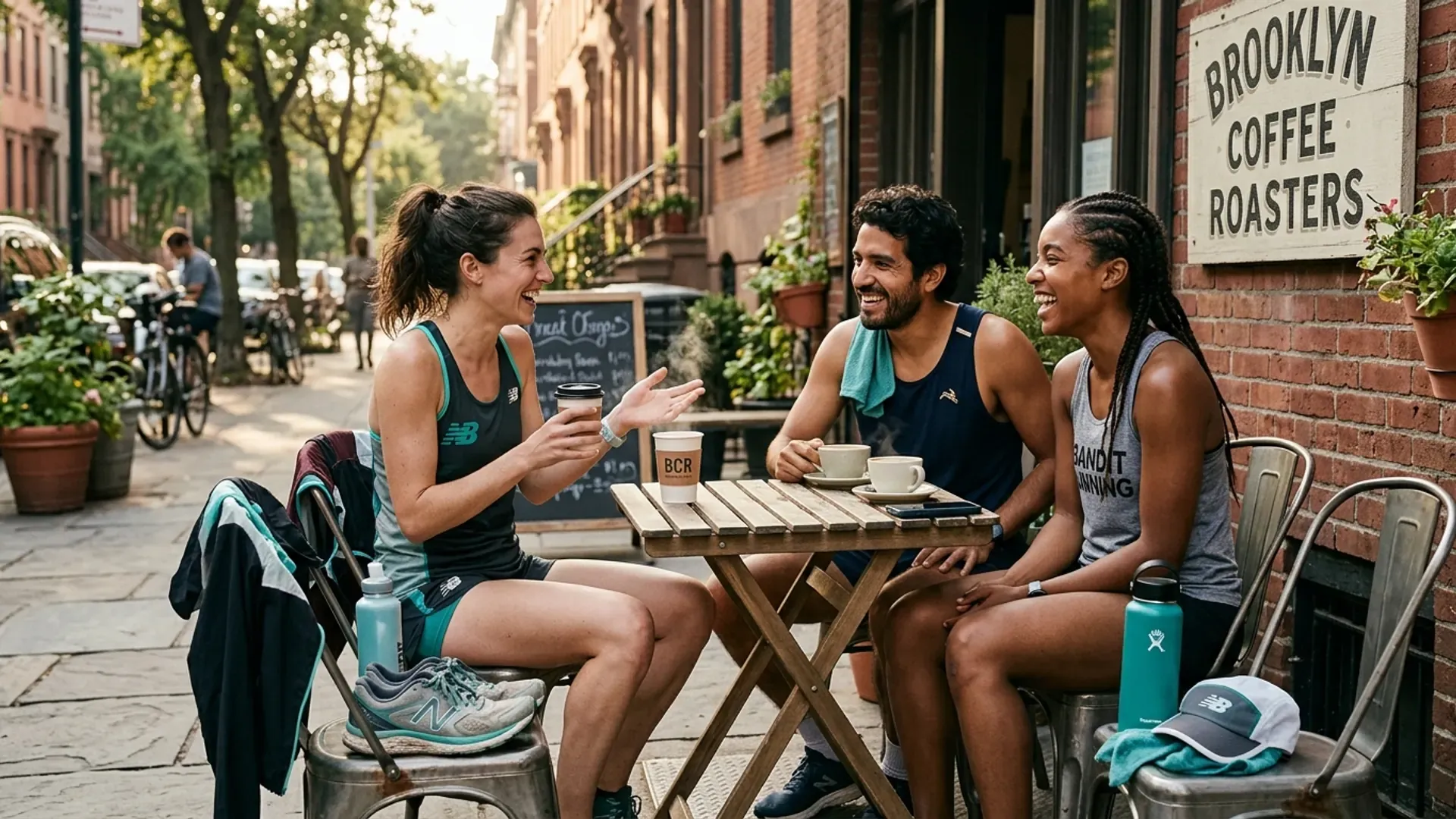
A coffee run club is exactly what it sounds like: an easy 3-5K group jog that ends at a specialty coffee shop, where the actual social time happens. Across NYC, LA, London, Sydney, and Tokyo, coffee run clubs are the breakout running format of 2026 — lower barrier than marathon training crews, more intentional than random social runs, and explicitly designed for people who want to make friends without the bar/dating-app circuit.
This guide covers the culture, why brunch-first design works, NYC/LA route ideas, and how to start your own coffee run if your city does not have one yet.
TL;DR — coffee run club in 30 seconds:
- What it is: 3-5K easy jog (8-10 min/mile pace) + 30-60 min at a coffee shop after
- Where it came from: hipster running crews (NYC Bridge Runners, Black Roses NYC) + brunch run culture, formalized into a "coffee-first" variant in 2024-2025
- Why it is hot in 2026: lower barrier than crews, more wholesome than bars, post-run coffee chat is less awkward than first-date dinner
- Who it is for: 25-35 year olds who want low-pressure friendships in their new city, runners burned out on dating apps
- How to join: search "coffee run [your city]" on Instagram / Strava Clubs, or start your own (route + coffee shop is the entire SOP)
What is a coffee run club? And how is it different from regular run clubs?
A coffee run club is defined by one structural choice: the post-run coffee is the actual event. The run is just the warm-up. This sounds trivial but it changes everything about who shows up and what happens.
- Marathon training crews (Nike Run Club training cohorts, brand-affiliated speed groups): focused on running. Pace groups, coaches, race prep. People scatter after the run.
- Social run crews (Bridge Runners, Black Roses NYC, November Project, your local hipster crew): focused on running + community. Mixed pace groups, post-run hangout is optional but common.
- Coffee run clubs: focused on coffee + community. The run is short (3-5K) and easy (8-10 min/mile) precisely so nobody is too winded to chat. The coffee is the headline.
Coffee runs occupy a specific niche: people who want the social-fitness combo of a run club but cannot commit to 5am training crews, do not want to "compete" at running, and would rather skip the bar scene for friendship-building. Related reading on the broader trend: Why Run Clubs Are Replacing Dating Apps in 2026.
Where did coffee run clubs come from? Cultural lineage and the 2026 boom
Coffee runs did not appear out of nowhere — they emerged from two converging cultures.
Lineage 1: NYC hipster running crews (2004 onward). Brooklyn-based Bridge Runners (founded 2004) and Black Roses NYC (2013) rewrote what "run club" meant for a generation — adding hip-hop, beer, fashion, and intentional community to what had been a sport dominated by suburban marathon clubs. This crew model spread through London, Tokyo, Seoul, Taipei, and beyond. Coffee run clubs inherit the "running as social fabric" DNA but strip out the late-night beer and bar element.
Lineage 2: brunch run culture (late 2010s). The weekend brunch run — long, slow, 8-10K followed by a 2-hour brunch — became a fixture in Brooklyn, Silver Lake, East London, and similar neighborhoods. Coffee runs are the weekday-evening compression of this format: shorter run (3-5K), faster post-run window (espresso instead of eggs benedict), whole thing wraps in 1-1.5 hours so it works after work.
The 2025-2026 global boom timeline:
- Q4 2024: dedicated coffee-first crews start appearing on Instagram in Brooklyn and LA, distinct from existing hipster crews
- H1 2025: London, Sydney, Melbourne pick it up, riding the specialty coffee wave
- H2 2025: Tokyo, Seoul develop standing coffee runs anchored to specific roasters
- H1 2026: specialty coffee trade media (Perfect Daily Grind, Sprudge) starts covering cafés as run-club anchor points; coffee runs become a recognizable subgenre across Instagram and run-club Discord communities
- mid 2026 onward: second-tier US cities (Austin, Portland, Denver, Boston) build out their own scenes; mainstream lifestyle outlets start including coffee runs in fitness/dating trend roundups
Why coffee run clubs are 2026's best low-pressure social format
Coffee runs work because they thread a specific cultural needle: younger adults want to make friends but are increasingly sick of obvious "social events" — singles mixers, dating apps, networking nights. Coffee runs avoid the "we are here to evaluate each other" energy that kills authenticity.
Five structural design choices that make coffee runs low-pressure:
- Shared task precedes connection — running together is "we are doing something" rather than "we are sizing each other up." Conversation starts post-run, when introductions are already organic.
- Built-in ice breakers — "how was that pace for you?" "do you come to this coffee shop a lot?" "what are you doing after?" Topics emerge from shared experience, no scripted opener required.
- Natural time boundary — 1-1.5 hours total. Lower stakes than open-ended bar nights. Easy to leave when you want without "killing the vibe."
- Pre-screened compatibility — people who show up to a 7am coffee run on a Wednesday have shared traits: they keep healthy routines, follow through on plans, and are decent at organizing their week. Those are useful signals when you're trying to figure out who's worth getting to know.
- Low cost to try — most coffee runs are free (you buy your own $5 espresso). Failure (no chemistry with anyone) costs $5 + 90 minutes, vs $50+ for most "intentional social events."
This aligns with the Strava 2024 Year in Sport report: 59% growth in global running club participation, 58% of respondents making new friends through fitness groups, nearly 1 in 5 Gen Z dating someone they met through sports. Coffee run is the most accessible entry point in this trend.
NYC and LA coffee run route ideas (3-5K + great post-run coffee)
These are starter route concepts pairing a runnable 3-5K with a coffee shop where 4-8 people can comfortably hang for an hour. These are illustrative — verify the exact route, coffee shop hours, and seating in advance before bringing a group.
NYC starter routes
- Brooklyn: Domino Park → Devoción (Williamsburg) — start at Domino Park, run the East River waterfront ~2K out and back, end at Devoción on Grand. 4K total, Brooklyn-aesthetic coffee scene, big enough to seat groups.
- Manhattan: Central Park Reservoir loop → Joe Coffee (UWS) — meet at 90th & East Drive, do the 2.5K reservoir loop twice (5K), end at any UWS specialty spot (Joe Coffee, Variety, Birch). Classic NYC.
- Queens: Astoria Park → Sweetleaf (LIC) — Astoria waterfront loop ~4K with Manhattan skyline views, end at Sweetleaf in Long Island City (~15 min away by train, or extend the run). Lower-key than Brooklyn, often less crowded.
- Brooklyn: Prospect Park inner loop → Variety Coffee (Crown Heights) — start at Grand Army Plaza, run the inner park loop ~3.5K, end at Variety on Bedford Ave. Big Brooklyn community, great post-run seating.
- Brooklyn: McCarren Park → SEY Coffee or Devoción — McCarren Park loop x 2 (~3K), then jog/walk over to either SEY Coffee in Bushwick (~15 min, can drive/Uber) or back to Devoción on Grand. Pick depending on whether the group wants more run or more coffee.
LA starter routes
- Silver Lake: Reservoir loop → Dinosaur Coffee or LAMILL — the reservoir loop is ~3.5K (2.2 mi) with zero traffic and just enough rolling hills to feel like effort. One loop for an easy day, 1.5 loops if you want closer to 5K. End at any of the Sunset Blvd specialty shops. The quintessential LA coffee run.
- Echo Park: Echo Park Lake loop → Eightfold — 1.5K loop x 2-3 = 3-4.5K, end at Eightfold (a few blocks from the lake). Flat, family-friendly, great views.
- Venice: Boardwalk run + Cow's End Cafe or Menotti's — meet at Venice Pier, run boardwalk to Santa Monica Pier and back (~5K), end at a Venice specialty coffee. Beach-flat, but watch tourist crowds.
For more on LA outdoor-first dating scenes, see 8 Best Run Clubs in Los Angeles for Meeting People (covers established run clubs you can join while you build your own coffee run).
How to start your own coffee run club in your city: 5-step SOP
- Step 1: pick the route + coffee shop (the only thing that matters) — 3-5K route with low car traffic, ending at a coffee shop that can seat 4-8 people for an hour. Walk it yourself, call the shop, confirm the seating works before posting.
- Step 2: set time + pace (be specific) — "Wednesday 7am, easy 8-10 min/mile pace, 5K, coffee at [shop name] after, wrap by 8:30." Specificity is what makes people commit.
- Step 3: post it where your people are — Instagram story / Strava Club / dedicated WhatsApp or Discord. Include: date, meet point (with Maps pin), pace, distance, coffee shop, headcount cap (4-6 is the sweet spot).
- Step 4: host like a host on day one — arrive 10 min early, intro yourself to each person who shows, mix the conversation during the run (do not let friends cluster), at the coffee shop arrange seating so strangers sit near each other. Buy the first round of coffees if you can — small cost, huge cultural impact.
- Step 5: post the recap, announce the next one — same day or next day, post a group photo + the route on the original platform, tease the next date. After 3-4 consistent runs you will have regulars and the club starts running itself.
Conversation hack — if you want to chat more with someone post-run, "I'm buying — what do you want?" lands 10x better than "want to grab dinner sometime?" It's low-stakes, the rejection cost is zero, and a yes opens the door naturally.
Who coffee runs are actually for (and who they are not for)
Coffee runs are not for everyone. Specifically: they work brilliantly for some profiles and feel like "just going for a run" to others.
- Best fit: 25-35 year olds wanting low-pressure friendships built around healthy routines — already running or want to start, tired of bar culture, allergic to dating-app discourse but still want to meet people.
- Best fit: recent transplants to a new city — coffee runs are less performative than singles events, less serious than committing to a marathon crew. Perfect midpoint for figuring out your city.
- Not great fit: complete running beginners — 3-5K is still a real ask if you have never run. Build to it with the Nike Run Club Couch to 5K plan (4-6 weeks) before joining.
- Not great fit: you're specifically looking to date — coffee runs work because they are not dating events. If you need clear dating intent, see 12 Best Dating Apps for Outdoorsy People instead. Keep the contexts separate — everyone wins.
Starting your own coffee run, fast
Search "[your city] coffee run" or "[your city] run club" on Instagram and Strava Clubs first — there is usually already something happening that you can join before you build your own. GRASS is worth a look for the same reason: it lists activities people are actually showing up to this week, which is the fastest way to find a run that already has regulars. If your city is small or coffee runs have not landed there yet, use the 5-step SOP above. First run with 3-4 people counts as success — regulars accumulate.
If you want a wholly activity-driven social app where coffee runs and similar low-pressure gatherings happen weekly, check out GRASS (browse this week's outdoor events — no signup required to look). Activity-first social design is the same philosophy that makes coffee runs work.
FAQ
Q1: What exactly counts as a "coffee run club"?
Three defining traits: (1) short, easy run (3-5K at 8-10 min/mile, no pace pressure), (2) ends at a specific coffee shop, (3) the post-run coffee + conversation is treated as the actual event, typically 30-60 minutes. If any of those are missing — speed-focused, no fixed coffee endpoint, or "everyone scatters after running" — it is a regular run club, not a coffee run.
Q2: Are coffee run clubs only for dating?
No, and pitching them that way actually breaks the format. Coffee runs work precisely because they are not labeled as dating events — that's what removes the awkwardness. Many participants are looking for friendships, networking, or just consistent post-work activity. Romantic connections happen, but as a side effect of repeated low-pressure exposure to compatible people, not as the primary goal. If you want explicit dating, use a dating app.
Q3: I can't run 5K yet. Can I still join?
Honest answer: 3-5K still requires baseline cardio. If you can walk-jog 5K (even slowly), join a coffee run with a 10 min/mile or slower pace group — be upfront in your reply ("I'm at 10 min/mile, can do 5K but slow") and most hosts will accommodate. If you cannot complete 5K yet, do Nike Run Club's free Couch to 5K plan for 4-6 weeks first. The community is welcoming but don't underestimate the run — show up to a 3K with zero training and you'll feel out of place.
Q4: Will I actually make friends, or will everyone stick with people they already know?
Depends on the host. Good hosts do 60-second go-around intros pre-run, mix conversation partners during the run, and arrange seating to put strangers near each other at the coffee shop. If you've gone to 1-2 coffee runs and felt invisible, try a different host or different city neighborhood — it's very host-dependent. The 1-2 standout coffee runs in any city are the ones run by hosts who actively facilitate.
Q5: What do you actually talk about over coffee post-run?
Coffee runs have built-in topics that no first date can match: (1) the run itself (the route, how it felt, your training history), (2) the coffee shop / coffee culture in your city, (3) "are you going to next week's?" — planning the next interaction is a natural extension, (4) "what made you start running?" — usually a story there worth hearing. If you exhaust all four, "what are you doing after this?" leads either to a natural goodbye or to an extension — both fine outcomes.