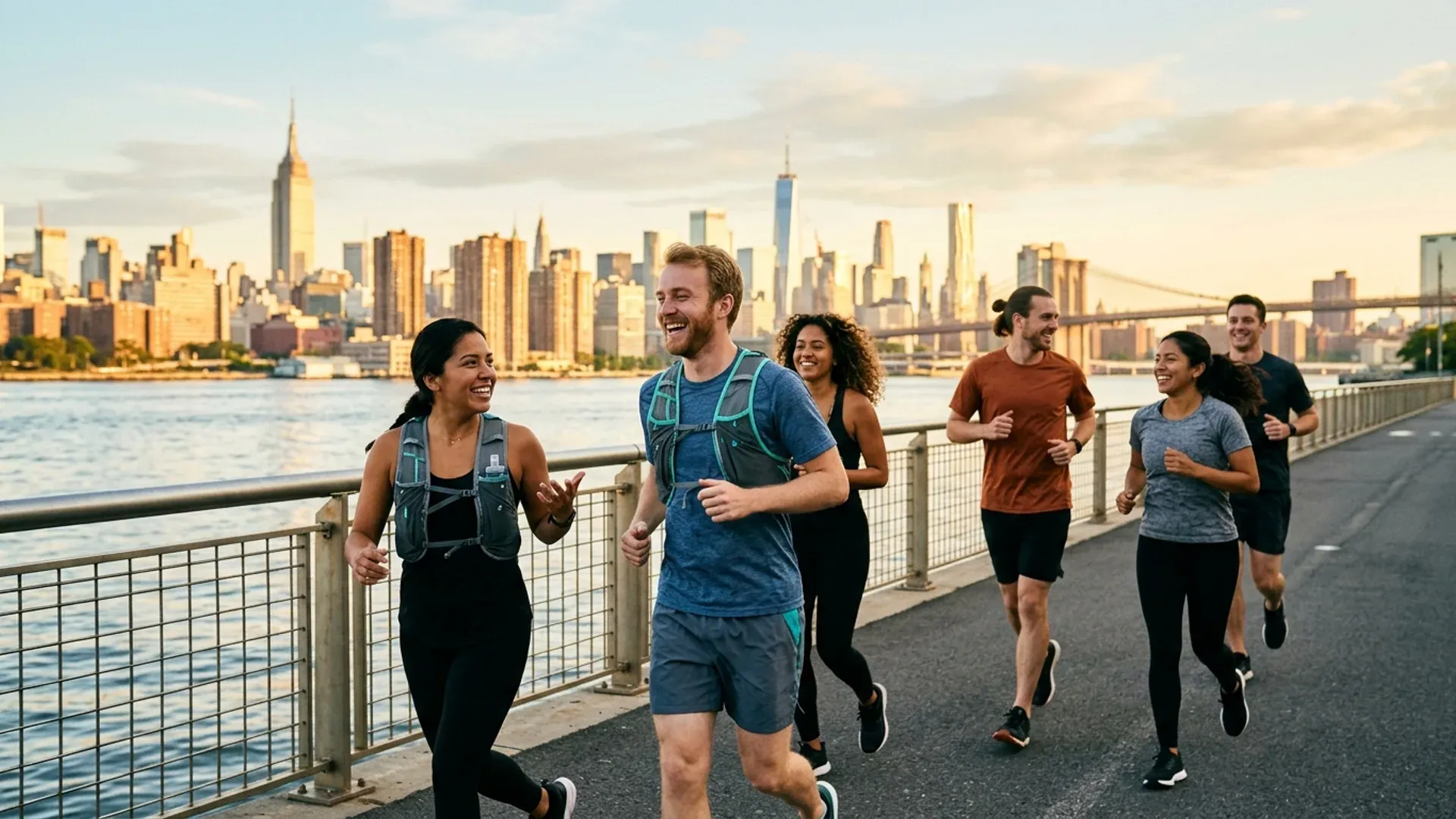
"Less Tinder, More Strava" isn't a tech company tagline. It's a slogan you'll find in TikTok captions, on club kit shirts from Brooklyn-based running brands, in r/running and r/dating thread titles, and quoted in post-race team photos across NYC, LA, and London. It belongs to the same family of Gen Z anti-online slogans as "Touch Grass" and "Coffee Date Without the Coffee Shop" — a cultural pushback against hyper-online, algorithm-mediated dating.
The literal meaning is direct: use Tinder less, use Strava more. But what the slogan is actually saying isn't about apps — it's about how you allocate hours. This piece decodes where the phrase came from, the three explosive data points behind it, why it lands so hard with Gen Z, and 6 ways to actually live it without deleting either app.
What "Less Tinder, More Strava" Actually Means (And Where It Came From)
The phrase began circulating in late 2024 and gained traction through 2025 via a few overlapping channels: Brooklyn-based running brands like Bandit Running began producing slogan apparel and crew kits with similar messaging; the hashtag #LessTinderMoreStrava spread widely on TikTok within Gen Z running culture; Strava's 2025 annual report headlined "running clubs as new dating apps" as a top trend. Around the same time, Match Group (parent of Tinder, Hinge, OkCupid, Plenty of Fish) announced 13% staff cuts in May 2025, and CEO Spencer Rascoff has publicly stated on earnings calls that traditional swipe apps "intimidate Gen Z" (reported widely by Global Dating Insights).
The slogan is constructed with cultural intelligence: two universally-recognized apps used as metonyms. Tinder stands in for "low-effort, low-signal swipe culture." Strava stands in for "sweat-required, time-invested, record-keeping activity culture." This isn't a tech choice. It's a values statement.
Three Data Points That Prove It's Not Just Vibes
Cultural narratives get inflated, so let's look at the numbers:
- Match Group announced 13% staff cuts in May 2025: the conglomerate behind Tinder, Hinge, OkCupid, Plenty of Fish. CEO Spencer Rascoff has publicly acknowledged the swipe format is losing Gen Z. This isn't industry slowdown — it's the core swipe business model being questioned by the people running it (Fortune coverage).
- Strava 2025 Year in Sport: running clubs +3.5x, hiking clubs +5.8x, total clubs on platform surpassed 1 million. The most striking number: Gen Z is 75% more likely than Gen X to enter a race — that's a "willing to train, register, show up" commitment signal (Strava Year in Sport 2025).
- Eventbrite 2026 Social Study: coffee clubbing +478%, sober-curious +92%. Coffee clubbing isn't working from a Starbucks — it's the "morning coffee + music + no alcohol" sober rave scene. Axios reported in the same window: US in-person singles events doubled between 2022 and 2025 (Eventbrite newsroom, Axios reporting).
Three independent sources telling the same story: Gen Z isn't opting out of meeting people. They're opting out of meeting people through swipe apps. They're putting hours into activities that produce sweat, shared experience, and verifiable evidence of effort.
(Further reading: Run Clubs Are the New Dating Apps: 2026 Trend Data | The Complete Guide to Outdoor Dating)
Why the Slogan Resonates: Three Psychological Mechanisms
1. The Sweaty Version of the 50-Hour Rule
University of Kansas professor Jeffrey Hall (2019) found it takes an average of 50 hours of shared time to move from acquaintance to friend, 200 hours to close friend. Swiping for 50 hours on Tinder will make you more cynical, not closer to anyone. Three 2-hour run-club sessions a week hits 50 hours in 4 months — and not with one person, with the entire 8-10 person crew you keep showing up with.
(Related: The 50-Hour Friendship Rule: How Long It Actually Takes)
2. Sweaty Vulnerability Beats Curated Profiles
What people look like out of breath, red-faced on a hill, soaked at the end of a rainy long run — that's vulnerability that can't be photoshopped, 10x more honest than a polished Instagram grid. Pew Research's 2023 online dating report finds "the gap between profile photos and the person in real life" is among the most common negative experiences online daters report — a baseline trust problem that swipe formats inherit. Activity contexts collapse that gap to zero. What you see is who they are.
3. Effort Is a Costly Signal
Why does a Strava profile feel more convincing than a Tinder profile? Because mileage can't be faked. Running 1,000 km versus 50 km, racing a half marathon versus a 5K, training 5 days a week versus 1 — these gaps are produced only by putting in time. There's actual econ research on this: economist Michael Spence introduced costly signaling in 1973 (work that later won the 2001 Nobel) — the harder a signal is to fake, the more reliably it transmits real value. A Strava feed is exactly that kind of signal.
(Related: The Science of Sweating Together: Exercise & Attraction)
The Real Shift Isn't App Replacement — It's Time Reallocation
The most common misread of the slogan is hearing it as "delete Tinder and download Strava." What the slogan is actually saying is about time: the hour you'd spend swiping, run it instead. Or hike it. Or paddleboard it. Or rock-climb it.
Why this reframe matters: "Working out specifically to find a partner" reads as Gen Z-coded hustle culture — and Gen Z is the most anti-hustle generation on record. The point isn't that the activity is a means to dating; the point is the activity is the thing, and meeting people is the side effect. Bumble's 2025 Global Dating Trends report echoes this: "being authentically you" has become a top-of-mind theme in how Gen Z and younger millennials approach dating — overtaking the older "algorithmic match efficiency" framing of swipe culture.
This is also the design premise underneath GRASS: activity is the main event, meeting people is the byproduct. We give time back to the activity itself; connection emerges in real contexts, not in another hour of swiping in another app.
Full philosophy: The Complete Guide to Outdoor Dating.
6 Ways Gen Z Is Actually Living "Less Tinder, More Strava"
How does the slogan translate into your week? These are six patterns that are actually happening in 2025-2026 run-club culture across NYC, LA, London, Lisbon, and Tokyo:
1. Morning Crew Run
3-5 colleagues or friends locked into a Wednesday 6:30 AM 5K + breakfast after. Fixed time + fixed people = proximity effect plus the 50-hour rule at maximum efficiency. NYC's November Project and Brooklyn Track Club basically run on this format.
2. Coffee Run Club (the Post-Run Hour Is the Real Social Event)
Weekend run-club's killer move: 5K → coffee shop → 60 minutes of actual hanging out. The post-run hour is the social main event; the run itself is the excuse to build shared experience. Coffee clubbing +478% is mostly this exact pattern.
(Related: Coffee Run Club: 2026 Post-Run Coffee Movement Decoded)
3. Parkrun Pilgrimage
Parkrun is a free, weekly, 5K event series with 2,000+ locations across 22 countries (UK, US, Australia, Japan, and more). Gen Z runners have turned it into a travel ritual: "every new city I visit, I run the local parkrun" — instant access to that city's running community in 60 minutes.
4. Strava Segment Hunting
Pick a specific segment (route) and chase the KOM/QOM (King/Queen of the Mountain — fastest recorded time). Strava surfaces other regulars on that segment, building a natural same-interest filter. Central Park's "Harlem Hill" or LA's "Nichols Canyon" have entire micro-communities formed around them. Strava records are a built-in "interest density same-tribe" filter.
5. Club Kit Social (Wearable Silent Signal)
Wearing Bandit Running / Tracksmith / Satisfy / Soar / local run-club kit to brunch is a silent signal. The other runner across the cafe sees it and gets it: we're from the same tribe. Club kit is the most low-key but high-signal dress code in 2025-2026 running culture — more effective than a wedding ring as identification, and instantly readable.
6. Brunch Run > Brunch Date (the Framing Hack)
Don't schedule a brunch with someone new. Schedule a "run + brunch". The two framings produce completely different first-meetings. Pure brunch is "interview format 1-on-1"; run + brunch is "do a thing together, then eat together" — orders of magnitude less pressure. Hinge and Bumble both pushing activity-based date suggestions into their prompt UX is them noticing this framing winning at the product level.
(Related: Strava Dating: Why Gen Z Replaced Tinder With Kudos in 2026 | 8 Best Run Clubs in Los Angeles for Meeting People)
What You'll See If You Watch This Play Out
Three downstream patterns worth watching:
- Cities reorganize around it. Run-club friendly infrastructure (closed loops, water fountains, post-run café density) is becoming a Gen Z migration variable — NYC, Lisbon, and Berlin score highest. SF's lack of a true running culture is one quiet reason its dating ecosystem keeps getting flagged as broken.
- Run brands become culture brands. Bandit Running, Tracksmith, Soar, and Satisfy are growing 3-5x faster than legacy running brands precisely because club kit is now a social signal, not just gear. The "tee that signals which crew you run with" is the new band tee.
- The dating-app stack quietly changes. Match Group's 13% cut isn't a one-off. Tinder MAU has declined two consecutive years. What's working with Gen Z isn't a better swipe app — it's activity-first social. Hinge, Bumble, and newer entrants like GRASS are all shifting toward this format in their own ways.
(Related: Touch Grass Dating: Why Gen Z Is Ditching Apps | Gen Z's Friendship Revolution: The Most Connected, Most Lonely Generation | AI Dating Trends 2026: The Return of Real Connection)
Want to actually live "Less Tinder, More Strava"? GRASS is an outdoor-first dating app aligned with that exact philosophy — activity is the main event, meeting people is the byproduct. Download GRASS free to start with your first run club, hike, or sunrise paddle.
Frequently Asked Questions
Where did "Less Tinder, More Strava" come from?
The slogan began circulating in late 2024-2025 through NYC / Brooklyn run-club culture, slogan apparel from running brands like Bandit Running, and Gen Z running-focused TikTok. By 2026 it had entered mainstream cultural commentary, helped along by Strava's 2025 Year in Sport report naming "running clubs as new dating apps" a top trend. It belongs to the same family as "Touch Grass" and "Coffee Date Without the Coffee Shop" — Gen Z anti-online cultural pushback.
Does Strava actually replace Tinder?
No — it's about time reallocation. The slogan means "spend the hour you'd spend swiping on something with a record of effort instead." You can still use Tinder. The shift is in how many hours you give to swiping vs. how many you give to IRL activities.
What if I don't like running?
Strava in the slogan is a stand-in for "anything that requires sweat, time, and produces a verifiable record." Hiking, climbing, cycling, SUP, yoga, CrossFit, HYROX, surf, trail running — any repeatable activity that generates shared experience qualifies. The point is replacing "swiping hours" with "doing-things-with-other-humans hours".
Has Gen Z actually quit Tinder?
Not "quit" — usage shifted. Match Group announced 13% staff cuts in May 2025, and Tinder MAU has declined two consecutive years per their earnings disclosures. Gen Z hasn't given up on meeting people; the time they'd have spent swiping is increasingly going into run clubs, climbing gyms, coffee runs, and outdoor activities. That's the substance of "less Tinder, more Strava."
Is parkrun in the US?
Yes — parkrun has US events but a smaller footprint than UK/AU (where the format originated). Better-established US analogs include November Project (free, body-weight workouts in 50+ cities), Bridge Runners (NYC), and local recreational running clubs that meet weekly at free public parks.
How does GRASS fit "less Tinder, more Strava"?
GRASS is an outdoor-first activity dating app designed around the slogan's premise — activity is the main event, connection is the byproduct. You don't spend hours swiping; you spend hours finding run clubs, hiking groups, sunrise paddles, and post-run coffee meetups. Download GRASS free to start your "less Tinder, more Strava" era.
Let stories happen naturally.