You matched, texted for two weeks, felt an actual spark — then you finally met, and the whole thing fell flat. Most people’s first instinct is to blame themselves: "I’m just bad in person." But when you lay these stories side by side, the problem usually isn’t your charm. It’s that the texting itself — long, constant, always-on — burns off the spark before you ever sit down together.
We looked at how people describe this on Reddit — recurring threads in communities like r/OnlineDating and r/datingoverthirty asking some version of "why was the chemistry gone in person?" — and checked the pattern against what social psychologists have actually measured. Three real reasons keep showing up, plus one counterintuitive fix. (The discussions are reworded and blended together; nothing here points to any individual.)
Great Chat, Flat Date Is Incredibly Common
It plays out like a script. You match, and for days you’re texting from good-morning to good-night, maybe an hour on the phone here and there, and it feels like you already know each other. Then you finally meet, and the closeness doesn’t carry over. The conversation stalls in ways it never did over text, and within a few days the replies quietly slow to nothing.
The same beats keep surfacing. Someone has "immediate chemistry over text" and a couple of "amazing, 3-hour phone calls," then meets up and the spark just isn’t there. Someone else says their "texting game was on point" and they had a ton in common — only to find that texting and meeting in person are "two different things." A third keeps getting excited by great texters whose dates fizzle, and decides they’d "rather gauge chemistry in person." Different words for the same gap — no chemistry in person, the vibe didn’t translate, good texter but a bad date — the distance between "we clicked online" and "there was nothing there when we met."
If you keep getting stuck at exactly this step, here’s the short version up front: this is much less about how interesting you are, and much more about how you’re going about it. Here’s why.
Why "Good Chat" Online Fools You
Because the person you’re texting is a carefully edited version of someone — and your brain quietly fills in the blanks with a more perfect one.
Communication researcher Joseph Walther named this dynamic back in 1996 — the hyperpersonal model. In text-only conversation, people do "selective self-presentation" — you show the side you want seen, you edit before you hit send, you always have time to think of the perfect reply. And the person on the other end fills the gaps by idealizing you — imagining you as funnier, warmer, and more in sync than the real you standing in front of them. In other words, part of the "amazing texter" you fell for is something you built in your own head.
In person there’s no edit window, no filter, no perfect delayed comeback. People stumble, there are awkward pauses, jokes land a half-second late. The idealized bubble pops the moment it meets a real human. The letdown isn’t that they got worse — it’s that the texting quietly set the bar impossibly high.
Why Texting for Weeks Actually Makes It Worse
Because there’s a window — and once you text past it, meeting up tends to go worse, not better.
Researchers who study "modality switching" — going from online to face-to-face — have found it’s not a simple "more texting = a better date" equation. A 2015 study in the Journal of Computer-Mediated Communication that surveyed 433 online daters found the payoff follows an inverted U: a little texting first helps, but there’s a point where waiting starts to work against you — the researchers put it at roughly 17 to 23 days. Past that window, the longer you wait, the more your good feelings about them tend to fade by the time you actually meet. The explanation lines up with the hyperpersonal effect: the longer you text, the thicker the idealized image gets, so when their real face and real cadence don’t match the version in your head, the gap between expectation and reality hits harder.
Which is the same thing people describe from the inside in those threads — great chemistry over days or weeks of texting, then "the chemistry isn’t there" the moment they meet — just measured in a study instead of felt on a bad first date. One is a pothole people keep stepping in; the other is the same pothole drawn on a graph.
Three Real Reasons Great Texters Fall Flat in Person
Put the research next to the real discussions and the "flat date" usually isn’t one cause — it’s these three stacking up at once:
You’ve already talked your whole lives away
When you’ve spent days texting through work, family, exes, star signs, and five-year plans, there’s nothing fresh left to discover on the actual date. It’s like a trailer that gives away all the best parts — by the time the movie starts, there’s nothing left to be surprised by. You spent the slow reveal that actually pulls two people together, one text bubble at a time.
The person in your texts isn’t the person across the table
Text lets you think, edit, and time your wit; the humor is built in post-production. In person you’re running on live reactions — timing, tone, eye contact, presence. Plenty of people who are razor-sharp over text go quiet across a table, and plenty of unremarkable texters are easy and warm to actually be around. Clicking on text was never the same skill as clicking in person. They’re two different things.
You’re treating the first date like a job interview
This is the exhaustion behind a lot of flat first dates: the meeting turns into a screening. Is he actually employed? Is she as easygoing as she seemed? Is this worth my Saturday night? The second you’re checking someone against a spec sheet, you’re not meeting a person — you’re reviewing a résumé. Sitting across a dinner table makes it worse: two people facing off, nothing else to do, every line quietly getting scored. Chemistry has no room to happen.
Sometimes "Cold" Isn’t Cold — It’s Someone Managing Their Safety
There’s one more layer that’s easy to miss. Before meeting a stranger, people don’t all worry about the same thing. For a lot of daters, the pre-date anxiety is "will they look like their photos?" For a lot of others — statistically, more often women, though plenty of men feel it too — the worry is "is this person safe, and will I get home okay?"
Someone in that headspace may have already texted a friend the address and their expected-home time, picked a busy public place, and be quietly running a safety check for the first ten minutes. In that state, being guarded reads a lot like being cold — but it’s not "no interest," it’s a guard that hasn’t come down yet. It’s a big part of why a relaxed, public, do-something first date is friendlier to everyone: it lowers the awkwardness and the wariness at the same time. Related reading: Social Anxiety and Outdoor Activities.
The Fix: Trade the Interview Dinner for Doing Something Together
Two moves: first, don’t text it into a soap opera — if you click, meet within a week or two; second, make the first date "something to do" instead of a face-off across a table.
This isn’t just individual stories, either. In Match and the Kinsey Institute’s 2025 Singles in America survey of 5,001 U.S. singles, 90% called sexual chemistry essential — and most said they can tell whether it’s there by around the third date. The survey doesn’t spell out this next part, but it follows: chemistry is something you read in person, over real time together — not something more texting can settle in advance.
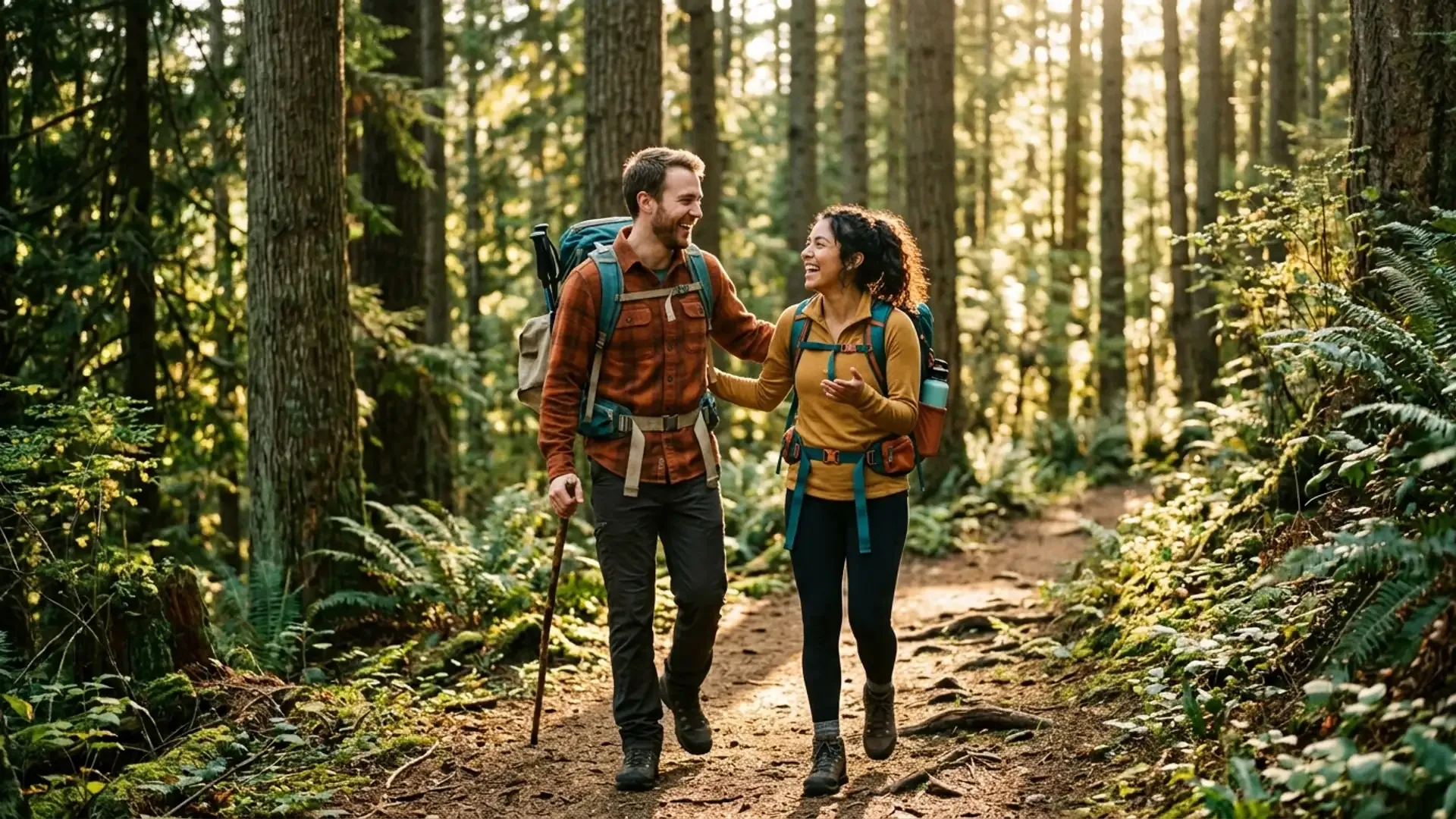
When you’re actually doing something — hiking a trail, hitting up a bouldering gym, wandering a farmers market or a gallery, showing up to a run club — the conversation grows out of what’s happening in front of you, so you’re not constantly hunting for the next thing to say. A missed hold, a wrong turn, whoever’s more out of breath — it’s all material. The environment catches the silences, and it takes the edge off the interview pressure. Most of all, you’re going through something together instead of auditing each other across a booth.
To be fair: some people argue you should text longer to really see how someone thinks and whether the humor holds up, and that’s a real point. The point isn’t the number of days — it’s whether what you built online turns into momentum to meet. The real value of leading with an activity isn’t "always meet early." It’s that when you do meet, there’s something to do — so even before you know each other well, you have something to share.
You can see that shift in those same discussions: people worn out by the great-texter-flat-date loop describe deciding they’d "rather gauge chemistry in person" within a day or two than text a connection to death — some push even faster, which is the same instinct dialed up. Starting from a shared activity is that instinct built in: have the thing to do first, meet the person second.
You can absolutely do a version of this on the apps you already have — suggest a walk or a climbing gym instead of drinks, and you probably should. But that’s still a one-on-one you had to talk someone into, sight unseen. GRASS flips the order: it gathers people around an actual activity, so you show up for the hike or the game, other people are already there, and meeting someone is the bonus. A regular run club is the same idea and worth doing for its own sake — the one thing GRASS adds is that everyone there already knows it’s also about meeting people, so you skip the "is it weird to say something?" guessing that turns an ordinary meetup into its own kind of gamble. The first meeting has something to do built in, and it doesn’t hinge on nailing the pitch first. If you want to see how to put this into practice, keep reading:
- Dating App Openers That Actually Get Replies — how to open so the conversation starts moving toward meeting, not stalling.
- Why Run Clubs Are Replacing Dating Apps — the activity-first model in the wild, and why intent still matters once you get there.
- The Psychology of Group Bonding — why two hours of doing something builds more trust than two months of messages.
- The Complete Guide to Outdoor Dating — the full playbook for meeting people through activities.
Instead of texting a connection until it burns out, meet a little earlier and a little lighter, and put you both in a real "doing something together" moment — that’s where the spark actually has room to catch. If you want to try the "meet people while doing the thing" version, you can start with GRASS.
How We Put This Together
The observations here are drawn from public Reddit discussions on dating — representative threads in communities like r/OnlineDating, r/datingoverthirty, and r/Bumble, surfaced through search — read against published social-psychology research: Walther’s hyperpersonal model and Ramirez and colleagues’ study on the timing of moving from online to in-person. The discussions are reworded and blended, with only short phrases quoted, and nothing here points to any individual; the studies and survey are linked so you can check them yourself.
Frequently Asked Questions
What does "good texter, bad date" actually mean?
It’s the gap between clicking with someone over text and feeling nothing when you meet in person. The cause usually isn’t just "they didn’t match their photos" — it’s the popped bubble of an idealized online version, a text personality that doesn’t match the real person, and the pressure and awkwardness of a first meeting that was set up like an evaluation.
How long should you text before meeting up?
Research on going from online to in-person points to a window: positive feelings tend to start slipping once you wait much past two to three weeks of texting. The practical version: if you’re clicking and it feels safe, move to meet within a week or two — comfortably inside that window — rather than letting the online thing run indefinitely.
Should you video chat before the first date?
If you’re not ready to meet in person yet, a short video call is usually a good middle step. It lets you get a real sense of what someone is actually like — their face, their voice, how they talk — before text alone builds up too idealized a picture, and it adds a layer of safety. Treat video as a way to lower the odds of a flat first date, not as a replacement for meeting.
Why do first dates feel so awkward?
A lot of it is structure. A first date built as dinner across a table is two strangers facing off with nothing to do but size each other up, which turns every line into something that gets quietly scored. Add the gap between the idealized person you built up over text and the real one across from you, and the pressure spikes. Give the date something to do — a walk, a gallery, a climbing gym — and most of that awkwardness drains out on its own.
What’s the least awkward kind of first date?
Pick "something to do" over sitting across a table. A walk, a gallery, a climbing gym, an easy trail, a market — anything where the conversation can grow out of what you’re doing, so you don’t have to manufacture topics and the environment catches the silences. The goal is a shared experience, not an interview across a booth.
I keep fizzling in person — is it me?
Usually not. If you consistently click over text and then cool off after meeting, the problem is usually how you’re going about it, not who you are: too much texting, an expectation bar set too high, and a first date run like a screening. Adjust the timing (meet sooner) and the setting (do something together) and things usually go noticeably better. Related reading: The Cure for Dating App Fatigue.