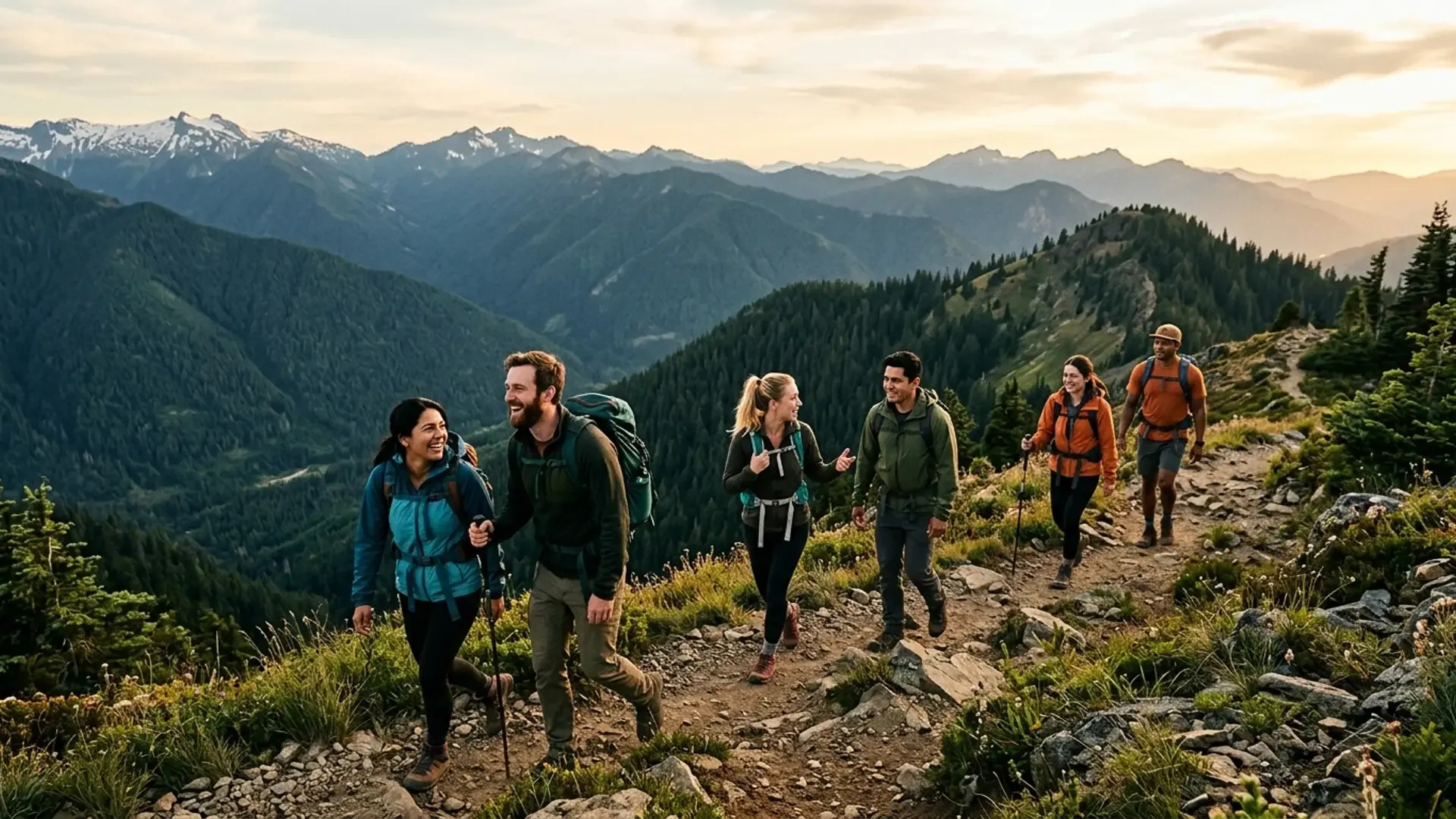
Why do strangers on a group hike feel like friends after one weekend, while people you message for two months on a dating app still feel like strangers? The answer isn’t personality, charisma, or chemistry. It’s mechanism.
Five decades of social psychology research—from Émile Durkheim to Stanford GSB to UC Berkeley—has identified a specific cluster of mechanisms that make group bonding work: behavioral synchrony, collective effervescence, shared challenge, in-group identification, group flow, and reduced evaluation pressure. Together, these mechanisms explain why two hours in a small group activity can build more trust than five one-on-one dates.
Pew Research’s 2023 online dating survey found that 46% of online daters describe their personal experiences with apps as negative, and over half of women report feeling overwhelmed by the volume of messages they receive. The more interesting question isn’t whether the apps are tiring—it’s why two hours with a small group of strangers can produce more trust than two months of dating-app messages.
If you’ve already read our Psychology of Making Friends overview—seven principles for friendship in general—this piece zooms into one of them: what specifically makes groups work. Here’s what the research says, and how to use it in your own social life.
What Is Group Bonding (and How It Differs From One-on-One Connection)
Group bonding is the rapid formation of trust, in-group identification, and shared emotional state among three or more people engaged in a common activity. Structurally, it differs from one-on-one connection in three ways:
- Distributed attention. No single person carries the conversational load.
- Shared external focus. The activity is the third axis of the interaction—nobody is the spotlight.
- Multiple bonding pathways. Synchrony, shared challenge, collective emotion, and group identity can all activate at the same time.
By contrast, one-on-one interactions—coffee dates, dinner dates, app conversations—rely heavily on a narrow channel: verbal exchange under mutual evaluation. If conversation falters, there’s no fallback. If one person evaluates the other harshly in the first 30 seconds, the date is functionally over. Awkward silence is read as bad chemistry. A clumsy joke is taken as a personality signal. Nothing absorbs the noise. Call it the single-signal problem: when one channel carries all the relational weight, the failure mode is fragile.
Group bonding sidesteps the single-signal problem entirely. You can have a quiet day on a hiking trip, a clumsy serve in a beach volleyball game, or zero clever lines on a group bike ride—and still walk away with three new friends. The mechanism doesn’t depend on you performing well. (For more on the time component of friendship, see The 50-Hour Friendship Rule.)
6 Psychological Mechanisms Behind Group Bonding
Across more than 50 years of social psychology, six distinct mechanisms have been identified that make group bonding work. Each is supported by published, peer-reviewed research.
1. Behavioral Synchrony
In a 2009 study published in Psychological Science, Stanford GSB researchers Scott Wiltermuth and Chip Heath asked participants to walk in step or sing together before playing economic cooperation games. Synchronized groups cooperated significantly more than non-synchronized groups, even when cooperation required personal sacrifice. The effect held across three experiments and didn’t require positive emotion to occur—the synchrony alone increased social attachment.
In practical terms: groups that match pace on a trail run, paddle in roughly the same rhythm, or move to a shared drumbeat are getting at least some of the synchrony Wiltermuth and Heath measured. The effect doesn’t require a metronome—shared cadence is enough to nudge body alignment toward cognitive alignment.
2. Collective Effervescence
Sociologist Émile Durkheim coined this term in 1912 to describe the energy that arises when people gather around a shared focus. Modern research has revived it. A 2017 study in the Journal of Personality and Social Psychology by Yang Bai and colleagues at UC Berkeley found that experiences of collective awe—being moved together by something larger than oneself—predict stronger social integration and a reduced sense of isolation. The mechanism: awe diminishes self-focus and increases identification with the group.
Sunset hikes, summit views, and collective wonder at a tide pool aren’t just scenery. They tilt the sense of self outward and the sense of group inward—the conditions Bai’s research found correlate with stronger social integration.
3. Shared Challenge ("Pain as Social Glue")
In a 2014 paper titled "Pain as Social Glue," Brock Bastian, Jolanda Jetten, and Laura Ferris (University of Queensland) showed that strangers who endured mild pain together—holding hands in ice water, performing leg squats, eating chili peppers—reported higher trust and bonding than control groups, and cooperated more in subsequent economic games. The shared adversity created an in-group, even between people with no other connection.
You don’t need to suffer. Mild challenge—a long uphill, a tricky climbing route, an unexpected rainstorm—does the same work.
4. In-Group Identification
Henri Tajfel’s classic experiments in the 1970s—the "minimal group paradigm"—showed that even arbitrary group labels (preferring Klee over Kandinsky paintings) cause immediate in-group preference and cooperation. Activities like running clubs, climbing crews, and surf collectives don’t just give you something to do. They give you a group identity, which the brain uses as a shortcut for trust.
This is why "the run club people" or "my hiking group" can feel emotionally loaded after only a few sessions. It’s not closeness yet—it’s the cognitive scaffolding closeness builds on.
5. Group Flow
Psychologist Keith Sawyer extended Mihaly Csikszentmihalyi’s flow concept to groups in his 2003 book “Group Creativity” and a 2007 follow-up, “Group Genius.” When a group is collectively absorbed in a task that’s challenging but achievable, individuals report a deeper sense of connection than they would in solo flow. Real examples: a team on a multi-pitch climb, a kayaking group navigating rapids, a doubles tennis match, a cooking-class team racing the clock. The condition is real coordination toward a real goal.
6. Reduced Evaluation Pressure
This one is less famous but matters most for introverts and anyone who runs hot under direct evaluation. When social attention is distributed across a group, no individual is the sole target—a phenomenon related to what social psychologists call evaluation apprehension. If you’ve ever been weirdly more yourself in a group of six than on a coffee date with one stranger, this is why. The part of your brain that locks up under the spotlight can finally stand down—not because the spotlight is shared more democratically, but because it’s genuinely off you. (More on this in Social Anxiety and Outdoor Activities.)
Why First Dates Are Psychologically Harder Than Group Activities
If group bonding has six bonding pathways, what does a one-on-one date have? Largely just one: verbal exchange under mutual evaluation. This isn’t a small disadvantage. It’s structural.
Two strangers, a single conversation channel, no shared activity, and explicit mutual evaluation: a format that maximizes anxiety and minimizes information. The single-signal problem isn’t a side effect of swipe-based dating—it’s the load-bearing assumption, and it’s the part that’s quietly breaking.
This is why so many people report that the friend they made on a hiking trip felt closer after one weekend than the person they messaged for two months on an app. It’s not nostalgia. It’s mechanism. The hiking weekend activated four to six bonding pathways simultaneously. The two-month message thread activated maybe one. (For the venue-specific science, see Outdoor Dating vs. Coffee Dates.)
The 4–8 Rule: Why Group Size Matters More Than You Think
Not all groups bond equally. Size matters more than most people realize.
Anthropologist Robin Dunbar’s research on conversation group size (Dunbar, Duncan & Nettle, 1995, “Human Nature”) found that a single conversation can sustain only about four active participants before it fragments into smaller side-conversations. That sets a useful range:
- 3 people: Too small. Triangulation is real, third-wheel dynamics emerge, no real "group" identity forms.
- 4–8 people: The sweet spot. Enough room for natural pairs to form during the activity, enough scale for a clear in-group, small enough that everyone knows everyone by the end of the day.
- 10+ people: Fragments quickly. Subgroups form, the activity becomes more individual, and group bonding degrades unless there’s a strong shared challenge holding the whole thing together.
This is why community run clubs that scale past 50 people typically subdivide into pace groups, why wedding tables are usually 6 to 10, and why outdoor adventure trips are often capped at 8. It’s not arbitrary. It’s the upper bound of what a single conversation can hold before it splits—below it you’re underbuilt, above it you’re a crowd.
How to Engineer Group Bonding in Your Own Life
If you want the science to work for you, optimize for the mechanisms—not just the social opportunity:
- Pick activities with built-in synchrony. Group runs, paddling, dance classes, group cycling, even singing. Anything where bodies move on a similar rhythm activates Wiltermuth and Heath’s mechanism.
- Pick activities with mild shared challenge. A 5-mile hike beats brunch. A climbing session beats a movie. Bastian’s "pain as social glue" effect doesn’t require real pain—just shared effort against shared resistance.
- Pick activities with awe potential. Sunsets, mountains, oceans, big sky. Bai’s research suggests collective awe is one of the fastest accelerators for group bonding. Indoor activities rarely deliver it.
- Repeat the same group. A single weekend won’t make lifelong friends. Hall’s 50-hour rule shows you need roughly 50 hours of shared time to move strangers to friends—and a recurring weekly group is the most efficient way to bank those hours.
- Avoid pure spectator formats. Concerts and sporting events as a passive audience deliver collective effervescence but not behavioral synchrony, shared challenge, or group flow. They’re emotional fireworks without the architecture.
Looking for a starting point? Trail running meetups and run clubs are some of the highest-mechanism activities you can join—synchrony, mild challenge, repetition, and small group size are baked in.
This is also the design logic behind activity-first apps. GRASS offers two ways into the same idea: one-on-one activity matching for people who want a single hiking, climbing, or paddling partner, and group adventures for people who want to join a small crew of strangers around a shared outing. The group-adventure format activates the multi-mechanism stack described above; the one-on-one format swaps the coffee-date setup for a shared activity. Either way, the format does work that swiping volume can’t.
If trying harder on swipe-based apps has stopped working, the science suggests the issue isn’t you—it’s the format. Try one where the mechanisms run in your favor. Find a group activity near you →
Related reading: Good Texter, Bad Date: Why Great Online Chat Falls Flat in Person — the same mechanism from the dating angle: why online chemistry fizzles at the first in-person meeting, and why doing something together beats texting it to death.
Also worth reading: How to Find a Run Club Near You — the practical version of all this: where recurring group activities actually live, and how to judge one before you show up.
FAQ
Why do I bond with strangers faster on a group hike than on a dinner date?
A group hike activates at least four bonding mechanisms—synchrony, shared challenge, in-group identification, and reduced evaluation pressure—while a dinner date typically activates one (verbal exchange under mutual evaluation). Mechanism count, not personality, drives the difference.
Is group bonding "shallower" than one-on-one connection?
No. Research from the University of Kansas (Hall, 2018) shows that close friendship requires roughly 50 hours of shared time, regardless of whether those hours happen one-on-one or in groups. Group activities often log those 50 hours faster because they’re naturally repeating and lower-friction to attend.
How long does it take to bond with a group?
A single shared activity with synchrony and challenge can produce noticeable in-group warmth in about 2–3 hours, consistent with Bastian and colleagues’ 2014 findings on shared adversity. Stable friendships from those groups typically require 6–12 weeks of recurring participation, in line with Hall’s 50-hour rule.
Do introverts benefit more or less from group bonding?
Often more. Reduced evaluation pressure—the fact that no single person is the focus of attention—removes the anxiety load that makes one-on-one dates exhausting for many introverts. See The Introvert’s Guide to Outdoor Dating for a deeper look at how this plays out.
What kinds of activities create the strongest group bonding?
Activities that stack multiple mechanisms: a group hike with a summit view (synchrony + shared challenge + awe), a multi-day backpacking trip (challenge + in-group + repeated synchrony), a recreational sports league (synchrony + group flow + repetition), or a recurring run club (all of the above on a weekly cadence).
Can group bonding lead to romantic connection too?
Yes—and the data backs this up. Stanford’s How Couples Meet and Stay Together survey, led by sociologist Michael Rosenfeld, has tracked the changing pathways to romance in the US since 2009. Even after the rise of dating apps, a substantial share of US couples still meet through friends, shared activities, work, and other group contexts. Group settings offer something one-on-one swiping can’t: the chance to see a person in motion, under mild challenge, with other people around them. When attraction does form, it’s already supported by trust and shared experience—rather than the other way around. For a fuller picture of why activity-based meeting holds up against swipe-based matching, see The Complete Guide to Outdoor Dating.