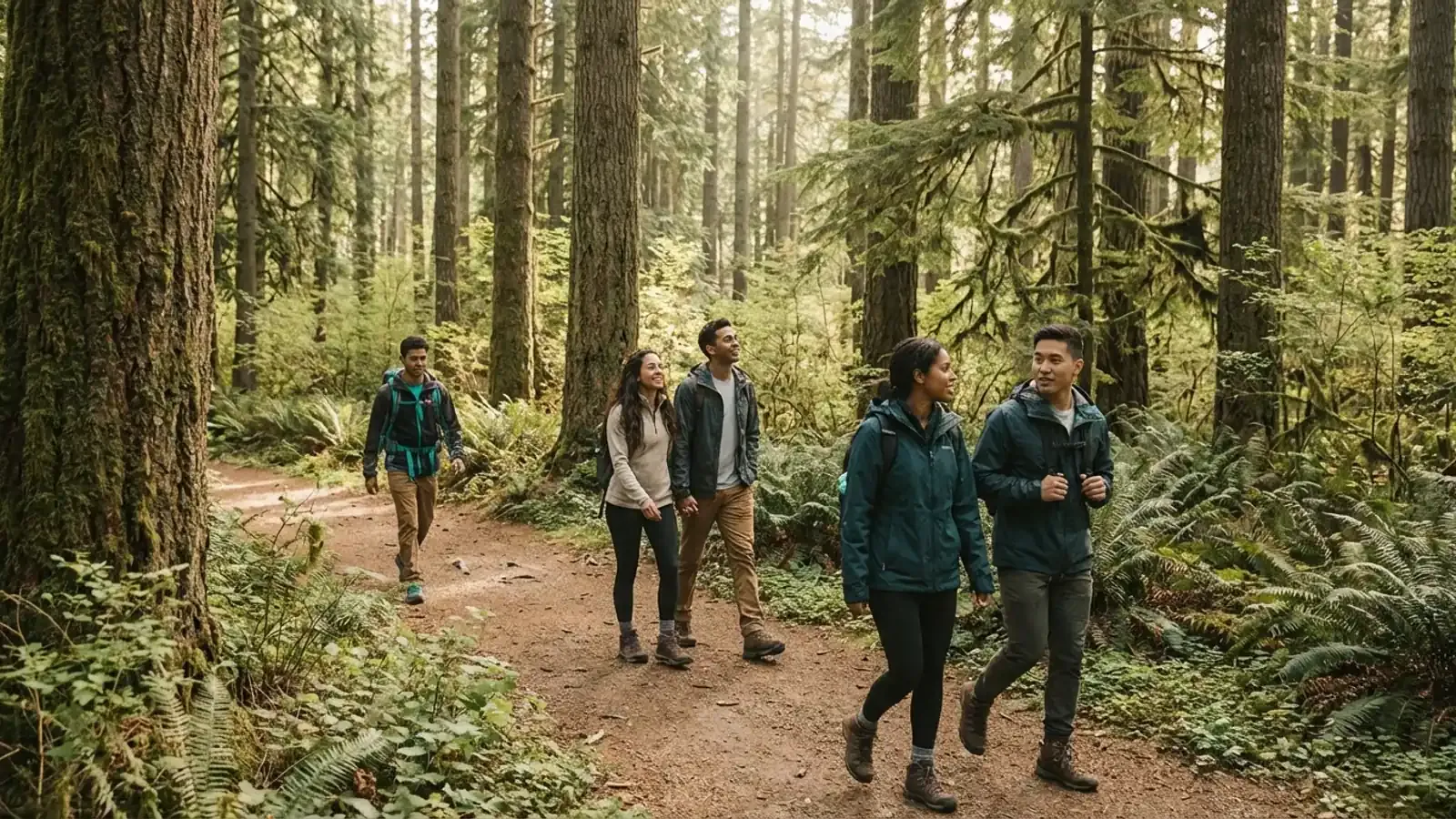
You said yes to the group hike. Then you spent three days rehearsing what you'd say when you got there. Then you canceled 45 minutes before it started and told yourself you'd "definitely go next time." If this sounds familiar, you're not alone—and you're not broken.
Can outdoor activities help with social anxiety? Yes—and the science backs what many anxious people already intuit. Research from the University of Michigan (Hunter et al., 2019, Frontiers in Psychology) found that spending just 20 minutes in a natural setting significantly reduces cortisol levels. Meanwhile, studies on spatial arrangement in social interaction (Sommer, 1969; Argyle & Dean, 1965) suggest that side-by-side activities—hiking, running, cycling—generate less social pressure than face-to-face interactions like dinner dates or networking events. For the approximately 15 million American adults living with social anxiety disorder (ADAA estimate), outdoor group activities offer a scientifically supported way to build genuine connections without the overwhelming pressure of traditional social settings.
This isn't about "just getting out more" or "pushing through the discomfort." It's about understanding why certain social environments are structurally easier for anxious brains—and strategically choosing settings where connection happens naturally, not forcefully.
Why Does Nature Reduce Social Anxiety? The Science Explained
Social anxiety isn't a character flaw—it's a neurological response pattern where the brain's threat-detection system (the amygdala) overreacts to social stimuli. Understanding this is key to understanding why nature helps.
Three evidence-backed mechanisms explain why natural environments reduce social anxiety:
1. Cortisol reduction (the stress buffer)
A landmark study from the University of Michigan (Hunter et al., 2019, Frontiers in Psychology) found that as little as 20 minutes in a natural setting—a park, a trail, a garden—significantly reduces cortisol levels. Lower cortisol means your baseline stress is already reduced before social interaction begins. You're literally starting from a calmer place.
2. Attention Restoration Theory
Environmental psychologists Rachel and Stephen Kaplan proposed that natural environments provide "soft fascination"—a gentle engagement of attention (rustling leaves, flowing water, birdsong) that allows the brain's executive function to rest and restore. For socially anxious individuals, this means fewer cognitive resources are consumed by environmental monitoring, leaving more capacity for genuine social engagement. Indoor social settings (bars, restaurants, networking events) demand constant environmental processing—noise, crowds, lighting—that depletes the very resources needed for comfortable conversation.
3. The side-by-side effect
Perhaps the most practical finding for socially anxious people: research on spatial arrangement in social interaction (Sommer, 1969, Personal Space; Argyle & Dean, 1965, equilibrium theory) suggests that side-by-side activities produce significantly less social pressure than face-to-face interactions. When you're hiking alongside someone, there's no sustained eye contact, no pressure to fill silences (the trail provides natural conversation pauses), and the shared physical activity gives your nervous energy a productive outlet. This is fundamentally different from sitting across from a stranger at a coffee shop.
For more on the psychology of connection: The Psychology of Making Friends: 7 Science-Backed Secrets
What Makes Outdoor Group Activities Different From Other Social Settings?
Not all social settings are created equal—especially for people with anxiety. Here's why outdoor group activities have structural advantages:
Built-in purpose removes "what do I say?" pressure
At a networking event, the entire point is to talk to people—which is precisely what social anxiety makes hardest. At a group hike, the point is to hike. Conversation is optional, secondary, and naturally prompted by the shared experience. "This view is incredible" or "How long have you been doing this trail?" are low-stakes, context-driven openers that require zero social performance.
Natural exit strategies reduce entrapment anxiety
A major trigger for social anxiety is feeling trapped in an interaction. Outdoor activities provide constant natural exit points—stopping to take a photo, adjusting your gear, falling back to a different pace group, admiring the scenery. You can regulate your social exposure in real-time without the awkwardness of excusing yourself from a dinner table.
Group format distributes social load
In a one-on-one date, you're responsible for 50% of the conversation—a paralyzing amount for someone with social anxiety. In a group of 6-8 people, you can participate at your own pace: listen when you want, contribute when you feel comfortable, and let others carry the conversation when you need a break. This is why the rise of group-based socializing is particularly significant for anxious individuals—it's a structurally more accessible social format.
Physical activity provides an anxiety outlet
Anxiety generates physical energy—elevated heart rate, restlessness, fidgeting. In a seated social setting, this energy has nowhere to go, amplifying discomfort. During outdoor activities, that same energy is channeled into movement, which the brain interprets as a productive response rather than a threat signal. Multiple studies (Wipfli et al., 2008; Stubbs et al., 2017) confirm that exercise significantly reduces anxiety symptoms.
Which Outdoor Activities Are Best for People With Social Anxiety?
Not all outdoor activities are equally anxiety-friendly. Here's a guide based on social pressure level, from lowest to highest:
Low pressure (great starting points):
- Group hiking—Side-by-side, self-paced, natural conversation flow. Groups spread out naturally on trails, giving you control over social density. Most hiking groups welcome solo participants.
- Running clubs (e.g., parkrun)—During the run, interaction is minimal (you're breathing too hard to talk). Socializing happens organically before/after, with the shared accomplishment as a natural bonding point.
- Volunteer outdoor cleanup events—Focus is on the task, not socializing. You're side-by-side, doing something meaningful, with built-in conversation topics. Very low expectation for social performance.
Medium pressure (once you're comfortable):
- Climbing gym sessions—Belaying requires trust and communication, which accelerates bonding. But it's structured (clear roles) and task-focused, which reduces ambiguity.
- Kayaking/SUP groups—On-water activities are naturally calming (blue space effect). Group paddling involves some coordination but minimal forced conversation.
Higher pressure (but still better than indoor alternatives):
- Group camping trips—Extended time together with less personal space. Best saved for when you already know some people in the group. But campfire conversations tend to be surprisingly easy—darkness and fire reduce self-consciousness.
For a comprehensive activity guide: The Complete Guide to Outdoor Dating
How to Prepare for Your First Group Activity When You Have Social Anxiety
Knowing that outdoor activities are structurally better for anxiety is helpful. But the hardest part is actually showing up. Here are strategies that work:
1. Start solo, not with a friend
This sounds counterintuitive, but research on social behavior shows that arriving alone actually makes you more likely to engage with new people. When you bring a friend, you default to talking to them—a comfortable safety net that prevents new connections. Solo participants are also perceived as more approachable by others. The temporary discomfort of arriving alone pays off in genuine new connections.
2. Set a minimum, not a maximum
Instead of pressuring yourself to "have a great time and make friends," set a minimal goal: "I will stay for 30 minutes." Anxiety thrives on high expectations. When you give yourself explicit permission to leave early, the paradox is that you usually stay longer—because the pressure is off.
3. Use the "3-sentence rule"
If initiating conversation feels impossible, commit to just three sentences: one observation about the activity ("Beautiful day for a hike"), one question ("Is this your first time here?"), and one response to their answer. That's it. Three sentences is enough to signal openness. The activity will carry the rest.
4. Choose recurring activities, not one-offs
The 50-hour friendship rule tells us that real friendships require repeated exposure. One-off events are high-pressure because you feel you "have to" make something happen. Weekly activities remove that urgency—if today isn't your day, next week will be. This patience is your secret weapon.
5. Process afterwards, not during
Social anxiety often manifests as real-time self-monitoring: "Am I being weird? Did I say the wrong thing?" The antidote is to save your analysis for later. During the activity, focus entirely on the physical experience—your feet on the trail, the scenery, your breathing. Post-activity reflection is more accurate and less catastrophic than in-the-moment anxiety spirals.
What Does the Research Say About Exercise and Social Anxiety?
Beyond the social benefits, the physical activity component of outdoor socializing has its own anxiety-reducing effects:
- A meta-analysis by Wipfli, Rethorst, and Landers (2008) found that exercise produces clinically meaningful reductions in anxiety symptoms, with the strongest effects for aerobic activities like running and hiking.
- Stubbs et al. (2017) published a systematic review in the Journal of Psychiatric Research showing that regular physical activity significantly reduces anxiety symptoms across multiple populations, including those with diagnosed anxiety disorders.
- The "green exercise" concept (Barton & Pretty, 2010) demonstrates that exercising in natural environments produces greater mood improvement and self-esteem gains than identical exercise performed indoors.
The implication is powerful: outdoor group activities combine three evidence-based anxiety reducers—nature exposure, physical exercise, and structured social interaction—into a single experience. No other social setting achieves this combination.
This is also why apps designed around activity-based matching—like GRASS, which connects people through shared outdoor activities rather than profile swiping—are structurally better for socially anxious users. The app does the organizing; the activity does the icebreaking; you just show up.
Ready to Try a Different Social Setting?
Social anxiety is real, and it's not something you "just get over." But the science is clear: certain environments make socializing dramatically easier. Natural settings lower your cortisol before you even start talking. Side-by-side activities remove the pressure of sustained eye contact. Group formats let you engage at your own pace. And physical activity channels nervous energy into movement instead of spiraling thoughts.
Somewhere near you this weekend, there's a group of strangers about to become friends on a trail. There's a spot for you if you want it. Browse outdoor activities on GRASS and find a low-pressure group hike or running club near you. Show up. Stay for 30 minutes. That's enough for today.
Frequently Asked Questions
Q1: Can outdoor activities actually help with social anxiety?
Yes. Research supports three mechanisms: (1) Natural environments significantly reduce cortisol levels (Hunter et al., 2019, Frontiers in Psychology), lowering baseline stress before social interaction; (2) Side-by-side activities like hiking produce less social pressure than face-to-face settings (Sommer, 1969); (3) Physical activity produces clinically meaningful reductions in anxiety symptoms (Wipfli et al., 2008). Combined, outdoor group activities offer a structurally easier social environment for anxious individuals.
Q2: What are the best outdoor activities for someone with social anxiety?
The best starting points are low-pressure, side-by-side activities: group hiking (self-paced, natural conversation flow), running clubs like parkrun (minimal interaction during the run, organic socializing after), and volunteer outdoor cleanup events (task-focused, low social expectation). As comfort grows, climbing gyms and kayaking groups offer medium-pressure options with structured interaction.
Q3: Should I go alone or bring a friend to a group activity?
Counterintuitively, going alone is often more effective for making new connections. When you bring a friend, you tend to default to talking with them, which prevents new interactions. Solo participants are also perceived as more approachable by others. The initial discomfort of arriving alone typically fades within 15–20 minutes and leads to more genuine new connections. That said, if going solo feels like too much right now, bring a friend and make a deal: you'll each talk to at least one new person independently.
Q4: How does nature reduce stress and anxiety?
Nature reduces anxiety through multiple pathways: significant cortisol reduction after as little as 20 minutes in natural settings (Hunter et al., 2019), Attention Restoration Theory (natural environments provide "soft fascination" that rests the brain's executive function; Kaplan, 1995), and the "green exercise" effect (exercising outdoors produces greater mood and self-esteem improvements than indoor exercise; Barton & Pretty, 2010). These effects are well-documented and replicated across multiple studies.
Q5: How long does it take to feel comfortable at a new group activity?
Based on the 50-hour friendship rule (Hall, 2019), it takes approximately 50 hours of shared time to move from acquaintance to casual friend. At weekly 2-3 hour activities, that's roughly 4-6 months. However, comfort with the setting itself usually comes faster—most people report feeling significantly less anxious by their 3rd or 4th attendance as the environment becomes familiar.
Q6: What if I have a panic attack during a group activity?
Outdoor settings are actually one of the better places for managing panic because you can step away easily (no trapped feeling), fresh air helps regulate breathing, and walking/movement is a proven grounding technique. Practical tips: tell one person you trust that you sometimes get anxious (this removes the fear of being "found out"), identify your exit route before starting, and remember that most people are focused on the activity, not observing you.