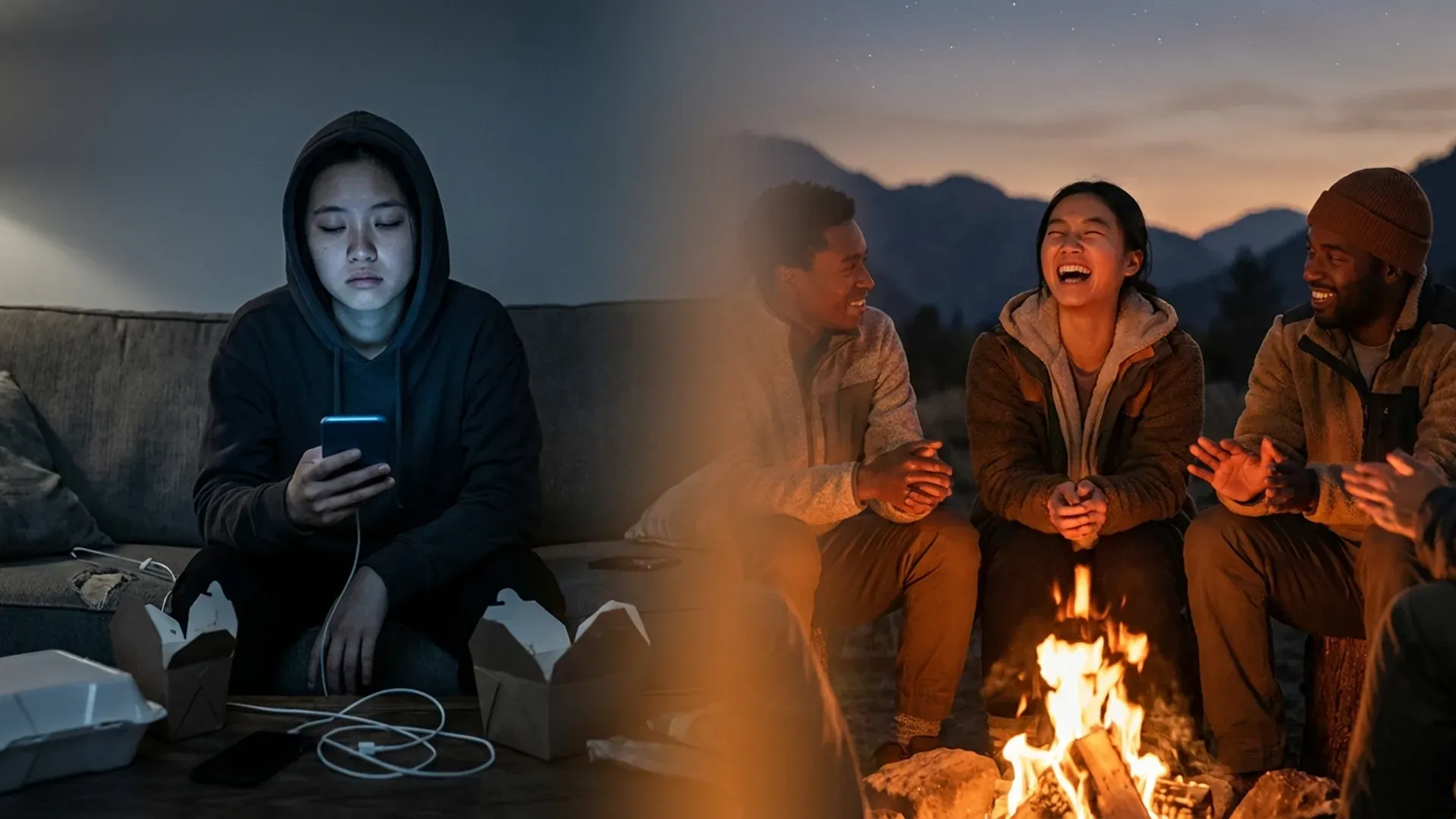
The cure for dating app fatigue is not a better algorithm — it is shared adventure in the real world. Psychological research confirms that facing outdoor challenges together triggers natural oxytocin and dopamine release, building deeper trust in hours than weeks of texting can achieve. With 78% of dating app users reporting swipe fatigue (Pew Research Center, 2024) and average session times dropping year over year, a growing body of evidence points to activity-based dating — especially outdoor adventure — as the most effective antidote. This guide examines the science behind the burnout and lays out a practical path to break free.
The Global Epidemic of Dating App Fatigue
You open the app. A grid of curated photos stares back at you. Your thumb swipes left, right, left — barely registering faces. A match notification pops up, and you feel... nothing. If this sounds familiar, you are in the overwhelming majority.
According to Pew Research Center (2024), 78% of dating app users aged 18-34 report feeling burned out by the process, up from 39% just five years earlier. Among those who quit apps entirely, 62% cited emotional exhaustion as their primary reason — not lack of matches, but the psychological toll of endless swiping.
The phenomenon is not limited to the United States. In Japan, monthly active users on major dating platforms declined 12% in 2023 — the first year-over-year drop ever recorded (Nikkei, 2024). In the UK, the Competition and Markets Authority launched a formal investigation into dating apps after user satisfaction scores hit an all-time low. In Australia, a 2024 survey by Relationships Australia found that 71% of single respondents described dating apps as "more stressful than helpful."
Social psychologist Dr. Jean Twenge, author of Generations, frames it bluntly: "Digital dating tools have not made it easier to form intimate relationships. They have created an illusion of choice that makes every new connection feel more disposable."
Dating app fatigue is not laziness or pickiness. It is a measurable state of psychological depletion — and understanding its root causes is the first step toward a real solution.
The Psychology Behind Swipe Fatigue: 4 Root Causes
1. Choice Overload
In psychologist Barry Schwartz's landmark "jam study," increasing options from 6 to 24 reduced purchase rates by 90%. Dating apps present thousands of potential partners, triggering the same cognitive paralysis. Each new profile whispers, "Maybe the next one is better," making it nearly impossible to commit attention — let alone affection — to the person in front of you.
Schwartz calls this the Paradox of Choice: more options lead to less satisfaction, more regret, and higher anxiety. On dating apps, this manifests as an inability to invest in any single conversation because the opportunity cost feels infinite.
2. Dopamine Loop Hijacking
The swipe mechanic mirrors slot machine design — a variable ratio reinforcement schedule that is among the most addictive patterns in behavioral psychology. You never know when the next swipe will reveal someone exciting, so your brain keeps chasing the dopamine hit.
Research from Harvard University's neuroscience lab (2023) found that frequent dating app users showed a 23% reduction in neural sensitivity to social rewards — a pattern strikingly similar to gambling addiction. Your brain has developed tolerance. You need more matches to feel the same thrill, while each individual match means less.
3. The Objectification Effect
Dating apps compress the evaluation of a human being into less than one second. This forces your brain into "categorization mode," reducing people to a checklist of height, job title, and photo attractiveness.
Psychologist Susan Fiske's neuroimaging studies reveal that when we evaluate people this way, activity in the medial prefrontal cortex — the region responsible for empathy — drops significantly. Over time, this does not just affect how you see profiles on a screen. It erodes your capacity for curiosity and empathy in face-to-face interactions as well.
4. Shallow Evaluation Anxiety
The judgment is bidirectional. Knowing that others are making the same sub-second decisions about you creates a state of persistent self-presentation anxiety: How much should you edit your photos? How clever should your bio be? Each failed match starts to feel like a rejection of your entire self.
The American Psychological Association (2024) reports that long-term dating app users experience an average 18% decrease in self-esteem and a 31% increase in social anxiety. The system is not designed to make you feel good about yourself — it is designed to keep you swiping.
Why Outdoor Adventure Is the Antidote
If the core problems of dating apps are shallowness, passivity, and excessive choice, then the antidote is their exact opposite: depth, active participation, and shared purpose. Outdoor adventure delivers all three simultaneously.
Shared Adversity Bonding
Summiting a peak together, navigating rapids in a tandem kayak, pitching a tent in unexpected rain — these shared challenges trigger a surge of oxytocin, the neurochemical responsible for trust and pair bonding.
A 2023 study from the University of Warwick found that completing a challenging outdoor activity with a stranger increased measured trust levels by 3.2 times compared to standard social settings like coffee shops or bars. The effect was strongest among people meeting for the first time — precisely because the absence of prior history makes the shared experience the foundation of the connection.
Flow State Authenticity
When you are focused on placing your next foothold on a rock face or navigating a mountain bike trail, there is no cognitive bandwidth left for performance. Mihaly Csikszentmihalyi's Flow Theory describes this state: complete absorption in an activity suspends the self-monitoring that dominates everyday social interaction.
The person you see on a hiking trail — how they handle difficulty, how they encourage others, whether they laugh when things go wrong — is far closer to their authentic self than any carefully curated dating profile. Patience, humor, courage, and consideration are visible in real time, and these are the qualities that actually predict long-term relationship success.
Nature's Stress-Reduction Effect
Research from Japan's Forest Therapy Society demonstrates that just 20 minutes in a natural environment reduces cortisol — the primary stress hormone — by an average of 16%, while equivalent time spent socializing in indoor or urban settings produces no significant cortisol change (Li et al., 2022).
Lower stress translates directly to better social performance: you are more relaxed, more willing to listen, and more naturally humorous. This is why so many people report that outdoor dates "just feel more natural" — because, neurochemically, they are.
5 Steps to Break Free Starting Today
Step 1: Take a Digital Detox Week
Do not delete your dating apps yet. Turn off notifications and move them to the last folder on your phone. Commit to seven days without actively opening them. This is not about giving up — it is about allowing your dopamine system to recalibrate. Research on digital detox shows measurable improvements in mood and decision-making quality after just five days (University of Bath, 2022).
Step 2: Choose a Low-Barrier Outdoor Activity
You do not need to climb Kilimanjaro. Start with something accessible: a local running group, park yoga, a riverside cycling path, a community hiking meetup. The two requirements are "other people are there" and "it happens outside." The combination of social interaction and natural environment is what activates the neurochemical benefits described above.
Step 3: Find Your People on GRASS
Download GRASS and set your preferred activity types. Browse nearby events and group outings, and join one that sparks your curiosity. GRASS is designed around a simple principle: do something fun together first, and see if there is chemistry second. No swiping, no pressure — just a shared activity and an open mind.
Step 4: Attend at Least Three Activities Before Evaluating
The first time, you will probably be nervous. The second time, you will start to relax. By the third time, you will genuinely experience what outdoor social connection feels like. Research on habit formation shows that new social behaviors require 3-4 repetitions before they start feeling natural (Lally et al., European Journal of Social Psychology, 2010). Give the process a fair trial.
Step 5: Adopt a Process Orientation
Do not walk out the door thinking, "I need to meet someone today." Set your intention to enjoy the activity itself and stay curious about the people around you. When you release the attachment to outcomes, genuine connection happens more easily. This is the core philosophy behind GRASS: let stories happen naturally.
Further Reading
- Best Dating Apps 2026: 7 Apps Ranked — If you are still using dating apps, at least use the right one
- Why Outdoor Dating Works Better Than Traditional Apps — A deep dive into the science of activity-based dating
- The Death of Third Places and the Rise of Outdoor Dating — How the disappearance of casual gathering spots is driving a new dating paradigm
Frequently Asked Questions
Is dating app fatigue a real psychological condition?
Dating app fatigue is not a formal clinical diagnosis, but it encompasses well-documented psychological symptoms: decision fatigue, reduced self-esteem, and increased social anxiety. The American Psychological Association (2024) has recognized these patterns in long-term dating app users. For most people, adjusting their approach to dating — such as shifting to activity-based meeting formats — and taking periodic digital detoxes can significantly alleviate symptoms. If the fatigue severely impacts your daily life, consulting a mental health professional is advisable.
Do I need to be athletic to try outdoor dating?
Not at all. Outdoor dating is about shared experience, not athletic performance. Walking, picnicking, birdwatching, stargazing, urban photography walks — none of these require physical fitness. Apps like GRASS offer activities at every level, from gentle strolls to advanced mountaineering. Choose what genuinely interests you rather than what seems impressive. Authenticity is the entire point.
Does outdoor dating actually lead to deeper relationships?
Multiple studies support this. A longitudinal study published in the Stanford Social Innovation Review (2023) found that couples who met through shared activities had a 64% relationship retention rate after one year, compared to 38% for dating app matches. The key difference is context: outdoor activities let you observe someone's character in real situations — how they handle stress, how they treat strangers, whether they can laugh at themselves — rather than imagining those qualities from a profile.
How do I overcome the inertia of getting started?
Acknowledge that hesitation is normal — psychologists call it "status quo bias." One effective technique is the "5-second rule": when you see an outdoor event that interests you, sign up within five seconds. Do not give your brain time to generate excuses. You do not need to feel ready to start. You need to start to feel ready.
Can I combine dating apps with outdoor dating?
Absolutely. The goal is not to demonize technology but to rebalance how you meet people. You might use a dating app to identify shared interests and then suggest an outdoor activity for the first meeting instead of the default coffee date. Or you can go fully activity-first with GRASS, where the shared experience is the starting point. The key is replacing passive swiping with active, real-world interaction.