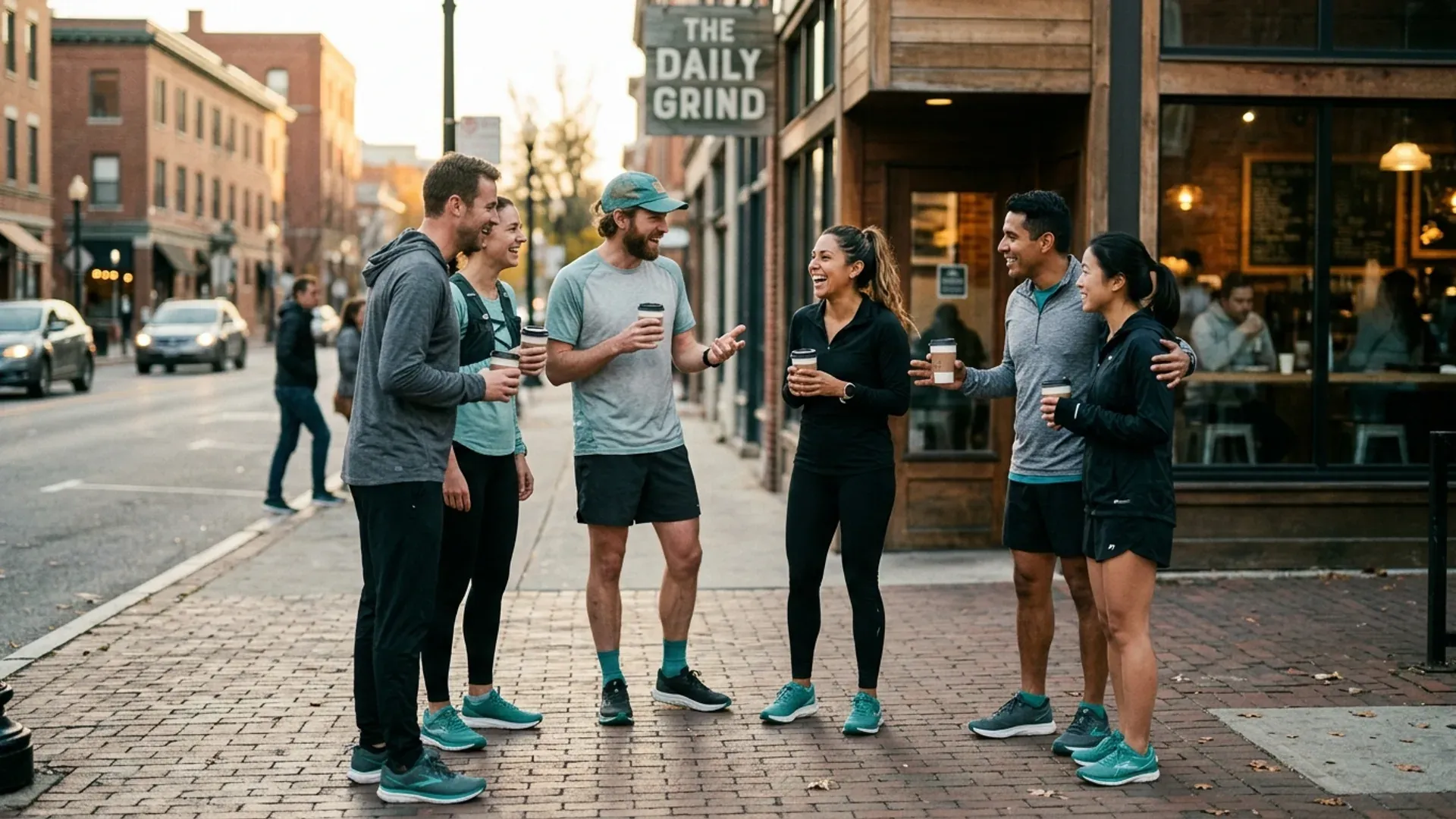
The fastest way to find a run club near you usually isn't a search engine — it's showing up once to a free weekly group run and asking the people there. Runners know which clubs in their city are welcoming to newcomers, which ones quietly expect you to hold a 7:30 mile, and which ones stopped meeting a year ago but never took the page down. One visit gets you a run and a local map.
You still need a starting point, though. This guide covers the five channels that actually work for road runners in the US, how to read a club's announcement before you commit a Tuesday evening to it, how to tell whether a group is genuinely social or just a hard workout with strangers, and what to do at your first run so that there's a second one.
Strava reported in its 12th annual Year in Sport report that new clubs on its platform nearly quadrupled in 2025, reaching a million clubs in total. Running clubs grew 3.5x year over year, second only to hiking at 5.8x, and club-organized events rose 1.5x. The same report found 39% more Gen Z than Gen X use fitness to meet people who share their interests. Those are global platform figures rather than US-specific ones, but the direction is hard to miss.
Separately, Running USA's 2025 Global Runner Survey drew more than 12,700 responses, roughly 90% of them from US-based runners. Of those, 50.1% said they never run with an organized club or crew. The survey asked whether, not how often, so it says nothing about how regular the other half is. What it does say is that running with other people isn't a niche habit — close to half of the runners surveyed have it in their lives at all. Whatever it feels like when you're the only one on the bike path at 7 a.m., you're not the outlier you might assume.
Where Do Road Runners Actually Find Clubs?
Five channels cover most of the road running scene in the US: the RRCA club directory, parkrun, running-store group runs, local race-series calendars, and the Instagram-native crews that no directory indexes. Each one has a predictable blind spot, and knowing the blind spot is what saves you a wasted Tuesday evening.
The RRCA directory: the widest net, the stalest data
The Road Runners Club of America is the oldest national organization for distance runners in the country, and its member-club directory is the closest thing that exists to a national list of road clubs. Search by state and you’ll surface clubs that predate every app on this page. Some of them have forty years of continuous Wednesday nights behind them.
The blind spot: directory listings go stale. A club stays listed as long as its dues are current, which tells you nothing about whether it still holds weekly runs. Treat an RRCA listing as a lead, not a schedule. Find the club’s Instagram or Facebook page and confirm it posted within the last month before you drive anywhere.
parkrun: the lowest-barrier way in
parkrun holds free, timed 5K events every Saturday morning, with roughly 96 active US locations as of November 2025. There’s no membership, no fee, and no pace requirement — you register once online, print a barcode, and show up. Walkers finish every event, and the results still list them.
The blind spot: parkrun is an event, not a club. You won’t get a training group or a Tuesday night crew out of it. What you’ll get is the easiest room in your city to meet local runners, because the people who show up every Saturday almost all run with other clubs too. Use it as reconnaissance, then ask.
Running-store group runs: a schedule you can rely on, a culture you can’t
Specialty running stores host the most consistent weekly group runs in the country. Fleet Feet locations advertise free weekly community fun runs — one store’s page shows the standard format — and independent shops usually run something similar. Brand-led clubs from the major shoe companies are generally free to attend as well, and they tend to be well organized about pace groups because that’s what keeps new customers coming back.
The blind spot: store runs vary enormously in character, even within the same chain. One location’s Wednesday run is a real social club with a decade of regulars; another’s is two employees and whoever wandered in. The schedule is reliable. The community isn’t guaranteed. Judge each location on its own rather than by the sign above the door.
Race-series calendars: the layer most people never search
Most metros have a local race series — a summer 5K circuit, a winter series, a charity race calendar. The sponsoring clubs and training groups are usually listed right on the series website, and they’re often the most established groups in town precisely because they’re the ones organizing the racing.
The blind spot: this layer is invisible to the obvious search. These groups market to runners who already race, so they rarely optimize for anyone typing run club near me. You have to go looking for the calendar first and the clubs second.
Instagram run crews: the ones no directory will show you
The most socially active groups in a lot of cities are never in a directory at all. You find them by following one crew on Instagram and watching who they tag and who tags back — that overlap is the real map of who runs with whom in your city. None of it is searchable by design, which is part of why these crews tend to be the youngest and most social layer of the scene.
The blind spot: you need one thread to pull. If you don't already follow a local crew, this channel gives you nothing at all. The way in is to get a single name from any of the four channels above — a parkrun regular, a store employee, a listing on the race calendar — and let the tags do the rest.
Identity- and pace-specific clubs: often the most welcoming rooms in the scene
Not a sixth channel — these run on the same five paths above, just filtered differently. They earn a separate mention because they answer a worry the others don't: the quiet suspicion that you don't look like a runner. Black Girls RUN! runs more than 70 chapters nationally, Latinos Run and Latinas Run have grown to more than 60, and Front Runners chapters serve LGBTQ+ runners and walkers in cities across the country, the Chicago one since 1982.
The Running Industry Diversity Coalition keeps a state-by-state directory of BIPOC-led run clubs organized by state, and because it lists them by Instagram handle it doubles as the best available index of the crews described above. Check the relevant chapter page before assuming there's one in your city. Coverage is wide, but not universal.
One question the pages themselves rarely answer up front: most of these clubs welcome allies and curious newcomers regardless of identity, but not all of them, and the norms vary by chapter. A quick DM to the account settles it faster than guessing, and saves you a wasted drive either way.
Separately from any of that, most metros have at least one club built explicitly around slower, back-of-pack paces. Different reason, same effect: it removes the question of whether you are fast enough to belong, which for a lot of people is the only thing standing between them and a first group run.
Looking for dirt rather than pavement? The trail scene runs on an almost entirely different set of channels — see our guide to finding trail running meetups near you. And if you’re in Los Angeles specifically, we have a breakdown of the run clubs worth showing up to in LA.
How Do You Read a Run Club Post Before You Show Up?
Three phrases carry almost all of the useful information in a run club announcement: no-drop, all paces, and a posted pace range. They’re not interchangeable, and one of them is a trap for new runners.
- No-drop is the strongest promise on this list. It means nobody gets left behind: there’s usually a designated sweeper at the back or fixed regroup points along the route. If you’re a beginner, this is the phrase to search for — pair it with your city and you’ve filtered out most of the clubs that would have been a bad first outing.
- All paces / all abilities is the softer version. You’re welcome at any speed, but nobody has promised to run with you. Large all-paces groups naturally split into packs within the first mile, and you can end up running alone in a crowd.
- A posted pace range — say 8:30 to 9:30 per mile — is a filter, not an invitation. If your comfortable pace is slower than the range, don’t make this club your first. You’ll spend the run anxious about hanging on, which is the opposite of why you came.
- No pace language at all usually means the group assumes you already know how it works. Not hostile, but not built for newcomers either.
Two more details most people skim past. Distance: a casual-sounding six-miler is over an hour for many newer runners, so check it against your longest recent run rather than your best one. And route shape: an out-and-back lets you turn around at any point and still get back to your car, while a loop commits you to the whole thing. For a first outing with an unfamiliar group, out-and-back is the safer bet.
How Can You Tell If a Run Club Is Actually Social?
The strongest signal is what’s scheduled after the run. A club that lists a coffee shop, a brunch spot, or a bar as part of the standing plan is telling you the run is the excuse. A club that ends in the parking lot is telling you the run is the point. Both are legitimate — they're just two different nights out, and the description usually tells you which one you're getting.
- A standing post-run stop. This is the highest-signal detail in any club description. Conversation during a run is fragmented and breathless; the twenty minutes afterward is where people actually become familiar to each other.
- A fixed meeting point and time. Same place, same hour, every week is what builds recognizable faces. Groups that rotate locations weekly are much harder to become a regular in, however good the routes are.
- Recent activity. Check whether the group posted in the last 30 days. Zombie clubs (pages that look active but stopped meeting long ago) are the single most common way a first attempt gets wasted.
- An intro circle. Some clubs gather before the run for names and a quick welcome. If the photos show people standing in a circle rather than mid-stride, somebody designed that on purpose, and that somebody was thinking about newcomers.
- Size. As a rough rule of thumb, 15 to 40 is the sweet spot. Under eight and you’re joining an established friend group; over sixty and you can attend three weeks running without anyone learning your name.
Do You Have to Pay to Join a Run Club?
Most routes into group running in the US are free. Paying is the exception, and when it happens it’s almost always tied to structured coaching rather than to access.
- Free: parkrun is free by design everywhere it operates, store-hosted community runs are typically free (Fleet Feet advertises its weekly fun runs that way), brand-led run clubs are generally free to attend, and informal neighborhood crews cost nothing by definition.
- Modest annual dues: traditional membership clubs often charge a small yearly fee. That usually covers insurance, race discounts, and club events rather than the right to show up on a Wednesday — and many clubs will let you run with them a few times before you decide.
- Genuinely paid: coached training programs — marathon build-ups, structured speed groups, race-specific camps. Here you’re buying a coach and a plan, and the price reflects it.
The practical rule: if someone wants money before your first run, you're looking at a training program rather than a run club. Just know which one you're signing up for.
How Do You Find a Run Club That Fits Your Schedule?
Run club schedules are far more predictable than they look, and the day you’re free narrows the search more effectively than your city does.
- Tuesday and Wednesday evenings are the densest slots by a wide margin. Monday is a recovery day on most training plans and the back half of the week competes with everything else in people’s lives. If you’re free midweek you’ll have the most options — and the most company.
- Saturday mornings are long-run day: earliest start times, longest distances. parkrun also lands here, which makes Saturday the single best morning for a newcomer to sample what a city has.
- Sunday skews toward recovery runs and brunch-first social groups — easiest paces of the week, and often the friendliest first outing you can pick. Be aware that plenty of training plans put the long run on Sunday instead, so some clubs invert the whole weekend. Check which convention your city's biggest club follows before assuming Saturday.
- Weekday mornings (5:30 to 6:30 a.m.) are rarer but unusually sticky. The regulars tend to be people whose evenings are unpredictable: parents, shift workers, anyone whose day can get hijacked. Attendance is high because nothing has gone wrong yet at 5:45 a.m., and that consistency turns strangers into familiar faces faster than any other slot.
- Friday runs are uncommon and almost always social-first, with the run functioning as a warm-up to whatever comes after it.
One search tip that works better than it should: search the day, not just the activity. A plain run club near me search mostly returns directories and roundups. Wednesday run club — or Monday run club, or whichever night you actually have free — plus your city name surfaces the groups themselves, because most of them bake their fixed night into their name or their weekly post.
What Happens at Your First Group Run?
Almost no weekly group asks you to sign up in advance, so if a search for a run club near me today turns up something meeting tonight, you can usually just show up. Arrive ten minutes early, say it’s your first time, and stay for whatever happens afterward. Those three things determine whether there’s a second run far more than your fitness does.
Early arrival matters because it’s the only window where conversation is easy — once the run starts, most people are too busy breathing. Announcing that you’re new is close to a universal key in running culture: in most clubs somebody will immediately attach themselves to you for the route, partly because they remember being new and partly because that’s the job of whoever is leading. And staying afterward is where the twenty minutes that actually build familiarity happen.
Well-run clubs tend to follow the same unwritten playbook: a pace leader for each sub-group, somebody whose job is to help new faces find where they belong, and a habit of running no more than two abreast so nobody gets clipped by traffic. The RRCA's safe group run guidelines spell all of this out, down to needing a permit once a group tops 25 runners. If you see a club doing these things on your first visit, somebody thought about you before you showed up. That's not bureaucracy, that's hosting.
If you’re meeting an unfamiliar group for the first time, the usual sensible precautions apply — check that the meeting point is public and well-lit for early or evening runs, tell someone where you’re going, and trust your read of the group in the first ten minutes. Our guide to meeting people safely through outdoor groups goes through this in more detail.
Give a club three visits before you decide. The first time you're a stranger, the second time somebody recognizes you, and only by the third do you start to learn who the regulars are. One visit tells you about the route, not about the people. But if you're three or four runs in and still nobody has learned your name, or the pace makes you miserable (or bored) every single week, or you're fighting your own calendar just to show up — that's your answer. Try a different one. Between the RRCA directory, parkrun, your nearest running store, and the local race calendar, there's almost always another option, and a bad fit isn’t a verdict on you.
Can You Actually Meet People at a Run Club?
Yes, and the mechanism is more boring than people expect. It runs on repetition. You see roughly the same twenty people every week, you’re side by side rather than face to face, and there’s a built-in reason to be there that has nothing to do with each other.
That structure does most of the work. Shared effort repeated over time builds familiarity considerably faster than conversation alone, and running shoulder to shoulder removes the interview dynamic that makes first meetings exhausting. Nobody has to perform. You’re both just trying to get up the hill. If you want the wider trend rather than the mechanics, we covered why run clubs started replacing dating apps for a lot of people separately.
One norm worth respecting: run clubs aren’t dating events, and treating them like one gets noticed quickly. Anecdotally, the people who do end up meeting someone through a club became a regular first. Show up for the running, stay for the coffee, and let the rest happen on its own schedule.
None of that is specific to running, which is the useful part. Repeated shared effort, shoulder to shoulder, on a schedule you both keep — that’s the whole mechanic, and any recurring outdoor activity runs on it. That is the idea behind GRASS: you join a real activity with people nearby — a hike, a climb, a weekend ride — so the repetition starts on your first outing instead of after you have found the right club. Same mechanism, fewer steps to reach it.
Frequently Asked Questions
How do I find run clubs in my area if I don’t live in a major city?
Start with the RRCA directory filtered to your state, then the nearest specialty running store, in that order. Smaller metros often have one long-standing club that everything else orbits, and store staff will know exactly which one it is. If nothing turns up within a reasonable drive, the nearest parkrun is usually the best substitute. Many of the roughly 96 US locations are in smaller cities rather than metro cores.
How fast do I need to be to join a beginner-friendly run club?
For a no-drop or all-paces group, comfortably run-walking three miles is enough. Well-organized clubs split into pace groups and, following RRCA guidance, help new members find the right one. If a listing posts a specific pace range and you’re slower than it, treat that as a filter and pick a different club — not a different goal.
Are run clubs free?
Most are. parkrun is free everywhere, running-store community runs are typically free, and brand-led clubs are generally free to attend. Traditional membership clubs charge modest annual dues that mostly cover insurance and race discounts. Coached training programs charge real money, because what you’re buying there is coaching rather than access.
Is it weird to show up to a run club alone?
Almost everyone does. Group runs are structurally built for solo arrivals: a fixed meeting point, a shared route, and usually a post-run stop that gives you a low-stakes way to keep talking. Saying it’s your first time is the fastest shortcut there is — in most clubs somebody will run with you for the whole route.
What should I bring to my first group run?
Less than you think. Whatever you normally run in, a phone, and water if the route is over four miles or the weather is hot. If you’re coming straight from work, ask whether you can leave your bag at the store — most groups meet somewhere with a counter to stash things behind. Arrive with your shoes on and laces tied, because some groups start moving within a minute of the posted time.
Your First Step This Week
Pick the day you’re genuinely free, search that day plus your city name on Google and Instagram, and check whether the group posted in the last month. If it did, go once and stay for the coffee. That’s the entire method — everything above is just detail on how to choose well the first time.
And the structure travels. Once you have one group in your week, adding a second gets much easier — hikes, climbs, paddles, weekend rides all run on the same repetition. GRASS is built around exactly that: real outdoor activities you can join with people nearby, instead of another feed to swipe through. Worth a look if that's more your speed.