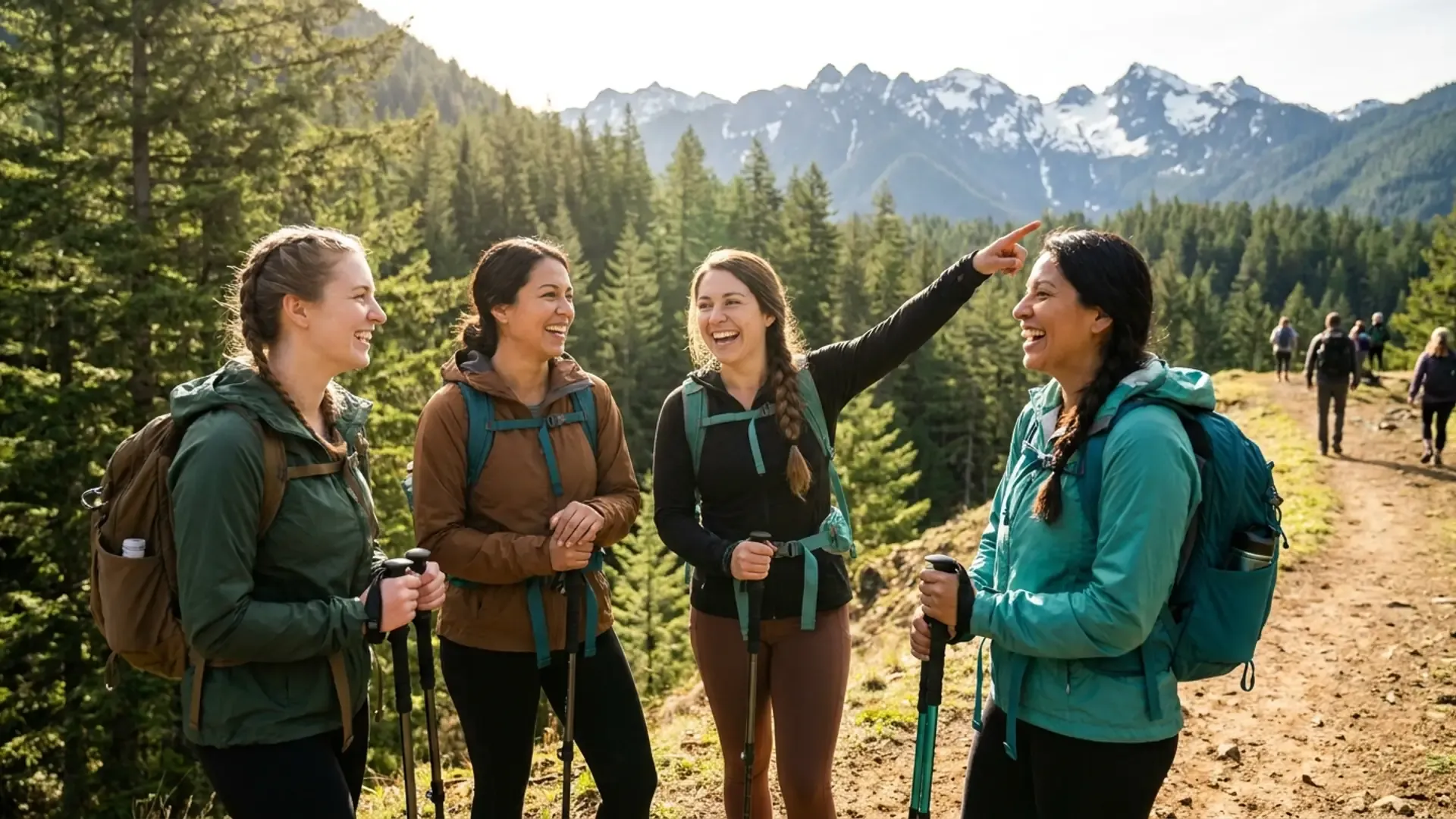
More American women are spending time outdoors than ever — and more of them are using that time to meet people. The Outdoor Industry Association's 2024 report clocked women's outdoor participation at 51.9% in 2023 — the first time more than half of US women recreate outside in a year. Women now make up 40.6% of all US hikers, roughly 24 million people (per industry-aggregated participation data). But there's a stubborn second number: surveys consistently find that around 65% of women cite personal safety as the primary barrier to hiking, running, or recreating outside alone.
This guide is for women who want to use the rise of outdoor dating apps — meeting through hikes, runs, climbing sessions, and group adventures — without absorbing the risk that comes from meeting a stranger one-on-one in a remote place. We'll cover what the actual data says about women's outdoor risk (the picture is more nuanced than most headlines), the women-led outdoor groups that act as a quiet pre-screen, and the specific playbook for moving from app match to first hike date safely.
If you want the broader dating-app scam, verification, and red-flag breakdown, start with our 2026 Dating App Safety Guide. This piece picks up where that one leaves off — the outdoor-meet stage, where most generic safety advice gets vague.
What the Data Actually Says About Women's Outdoor Risk
Three findings from the most-cited outdoor safety research should reshape how you think about risk:
- Public lands are statistically safer than urban areas. A 2025 analysis covered by National Parks Traveler found that fewer than 1% of national park visitors between 2000 and 2023 were issued a citation, and 66% of those were traffic-related. "Most popular trail" generally means "lots of witnesses," not "lots of risk."
- Once lost or injured, women have better survival outcomes than men. Reporting summarized by outdoor publications including the Appalachian Mountain Club draws on Mountain Rescue Association data showing women tend to ask for help earlier, follow instructions more reliably, and die less often once a search begins.
- The dominant outdoor risk for solo women is navigation and exposure, not crime. Solo female hikers are over-represented in lost-hiker cases and slightly more prone to non-fatal hiking injury — both addressable with route choice, pacing, and gear preparation rather than avoidance.
The honest takeaway: the average outdoor first meeting is safer than the average bar first meeting. The real risks women face come from two specific spots — being alone with a stranger on a remote section of trail, and being in a vulnerable spot (lost, injured, dehydrated) far from help. Both are addressable.
For why "outdoor + group + activity" out-performs the standard "drinks at a bar" first meeting structurally, see the psychology of group bonding — group physical effort produces faster, more accurate character read-outs than any number of text exchanges.
Why a "First Meeting Outdoors" Default Changes Things for Women
Compare two common 2026 first-date scenarios for an app match:
- Drinks at a bar, 8pm Saturday. Indoor, often poorly lit, alcohol present, no clear "exit" because the venue rewards staying. You learn very little about the person's character because the entire interaction is performance under low-stakes conditions.
- Saturday morning group hike, popular trailhead, 9am start. Outdoor, daylit, no alcohol, dozens of other hikers around, a built-in exit (the hike ends), and a 2-hour window of seeing the person do something physical with other people. You learn more in 90 minutes than you would in three bar dates.
Every standard safety rule — public place, your own transport, a friend knowing the plan, watching your drink count — is structurally easier to follow at a trailhead than at a bar. The FTC's Online Dating page and women's safety nonprofits like RAINN have published these rules for years. The honest issue is they all assume an evening dinner-and-drinks scenario. Move the first meeting to a group trail or running event and you don't have to remember any of them as discipline — the format does the work for you.
This is the asymmetric advantage of moving the first meeting outside. It's not that the bar is dangerous and the trail is safe — it's that the structural defaults of outdoor group meetings make safety the easy choice rather than the disciplined one.
The Hidden Safety Layer Most Guides Miss: Women-Led Outdoor Groups
If you search "women only walking groups with safety features and verified profiles," you'll find a small number of dating apps trying to build features for that. What gets missed in those results is that the strongest women-only outdoor screening system in the US is the network of women-led outdoor recreation groups that already exists offline — most of which now run hybrid online/IRL meetups that welcome new members.
A non-exhaustive list of women-led organizations with active US chapters in 2026:
- Trail Sisters — national women's trail running community with regular local meetups, beginner-friendly events, and a strong vetted-member culture.
- Outdoor Afro — Black-led outdoor network with a national leadership team across many US states. Regular group hikes, kayaking, camping. Founded 2009 by Rue Mapp.
- Black Girls Hike — founded by Asia Bright during the pandemic, originally based in Maryland and now running US chapter meetups plus curated international trips.
- Latino Outdoors — bilingual outdoor community with chapter leaders across the western and southern US.
- Native Women's Wilderness — Native women's outdoor education, trip leadership, and ancestral-lands advocacy.
- Black Girls Run — women's running meetups with chapters in many US cities, often led by certified pace leaders.
Important note for women of color: the trail can carry an additional layer of surveillance and racialized risk that the standard "be friendly to the volunteer ranger" advice does not address. For Black, Indigenous, Latina, and Asian women, the groups above are not just supplemental — they are often the primary entry point, because the safety the groups provide includes the safety of being in community with people who recognize and have already navigated that second layer.
Why this is a safety system: every one of these groups runs on the principle that vetting happens through repeated low-stakes shared activity, not paperwork. New members show up at a few group hikes or runs. Existing members watch how they behave around the group. People who give off bad signals don't get invited back. By the time you've been in the group for a month, the cohort around you has already done the verification an algorithm can't.
This is also where outdoor dating apps that integrate with real activities — rather than just adding a "let's go hiking" prompt to a swipe interface — start to make sense. Activity meetups put potential matches into the same vetting environment a women-led running club uses, just at a wider scale.
The Outdoor Pre-Meet Playbook (10 Specific Rules)
Generic "tell a friend, meet in public" advice doesn't cover the outdoor case well. Here's the trail-specific version:
- Pick the meetup, not just the person. For a first outdoor meet, choose a busy, well-marked trail or a known group meetup — not a remote area-of-the-week your match suggests.
- Trailhead start, separate cars. Drive yourself or take a rideshare you control. Never accept "I'll pick you up at home" for a first outdoor date — you're trading the entire safety advantage of public-space meeting for door-to-door convenience.
- Pick a route with cell signal end-to-end. Use Gaia GPS, AllTrails Pro, or your state park's coverage map to confirm. A first date is not the day to try a canyon route that drops signal.
- Share live location with a specific person + a check-in time. iPhone Find My, Google Maps live location, or Life360 all work. Tell that person: "If you don't hear from me by 1pm, call me."
- Screenshot their dating profile to your friend. Names, photos, app, last few messages. This is 30 seconds of work that turns a missing-person guess into a solvable case.
- Match difficulty and pace honestly. Ask their typical pace, mileage, and recent hikes/runs. A first date is the wrong time to find out you picked an objectively harder hike than either of you is fit for — fatigue is where outdoor risk compounds.
- Bring your own essentials. Water, snacks, a small first-aid kit, a fully charged phone with a backup battery, layers for unexpected weather. Don't depend on your date to bring anything you need.
- Group format whenever the option exists. If the app offers a group activity that matches the same interest, take that over the one-on-one option for a first meeting. Time to learn whether someone is who they say they are is much faster in a group of 8 than in a party of two.
- Create a witness at the trailhead. Most popular trailheads have ranger stations, volunteer ambassadors, or regulars who hike the same loops weekly. A quick "hi, we're heading up the X loop, should be back by noon" takes ten seconds and means someone non-random knows your plan.
- Keep the first one short. 90 minutes to two hours is plenty for a first outdoor date. There's no reason to commit to a six-hour summit attempt with someone you've known for three weeks of texting.
On the Trail: Six Signals and the 90-Minute Rule
Once you're actually moving, your job is to read character, not to interrogate. Six signals worth paying real attention to:
- How they treat other people on the trail. Do they say hi to passing hikers? Yield politely? Acknowledge a volunteer ranger? This is the cheapest, most reliable character read available.
- How they react to small problems. A blister, a missed turn, a tougher-than-expected section. Whether they get frustrated, blame you, or roll with it tells you more than any video call.
- Whether they respect your pace and physical space. Crowding the trail behind you, repeatedly speeding up to pull ahead, or pressuring you to extend the route are all signals worth noticing.
- Whether they push the route or the timeline. "Let's just go a little further" past your planned turnaround is a small thing once. It is not a small thing if it happens repeatedly.
- What they bring up unprompted. On a 90-minute walk a real person's actual interests, frustrations, and conversational habits show up. Listen for whether they ever ask a real question back.
- Whether they treat the outdoors as a backdrop or the point. Spending the entire hike on their phone, or treating the trail purely as a venue for monologue, is information.
The 90-minute rule: if at the 90-minute mark you're not enjoying it, you finish the planned loop politely and you do not commit to a second meeting. You don't owe a stranger more time because they're a fellow hiker. "That was fun, thanks for the meetup, I've got to head out" is a complete sentence on a trail just as it is in a bar.
Why GRASS Builds Group Outdoor as the Default
Here's the thing the standard safety advice rarely admits out loud: every rule above is a workaround for a default behavior that wasn't designed for women's safety in the first place. "Tell a friend, meet in public, drive yourself, leave when uncomfortable" is the safety bolted onto a model that assumes the first meeting is an alone-with-a-stranger evening in private. If you can change the default, you can stop relying on women to remember to apply five separate rules under social pressure.
That's the structural argument behind GRASS — an outdoor-first app where the standard first meeting is a small group activity in a public outdoor space, with verification baked in at signup. The product is built so the safety-default is the easy-default, not the disciplined one.
For US users new to the app, our step-by-step guide to using GRASS in 2026 walks through how to find a group activity that fits your pace, plus the trail- and run-specific features. If you want a side-by-side with the major mainstream apps, our GRASS vs Bumble comparison is a good place to start — both apps frame themselves around women's safety, but in very different ways.
If GRASS isn't in your city yet, the women-led groups listed earlier in this piece are the next-best option. Walking into a women-led hiking or running club, going to three meetups before agreeing to a one-on-one with anyone, and letting the cohort do the screening is the version of this playbook that doesn't require any app at all.
FAQ: Women's Outdoor Dating Safety
Is hiking with a stranger safer than meeting at a bar?
For most women, on most days, yes — structurally. National park violent crime rates are a fraction of urban rates, popular trails come with built-in witnesses, alcohol isn't in the equation, and the activity itself takes the pressure off "small talk performance" so character is easier to read. The caveat: this advantage shrinks on remote routes with no cell signal, no other hikers, or in adverse weather. Pick a busy, well-marked trail for a first meeting and the structural advantage holds.
What's the best dating app for women who want to meet through outdoor activities safely?
Look for three things: (1) verification at signup, not optional; (2) some form of group or activity feature that doesn't default to one-on-one; (3) a moderation track record you can actually find. Tinder rolled out mandatory video-selfie Face Check for new US users in October 2025, and Bumble offers optional government-ID verification through Veriff. GRASS is built around group outdoor activities as the default first meeting. For a full breakdown of verification features across the major apps, see our 2026 dating app safety guide.
Are women-only hiking or walking groups good for meeting men?
Directly, no — they're women-only. Indirectly, often yes. Many women-led groups host mixed-gender events (Outdoor Afro and Trail Sisters both do), and members of women-only groups also recommend mixed clubs and outdoor co-ed run clubs they've personally vetted. The community itself becomes a referral network. Starting in a women-only group for a season and then asking trusted members where they'd send a friend is one of the highest-trust ways to find mixed outdoor communities.
What should I do if I'm on a hike and something feels off?
Trust it. Common moves: turn around and finish at the trailhead at your pace; cut the planned route short by taking a known bailout trail; "happen to" run into another group going the other way and walk with them for a stretch; pull out your phone and call your check-in person on speaker as if you're confirming pickup. Once back at the trailhead, you're done. No second meeting required. You can report concerning behavior to the dating platform and, in serious cases, to law enforcement or RAINN for support.
Is solo female hiking actually dangerous, or is that exaggerated?
It's overstated in headlines and understated in nuance. Hiking fatality rates are very low compared to common everyday activities like driving, and violent crime against hikers in national parks is rare. But solo female hikers are over-represented in lost-hiker SAR cases — meaning the dominant outdoor-specific risk for women is navigation, injury, and exposure, not strangers. The fix is preparation (route, pace, gear, communication), not avoidance. For a first dating meet, sticking to a busy popular trail removes the navigation and exposure risk almost entirely.
How do I find women-led outdoor groups in my city?
Search the national orgs listed earlier in this piece (Trail Sisters, Outdoor Afro, Black Girls Hike, Latino Outdoors, Native Women's Wilderness, Black Girls Run) for a local chapter. Then layer on city-specific groups — REI's local store calendars list women-led events, Meetup.com has searchable "women only hiking" and "women run club" filters, and most metros now have at least one informal women's trail running group on Strava. Plan to attend three events with any new group before making a judgment — culture shows up between the first and third meeting, not the first.
Move the First Meeting Outside, on Your Terms
The short version of this guide: women's safety on dating apps doesn't hinge on a single verification feature or a clever red flag. It hinges on whether the default behavior of the platform you use puts you in the kinds of situations where the standard safety rules even apply. Group activity outdoors, in daylight, with witnesses, with an exit baked in, with women-led communities as a screening layer — that's the default that does the work for you.
If you want to try that default, download GRASS and pick a women-friendly group hike, trail run, or beginner climb in your city as your first meetup. If your city has a Trail Sisters chapter, Black Girls Hike meetup, or local women's run club, join one of those for a season first. The safest first date is the one where the structure is already on your side.