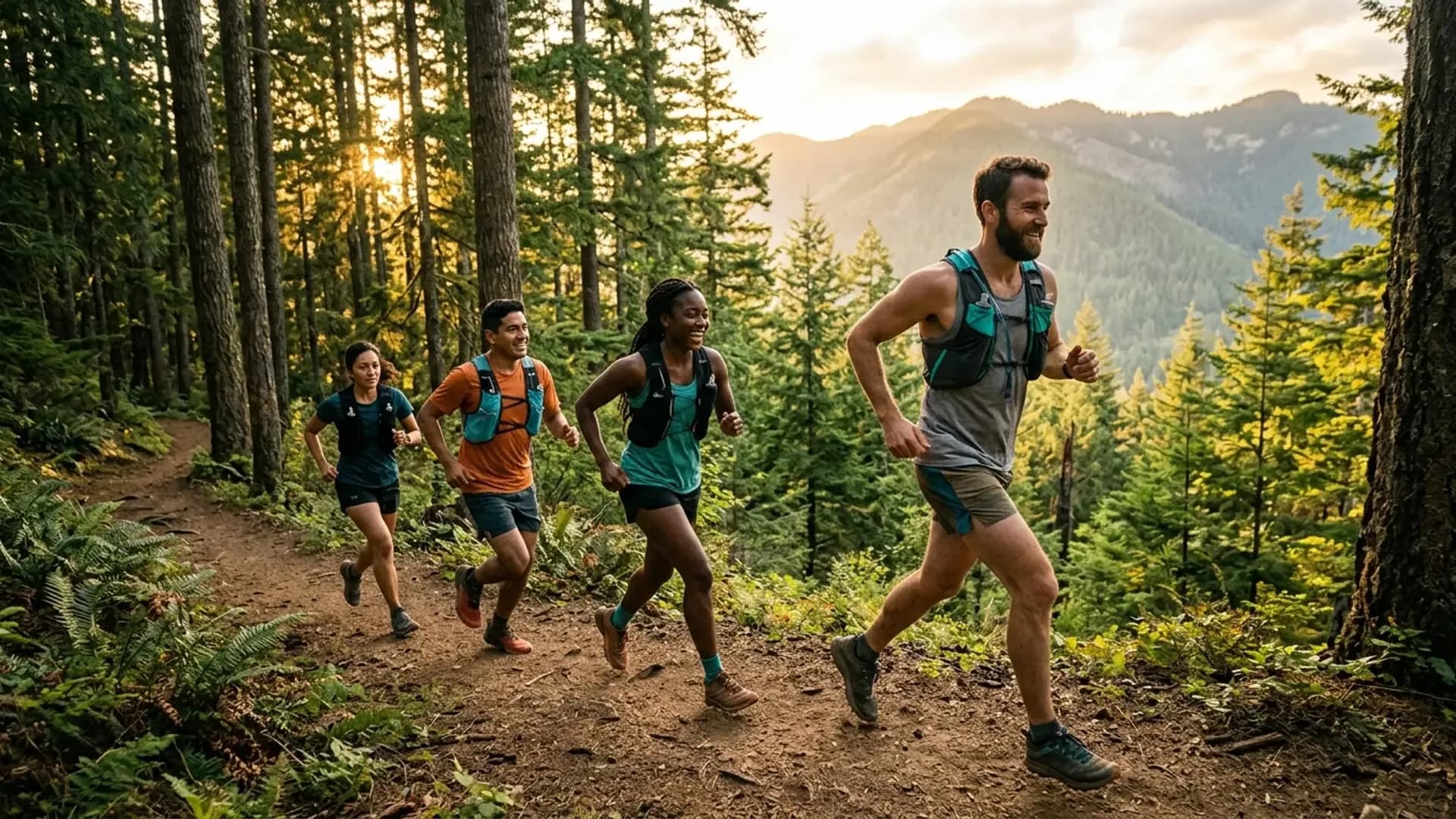
Road run clubs got the press in 2024. Saturday morning 5Ks, coffee shops crammed with sweaty 27-year-olds, the whole "run club is the new dating app" media cycle. But the more interesting movement happened uphill, off pavement, in places where most run clubs never go.
In 2024, the US added 1.3 million new trail runners — bringing the total to 16.1 million, according to the Outdoor Industry Association's 2025 Trail Running Topline Report. That's an 8.8% jump in a single year. For context, overall running grew 0.5% in the same window. Trail running is growing roughly eight times faster than road running. If you've spent a year trying to meet people through dating apps and given up — or you've walked into a road run club and felt like everyone already knew each other — the trail crew is probably what you're actually looking for.
And here's what most articles miss: the social dynamic on trails is structurally different from a Sunday morning 5K. Slower pace. Longer time together. Forced conversation on technical climbs. Post-run breakfasts that turn into Sunday afternoon hangouts. If you've been trying to meet people through running and the road scene feels too fast or too cliquey, the trail crew is probably what you're actually looking for.
This guide covers exactly how to find one — five platforms, eight of the best US trail running cities, and what to expect when you show up to your first meetup.
Why Trail Running Is the Most Social Fitness Trend of 2026
Trail running used to feel like a niche endurance sport — something ultrarunners did in Colorado at 6,000 feet. That image is officially out of date.
Three forces converged in 2024–2025. First, the post-pandemic move outdoors never really reversed: the National Park Service logged 331.9 million recreation visits in 2024, a record. Second, the road run club explosion created a generation comfortable showing up to fitness as a social activity, not a solo grind. Third, Strava reported 59% growth in global run club membership in its 2024 Year in Sport report, and a lot of that overflow ended up looking for something quieter than the Saturday morning bridge run.
Trail running absorbed all of it. Trail Sisters, the women-focused trail running community, now has more than 100 local chapters across the US. Long-running road clubs have started spinning up "trail night" subgroups. New formats keep appearing: weekday evening trail meetups in city parks, all-paces "no-drop" group runs, post-run breakfast clubs that are arguably more about the breakfast.
Why Trail Running Builds Friendships Faster Than Road Running
Anyone who's tried both will tell you they feel completely different socially. The reasons are mostly structural:
- Slower average pace. Trails force you to slow down on climbs, watch your footing on descents, and walk anything technical. That alone makes conversation possible. A 9-minute road mile is a wall of breathing; a 13-minute trail mile is two people actually talking.
- Longer time together. A typical road club run is 45 minutes. A typical trail meetup is 90 minutes to two hours, plus driving to and from the trailhead. You end up spending three times as much time with the same people.
- Shared discomfort builds trust. A 1,200-foot climb in 80°F humidity is a bonding event. There's a reason wilderness therapy programs exist. Mild Type 2 fun — the kind of suffering you laugh about later — on a Saturday morning does a lot of the same work.
- No-drop culture is the norm. Most trail running groups operate on a "regroup at the top" or "no one left behind" model, in part because the terrain demands it. That removes the pace anxiety that keeps newer runners away from road clubs.
- The post-run hang is non-negotiable. Trail crews almost always go to breakfast. You drove 30 minutes to the trailhead together. Nobody's sprinting to their car after.
If you've read our piece on why run clubs are replacing dating apps, everything in that argument applies double on trails. Repeated, low-pressure exposure plus shared challenge is one of the most well-documented friendship-formation patterns in social psychology.
5 Ways to Find Trail Running Meetups Near You
There's no single national directory of trail running groups — the scene is hyperlocal by nature. These are the five places that actually work, ranked roughly by hit rate.
1. Strava Clubs
Open Strava's Clubs search, filter by Running, and search your city. Most active local trail groups now post their weekly schedule, route GPX files, and meet-up locations directly in Strava's club feed. You don't need a paid Strava account to join. This is the highest-signal first stop in 2026 — if a trail group exists in your city, it almost certainly has a Strava club.
2. Trail Sisters Local Chapters
If you identify as a woman or non-binary, Trail Sisters runs more than 100 volunteer-led chapters across the US. The format is intentionally welcoming: no-drop pace, all abilities, group runs followed by breakfast or coffee. For first-time trail runners and anyone who's found road clubs intimidating, this is consistently the easiest way in. If you don't fit the women/non-binary description, every other platform on this list is co-ed by default — Strava clubs, Meetup, REI events, and AllTrails groups all skew about evenly.
3. Meetup
Meetup feels like a 2010s platform but it's still where many trail-specific groups list public events, especially outside the major running cities. Search "trail running" plus your metro area. Look for groups with recent events (within the last 30 days) and at least 3–4 RSVPs per run — those are the ones that actually meet.
4. REI Co-op Events and Local Running Stores
Most REI stores host monthly group trail runs led by staff or partner groups, free and open to the public. Independent specialty running stores — Fleet Feet, Road Runner Sports, your local indie — often host weekday trail nights too. These tend to be the most beginner-friendly entry points because the staff are paid to make new people feel welcome.
5. AllTrails and Instagram Hashtags
Less obvious, but useful for finding the unofficial scene: search AllTrails reviews on the most popular trails in your area for mentions of "group run" or "Tuesday night." Cross-reference with Instagram hashtags like #yourcityrunning or #yourcitytrails. The most active local trail crews almost always have an Instagram presence even when they don't advertise on traditional platforms.
8 Best US Cities for Trail Running Communities
Some cities just have it — proximity to good dirt, year-round running weather, and a critical mass of people who organize their week around weekend long runs. If you're relocating, traveling, or trying to figure out where the trail running scene is most welcoming to newcomers, start here.
Boulder, Colorado
The default answer. Boulder has more than 200 miles of trails accessible from town, multiple weekly group runs (Chautauqua trailhead is the unofficial hub), and a deep elite-runner scene that filters down into welcoming community runs. The altitude is real, but the culture compensates: most groups expect you to walk the steep parts, regardless of who you are.
Bend, Oregon
In Bend you can be on a trail within ten minutes from almost any neighborhood. The Bend Trail Series runs monthly Thursday-evening races from April through July — small, social, and one of the easiest ways to plug into the local scene without committing to a full club. Phil's Trail Complex is the social heart of the city.
Asheville, North Carolina
The Blue Ridge Mountains do most of the work. Bent Creek Experimental Forest alone has enough trail mileage to support multiple weekly group runs, and the city's trail running culture is noticeably less competitive than the western mountain towns. If you're intimidated by Boulder, Asheville is the same idea at sea level with more humidity and friendlier strangers.
San Francisco Bay Area
Marin Headlands is the standout — Tennessee Valley, Rodeo Beach, the Coastal Trail. The Bay Area trail scene runs across multiple disconnected pockets (Marin, the Peninsula, the East Bay regional parks), so it pays to find a group that's based near where you actually live. The Dipsea, Quad Dipsea, and the Marin Ultra series anchor the racing calendar and most local groups orient around them.
Denver and the Front Range
Denver itself is flatter than its reputation, but the Front Range corridor — Golden, Boulder, Lookout Mountain, North Table — is dense with weekly trail meetups. Our guide to hiking trails for meeting people covers some of the same geography from a slower angle. The trail running scene here skews fast but is more accessible than Boulder proper.
Seattle and Portland
Wet, green, and surprisingly social. Discovery Park and Cougar Mountain anchor the Seattle scene; Forest Park (the largest urban forest in the US) is the Portland equivalent. Both cities have strong all-weather running cultures — if you can run trails in November rain, you can run trails anywhere — and the local groups tend to be tight-knit because nobody else is showing up to a 6 a.m. trail run in 38°F drizzle.
Los Angeles
Los Angeles surprises people. Griffith Park, Eaton Canyon, the Verdugos, and the Santa Monica Mountains add up to a serious urban trail network. The LA scene is split between the road-heavy clubs we covered in our guide to the best run clubs in Los Angeles and a smaller but growing trail-specific subculture, mostly centered on weekend long runs in the Santa Monicas. Show up to a trail meetup and you'll meet people you'd never run into at a Venice Beach 5K.
New York City and the Hudson Valley
East Coast trail running is denser than its reputation suggests. Van Cortlandt Park in the Bronx — the historic home of US cross-country since 1913 — anchors the city scene year-round. The Palisades across the Hudson, Bear Mountain, and the Catskills all sit within a 90-minute drive of Manhattan. Active groups include Brooklyn Trail Club (run by Brooklyn Track Club), Trailish (a newcomer-friendly series with Hudson Valley access), and Asian Trail Mix. Weekday evenings happen in city parks; weekend long runs head north. The scene is smaller than NYC's road club explosion but tends to be more durable — people stay for years.
Your First Trail Running Meetup: What to Expect
The biggest psychological barrier to showing up to a new group is the fear of being the slowest, the most undertrained, or the one in the wrong shoes. A few realistic expectations:
- Pace is almost always slower than you think. Most "easy" group trail runs land between 11:00 and 14:00 minutes per mile depending on terrain. If you can run-walk a flat 5K in under 45 minutes, you can keep up with the back of the pack on most no-drop trail group runs.
- You don't need trail-specific shoes for a flat dirt path. For your first few outings on non-technical trails, road shoes are fine. If the group is meeting at something steep or rocky, look up the route and decide based on that.
- Bring water, even on short runs. Trail miles take longer than road miles and you'll be out longer than you think. A handheld water bottle is enough for under 60 minutes; a small vest is the standard for longer.
- Show up 10 minutes early. There's usually a brief intro circle — names, paces, route. Walking up mid-circle is the most common rookie mistake.
- Stay for the post-run breakfast. This is where the group becomes a group. Skip it the first time and you'll show up to the second run feeling like a stranger again.
From Trail Crew to Real Friendships
Here's the thing nobody puts in the brochure: the dating app industry has spent a decade trying to algorithmically reproduce the conditions that a Saturday morning trail run produces for free. Repeated low-pressure contact. Shared physical challenge. A natural reason to keep showing up. The mere-exposure effect (Zajonc, 1968) — the finding that repeated exposure to a person increases liking — explains part of it. The other part is closer to Arthur Aron's self-expansion research: shared novel and slightly arousing experiences accelerate closeness in a way that ordinary conversation doesn't. A trail run delivers both at the same time.
It's why a lot of people are quietly shifting their social energy from apps to activities. We covered this from a different angle in our piece on why men are leaving dating apps — but the underlying pattern is the same on the women's side, and it's the same on the friendship side. The trail crew you run with for six months ends up knowing you in a way most app conversations never get to.
If the trail meetups in your area look thin — or if you want a way to find people who specifically want to do outdoor activities together, not just match and disappear — GRASS is built around exactly this: people use it to host and join real outdoor activities, not to swipe. It works as a complement to the trail group scene, especially in cities where trail running culture is still emerging.
FAQ
How fit do I need to be to join a trail running group?
Most "no-drop" or "all-paces" groups assume you can comfortably run-walk a flat 5K. Trails slow everyone down — the pace at the back of a group trail run is typically much closer to a brisk hike than a road run. If you can keep up on hilly walking, you can keep up.
Are trail running groups beginner-friendly?
The trail scene is generally more beginner-friendly than the road scene because the terrain forces everyone to slow down. Trail Sisters, REI store events, and any group that explicitly labels itself "no-drop" or "all-paces" are the safest first stops. Avoid anything that lists a specific target pace in the description for your first outing.
Do I need trail running shoes to start?
Not for your first few runs on flat or moderately graded dirt paths. Road shoes work fine on packed singletrack and most urban park trails. If your group meets somewhere with rocks, roots, or significant elevation, look at the route description first — that's when you'll want trail-specific shoes with more aggressive lugs.
Is it weird to go to a trail running meetup alone?
Almost everyone shows up alone the first time. Group trail runs are structurally designed for it: there's a pre-run intro circle, a shared route that forces conversation, and a post-run breakfast that gives you a low-stakes way to keep talking. You'll likely leave the first run with two or three new contacts — and by the third run, those contacts start becoming actual friends.
Do people actually meet romantic partners in trail running groups?
Yes — and they meet them in a structurally different way than apps. The friendships come first. The routine is weekly or biweekly. The pool is small and you actually get to know who someone is before any romantic question shows up. It's slower than swiping, and that's most of the appeal — by the time something romantic happens, you're past the introduction stage that apps make you repeat indefinitely.
What if there's no trail running group in my area?
You have two real options. The first is to start one — Strava makes club creation free, and most successful trail groups started with one person posting a Saturday morning route. The second is to post a one-off run on an activity-based meetup app like GRASS, where people opt in to the specific activity instead of committing to a recurring club. The first builds a community over time; the second works this weekend.
If you want more on this from a different angle, our pieces on the best hiking trails for meeting people and why run clubs are replacing dating apps both cover adjacent ground. Trail running is, in a way, the slow version of the road running social trend — and the version that's most likely to leave you with friends still around three years from now.