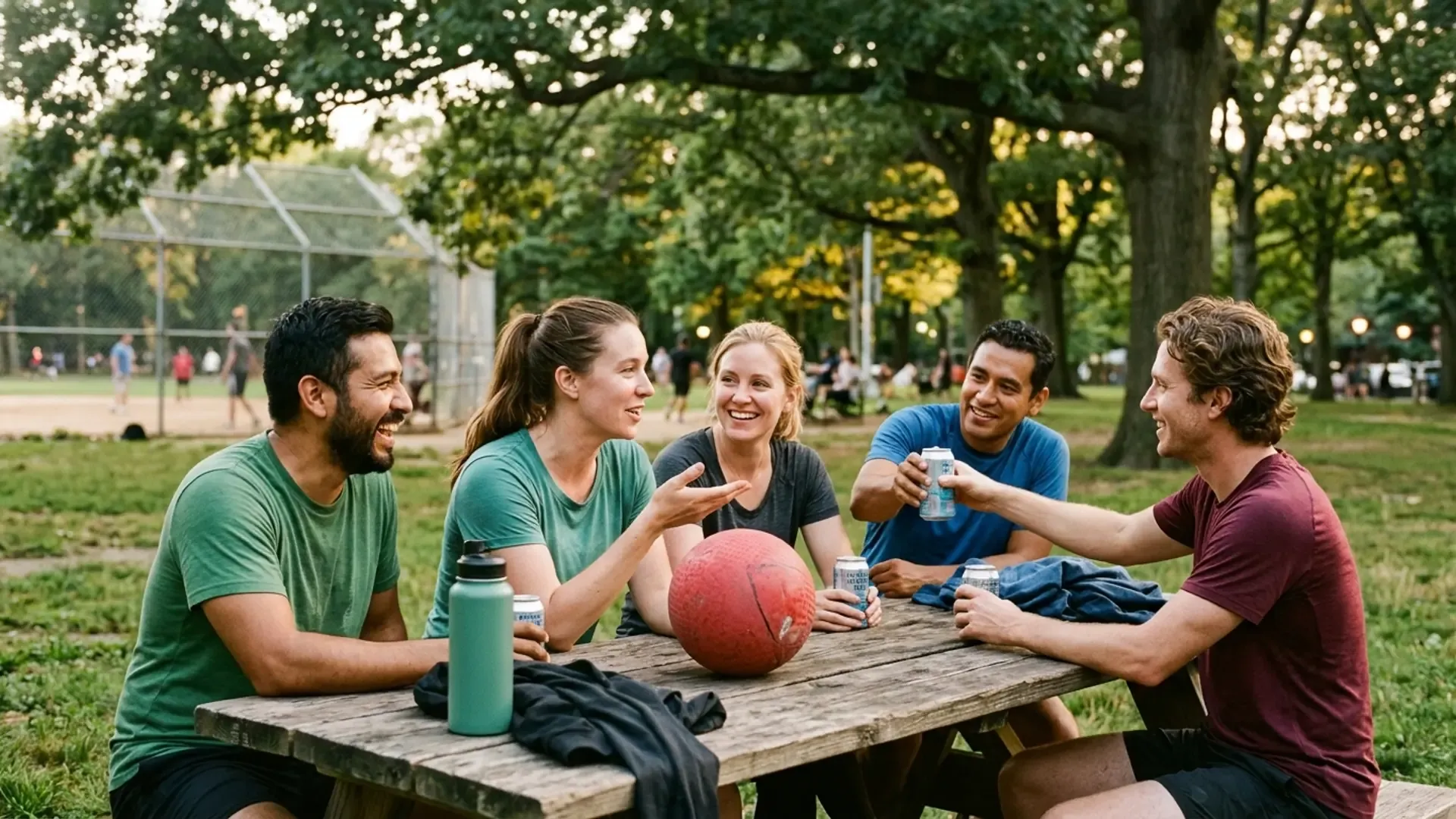
To make friends as an adult, pick one weekly activity where the same people show up, and keep going. Within two to three months you will be on first-name terms and can invite someone to something outside it. Getting to roughly 50 hours together, the point where acquaintances start to become casual friends, takes about 6 months at the fastest weekly settings and a year or more at slower ones, and less if you add a second setting.
If you moved for a job, or your friends' calendars quietly filled up, you've probably noticed it got harder after school. That isn't a personality flaw. School handed you the right conditions for free, and adult life took them away. Below, we score 12 common places to meet people on those conditions, estimate how long each takes, and turn it into a 10-week plan.
Why Is Making Friends as an Adult So Hard?
Sociologist Rebecca G. Adams of the University of North Carolina at Greensboro has described three conditions that make close friendships form: proximity, repeated, unplanned interactions, and a setting that encourages people to let their guard down (quoted in a 2012 New York Times piece, "Friends of a Certain Age"). In plain terms: being near each other, running into each other without planning it, and somewhere relaxed enough to open up. A dorm hits all three without anyone trying. Work, a commute, and plans booked two weeks ahead hit almost none.
If this feels hard, it is hard, and it is common. In the Survey Center on American Life's 2021 survey, 12% of Americans said they have no close friends, compared with 3% in a 1990 poll (the two used different survey methods). In a 2024 Gallup poll, 20% of U.S. adults said they felt lonely a lot of the previous day.
The useful part of Adams's list is that it tells you what to look for. You don't need a more exciting social life. You need the same faces, time that isn't scheduled down to the minute, and a reason to talk.
How Many Hours Does It Take to Make a Friend?
Communication researcher Jeffrey Hall at the University of Kansas estimated in 2018 that it takes about 50 hours together to go from acquaintance to casual friend, about 90 hours to become a friend, and more than 200 hours to become a close friend. We cover how that study worked and what counts as an "hour" in The 50-Hour Friendship Rule.
For planning, the takeaway is simple: divide 50 by the hours per month you actually spend talking with the same people. That gives you a rough timeline, and it explains why a monthly book club can feel friendly for two years without producing a friend you would call on a bad day.
Where to Make Friends as an Adult: 12 Places, Scored
Short version: outside of work, weekly volunteer shifts, rec sports teams, and recurring hobby groups reach 50 hours fastest; one-off mixers and one-night apps rarely get there. The first two columns follow Adams's conditions. "Social hours" means time actually talking or doing something with the same people, not time in the building. The hours and months are our estimates for a typical week, not measured data, so use them to compare options and adjust for your own schedule.
Setting | Same people, repeated unplanned contact? | Relaxed enough to open up? | Social hours / month (our est.) | Months to ~50 hours (our est.) | The catch |
|---|---|---|---|---|---|
Coworkers (your own team) | Yes | Depends on the office | ~10 | ~5 | Ends when a job does |
Weekly volunteer shift | Yes | Yes, during slow stretches | ~8 | ~6 | Pick a shift with downtime, not a solo task |
Rec sports team + drinks after | Yes, same team all season | Yes, after the game | ~6 | ~8 | Seasons run several weeks and cost money; re-register with the same team |
Climbing gym on class or league nights | Often, if you go the same nights | Yes, between climbs | ~6 | ~8 | Drop-in sessions are quieter; many climbers wear headphones |
Recurring hobby group (e.g., a weekly Meetup group) | Yes | Usually | ~6 | ~8 | Only if the group meets weekly, not monthly |
Dog park, same time most days | Yes | Short and shallow | ~6 | ~8 | Talk rarely goes past the dogs without an invite |
Multi-week class (pottery, improv) | Yes, for one session | Some | ~5 | ~10 | Only if you re-enroll with the same people |
Weekly run club with coffee after | Yes | Yes, at coffee and easy pace | ~4 | ~12 | Skip the coffee and it drops to near zero |
Faith community + coffee hour | Yes | Yes | ~4 | ~12 | Join a small group, not just the service |
Monthly book club | Yes | Yes | ~2 | ~24 | Pleasant, but slow |
1:1 friend-matching and one-night dinner apps (e.g., Bumble For Friends, Timeleft) | No, new people each time | Yes, one-on-one | ~2 with each new person | ~24+ | Starts at zero unless you set a repeat plan |
One-off mixers and event nights | No, new people each time | Yes | ~1 with each new person | 50+ | Good for meeting, bad for compounding |
A few things jump out. First, settings with a built-in "after" win: the drink after the game or the coffee after the run is where most of the talking happens. Second, anything that resets to new people every time never compounds, whether it is a mixer, a one-night dinner, or a one-on-one app match that never becomes a second meeting. Third, apps and classes work when you turn them into something recurring. "Same time next week?" does more than a great first conversation.
A 10-Week Plan to Make Friends as an Adult
- Weeks 1–2: Pick one setting with a built-in "after." Choose by schedule, not excitement. The one you can make every week beats the one you would love but can only make twice a month.
- Weeks 3–5: Show up at the same time, every time. Learn three names. Arrive five minutes early and stay ten minutes late, because that is when unplanned conversation happens. Expect it to feel awkward; research on the liking gap (Boothby, Cooney, Sandstrom and Clark, 2018) found people consistently underestimate how much their conversation partners liked them.
- Weeks 6–8: Join the "after," then make one invite outside it. If a few people grab food after, go. If nobody does, suggest it once: "A few of us getting tacos after, want to come?" Then invite one person to something low-key and tied to what you already do together, like a Saturday trail run or a pottery open studio.
- Weeks 9–10: Add a second setting if you can. Ideally one where you can bring someone from the first. Overlapping circles stack hours without taking more of your week.
A realistic finish line: by week 10 you will be maybe 10 to 15 hours in, about a quarter of the way to 50. What you have is a few people who know your name and one person who has said yes to an invite. That is the real win for the first ten weeks. Keep going and the hours pile up.
If a group has no "after" and nobody has talked to you beyond hello by week six, it is fine to switch. Some groups just aren't social, and that is not about you.
What to say when you don't know what to say
- First weeks: "Are you here every Tuesday?" Simple, and it signals you plan to come back.
- After a few weeks: "How did your race go?" Remembering one detail from last time does more than any opener.
- The first invite: "I'm doing the longer loop Saturday morning, want to join?" A specific plan is easier to say yes to than "we should hang out sometime."
- If they say no: "No worries, maybe next time." Then actually ask again in a few weeks. One no usually means a busy week, not a verdict.
How to Make Friends in Your 30s or After Moving to a New City
Your 30s add two problems: less free time and friends whose schedules fill up fast. The fix is the same structure with tighter priorities. Pick settings that also do something you already need, like exercise, a skill, or a cause, so friendship time is not competing with everything else. If your friends have kids, a standing weekend-morning plan (a 7am run, an early hike) often works better than evenings. After a move, the first two months matter most: say yes to more than feels natural, because every recurring setting you join early keeps paying off.
Proximity matters more than people expect. In a 2008 Psychological Science study by Back, Schmukle and Egloff, college freshmen were assigned seats at random at their first session, and a year later the students who happened to sit next to each other rated their friendships as closer. Small, accidental closeness adds up. When you choose between two similar groups, choose the one closer to home. You will go more often.
What If There's No Group That Fits Your Schedule?
Then start a small one. It sounds like more work, but the host has an advantage: everyone who comes meets you, and a standing plan means you see the same people over and over. Keep it simple. Same day, same time, same place, a low bar ("easy 3 miles, all paces"), and a reminder the day before. Invite one person you already know to the first one so it never starts at zero. Expect two people the first week. Two people every week for three months is a real start.
This is where GRASS fits. GRASS is our app, and its focus is recurring group plans: you can join a plan near you or post your own, like "Sunday 9am, 3 miles around the reservoir, coffee after." No swiping, no profile to polish, just a time, a place, and a plan. We are still early in the U.S., so in many areas you may be the one posting the first plan. Some people you meet this way become dates, too, and the same structure works for that. GRASS is free to download, with optional Premium and Ultimate tiers.
FAQ: Making Friends as an Adult
Why is it so hard to make friends as an adult?
Because adult life removes the conditions friendships need. Sociologist Rebecca Adams describes three: being near each other, repeated unplanned contact, and a setting relaxed enough to open up. School provides all three by default; most adult schedules provide none, so you have to rebuild them on purpose.
Where is the best place to make friends as an adult?
Somewhere you can attend every week where the same people show up and there is time to talk: a volunteer shift, a rec sports team, a climbing gym on regular nights, a weekly hobby group, or a run club with coffee after. Recurring beats exciting.
How long does it take to make friends as an adult?
Jeffrey Hall's 2018 research estimated about 50 hours together to become casual friends, about 90 hours to become friends, and more than 200 hours to become close friends. At one weekly activity, our estimates put 50 hours at roughly 6 months at the fastest settings and up to 2 years at slower ones. Adding a second setting or time together outside the activity shortens it.
How do I make friends in my 30s when everyone is busy?
Join settings that also do something you already need, like exercise, so friendship time does not compete with the rest of your week. Then make small, specific invites. Busy people tend to say yes to concrete plans more easily than to "let's hang out sometime."
How do I make friends if I work from home?
You lose the coworker row, the fastest one in our table, so you need to replace it on purpose. Two recurring settings per week, such as a weekday volunteer shift and a weekend sports team or run club, get you to roughly 12 to 14 social hours a month, or about 4 months to 50 hours by our estimates.
Do friend-finding apps work?
They can, if you turn a good first meeting into a standing plan. One-on-one matches and one-night dinners restart at zero each time, so the hours never add up. The app is the introduction; the recurring plan is what makes the friend.
Start With One Recurring Thing This Week
Pick the row in the table that fits your week and put the next three sessions on your calendar before you talk yourself out of it. If nothing near you fits, post your first plan on GRASS and bring one friend along to the first one.
Related reading:
- The 50-Hour Friendship Rule, how the hours research works
- The Psychology of Making Friends, why some connections click
- The Gen Z Friendship Revolution, why the most connected generation feels lonely
- How to Find a Run Club Near You, one of the easiest recurring settings to start with