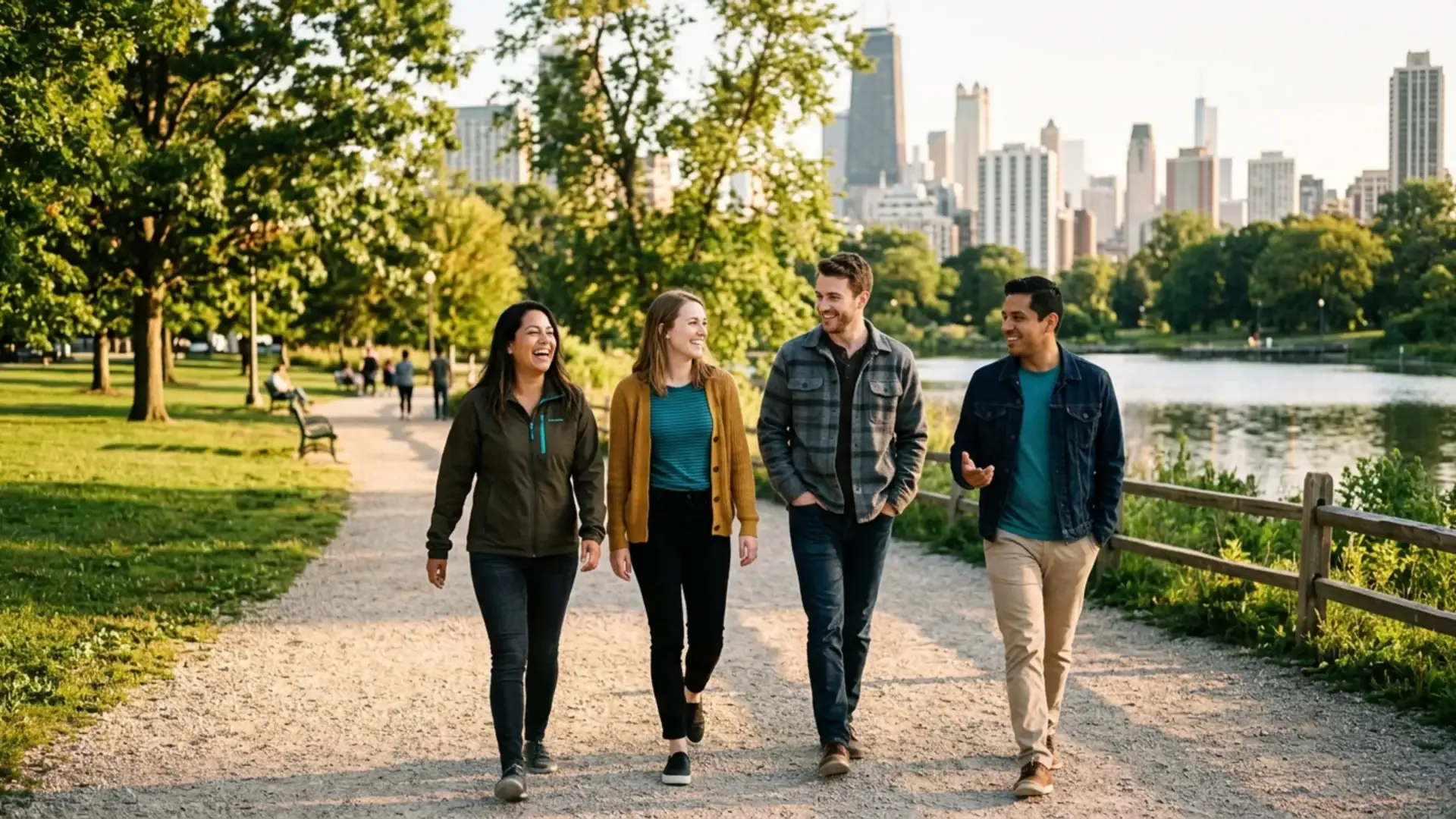
Which US Cities Are Best for Outdoorsy Singles?
On the numbers: Washington, DC, San Francisco and Minneapolis, followed by Cincinnati and Boston. We ranked 86 large US cities on two public measures. The first is how good the city's park system is, using Trust for Public Land's ParkScore 2026. The second is how many of its residents aged 25 to 34 have never been married, using the Census Bureau's 2024 American Community Survey. The 12 cities with the highest combined score are below, along with exactly how we got there.
It's a strangely overlooked question. Rankings of the best cities for singles are everywhere, and so are rankings of the best cities for people who love the outdoors. Almost nobody puts the two together, which is the whole point if you're someone who wants both: a city where you can be outside after work, and where plenty of the people you'd meet out there are single.
The result isn't the list you'd guess. The mountain towns people usually name for this are missing, for a reason we'll explain, and four Great Lakes cities (Chicago, Milwaukee, Buffalo and Cleveland) made the top 12, two of them largely on the strength of their singles numbers.
How We Built This List
Two public numbers, one for each half of the question. Neither is ours, and both are free to check.
- The outdoors half: Trust for Public Land's ParkScore 2026, released May 20, 2026. TPL describes it as covering the 100 most populous US cities, though its 2026 data lists 99. It grades the public parkland inside each city on five things: acreage, investment, amenities, access and equity. Its access measure is the share of residents who live within a 10-minute walk of a park with public access.
- The singles half: the share of residents aged 25 to 34 who have never been married, from the Census Bureau's 2024 American Community Survey one-year estimates (table B12002), matched as closely as census boundaries allow to the area ParkScore grades. We picked 25 to 34 because it brackets the typical first wedding: the Census Bureau puts the median age at first marriage at 30.8 for men and 28.4 for women in 2025, both inside that range.
We turned each number into a percentile among the same cities and averaged the two, weighted equally. Within the top 12, three pairs of cities tied on that average: Cincinnati and Boston, St. Paul and Portland, and Denver and Cleveland. In each pair, the city with the higher ParkScore goes first.
A second run: we ranked the cities again using only ParkScore's walking-access measure instead of its overall grade, to see whether the top of the list held. Eight of the 12 cities stayed. Cincinnati, St. Paul, Portland and Denver dropped out, and Seattle, New York, Baltimore and Detroit came in. All four of the cities that dropped score better on ParkScore's overall grade than on walking access alone, and the top three stayed in the top six either way.
Both numbers are matched to the same area on purpose. ParkScore grades the parkland inside a city, so the singles number has to describe the same place. Pair it with metro-area census data instead and you're comparing a city's parks with its suburbs' residents, which produces a tidy-looking ranking of nothing in particular.
One more gap. The Census Bureau doesn't publish this particular table in its one-year estimates for 13 of the cities ParkScore grades, including Irvine, California, which has the second-best park system in the country. We could have filled those in from the older five-year survey, but that would mean ranking cities on data from different years, so we left them out. That leaves 86 cities.
Five limits are worth knowing before you read the list:
- Never married is not the same as single. It counts people in long relationships who haven't married, and it leaves out anyone divorced. The census publishes it consistently for most large cities, but it isn't a count of who is available. And it's a survey estimate, so cities within a point or two of each other, like San Francisco and Buffalo, shouldn't be read as meaningfully different.
- Some of it is who moves where. Cities full of college students and people in their first jobs have more never-married 25-to-34-year-olds partly because that's who they attract. A high share can also reflect who has left a city, and the census number can't tell those two stories apart. Either way it's a real pool of people, but it isn't a measure of how easy dating is.
- It counts men and women together. The balance between the two differs from city to city, and it matters if you're looking for someone of a different gender than you. We didn't try to untangle that here.
- Parks are not mountains. ParkScore grades the public parkland inside a city's limits, whoever manages it, not the national forest an hour away. A city with an excellent park system and no peaks in sight can outscore one that sits at the foot of a range.
- Big cities only. ParkScore covers only the country's largest cities, which is why some towns you'd expect to see are missing. More on that below.
The Top 12 US Cities for Outdoorsy Singles
Each city shows its national ParkScore 2026 rank, the share of residents who live within a 10-minute walk of a park, and the share of 25-to-34-year-olds who have never married. Each city's ParkScore links to its official report.
# | City | ParkScore 2026 | 10-min walk to a park | Never married, 25–34 |
|---|---|---|---|---|
1 | Washington, DC | No. 1 (85.1) | 99.2% | 77.6% |
2 | San Francisco, CA | No. 6 (80.0) | 99.9% | 75.6% |
3 | Minneapolis, MN | No. 3 (83.4) | 99.0% | 71.6% |
4 | Cincinnati, OH | No. 5 (81.2) | 90.9% | 72.2% |
5 | Boston, MA | No. 12 (71.9) | 99.7% | 74.8% |
6 | Chicago, IL | No. 10 (74.3) | 98.2% | 73.3% |
7 | Milwaukee, WI | No. 14 (68.8) | 95.6% | 74.6% |
8 | Buffalo, NY | No. 22 (66.1) | 90.6% | 75.6% |
9 | St. Paul, MN | No. 4 (83.2) | 98.8% | 70.0% |
10 | Portland, OR | No. 9 (75.1) | 89.5% | 71.2% |
11 | Denver, CO | No. 11 (73.5) | 96.3% | 71.3% |
12 | Cleveland, OH | No. 31 (61.8) | 88.1% | 78.1% |
1. Washington, DC
ParkScore No. 1 (85.1) · 99.2% of residents within a 10-minute walk of a park · 77.6% of 25-to-34-year-olds never married
DC is strong on both halves at once. It has the best-graded park system in the country, parkland covers 21.5% of the city, and its never-married share is the third-highest of the 86 cities we scored. One of its biggest parks is federal: Rock Creek Park, a 1,754-acre national park authorized in 1890, sits inside the city limits.
2. San Francisco, California
ParkScore No. 6 (80.0) · 99.9% of residents within a 10-minute walk of a park · 75.6% of 25-to-34-year-olds never married
San Francisco is close behind on both halves. Its park system is sixth nationally but fifth among the 86 cities we scored (Irvine, at No. 2, isn't in our pool), and its never-married share is among the highest of the 86. Effectively everyone in San Francisco lives within a short walk of a park, and parkland covers 21.4% of the city. One of the largest pieces is the Presidio, 1,491 acres that became a national park site in 1994.
3. Minneapolis, Minnesota
ParkScore No. 3 (83.4) · 99.0% of residents within a 10-minute walk of a park · 71.6% of 25-to-34-year-olds never married
Minneapolis and its twin, St. Paul (No. 9 below), together hold two of the country's four best-graded park systems. Parkland covers 15.6% of Minneapolis, and 99% of residents live within a 10-minute walk of a park. The singles half is solid rather than spectacular, which is why it lands third rather than first.
4. Cincinnati, Ohio
ParkScore No. 5 (81.2) · 90.9% of residents within a 10-minute walk of a park · 72.2% of 25-to-34-year-olds never married
The surprise near the top. Cincinnati's park system is graded fifth in the country, ahead of every West Coast city on this list, with 8,397 acres of parkland covering 17.1% of the city. Walking access is lower than most of the top 12, at 90.9%, which is exactly why it drops out when we rank by access alone.
5. Boston, Massachusetts
ParkScore No. 12 (71.9) · 99.7% of residents within a 10-minute walk of a park · 74.8% of 25-to-34-year-olds never married
Boston ranks only 12th on parks overall, but almost everyone lives within a 10-minute walk of one, and parkland covers 20.6% of the city, close to DC and San Francisco. The city's parks department describes the Olmsted-designed Emerald Necklace as a 1,100-acre chain of nine parks linked by parkways and waterways. Add a 74.8% never-married share, one of the ten highest of the 86 cities, and Boston ends up tied with Cincinnati.
6. Chicago, Illinois
ParkScore No. 10 (74.3) · 98.2% of residents within a 10-minute walk of a park · 73.3% of 25-to-34-year-olds never married
Chicago returned to ParkScore's top 10 this year, and it brings something no other city on this list comes close to: sheer numbers. Nearly 400,000 residents aged 25 to 34 have never married, more than three times the figure for any other city in this top 12. Parkland covers a smaller share of the city (9.1%) than most of the list, but 98.2% of residents live within a 10-minute walk of a park.
7. Milwaukee, Wisconsin
ParkScore No. 14 (68.8) · 95.6% of residents within a 10-minute walk of a park · 74.6% of 25-to-34-year-olds never married
Milwaukee is one of the most balanced cities on this list, strong on both halves without leading either. Its never-married share is among the ten highest of the 86 cities, its park system ranks 14th nationally, and 95.6% of residents live within a 10-minute walk of a park.
8. Buffalo, New York
ParkScore No. 22 (66.1) · 90.6% of residents within a 10-minute walk of a park · 75.6% of 25-to-34-year-olds never married
Buffalo is on this list mainly for its singles number. Its never-married share, 75.6%, is among the highest in this top 12, while its park system ranks 22nd. Part of that system is run in an unusual way: the Buffalo Olmsted Parks Conservancy describes itself as the first nonprofit in the country to manage and operate an entire historic urban park system — Buffalo's 850 acres of Olmsted parks, parkways and circles.
9. St. Paul, Minnesota
ParkScore No. 4 (83.2) · 98.8% of residents within a 10-minute walk of a park · 70.0% of 25-to-34-year-olds never married
On parks alone, St. Paul would be near the top: fourth in the country, with its parks department managing 186 parks and open spaces, more than 120 miles of trails and more than 17 miles of Mississippi riverfront. It ranks ninth here because its never-married share, 70.0%, is the lowest in this top 12.
10. Portland, Oregon
ParkScore No. 9 (75.1) · 89.5% of residents within a 10-minute walk of a park · 71.2% of 25-to-34-year-olds never married
Portland topped Bustle's 2016 list and still makes this one. Its biggest asset is sheer acreage: 13,015 acres of parkland, the most of any city in this top 12, including Forest Park, more than 5,200 acres of native northwest forest reachable from the urban core. Walking access is lower, at 89.5%, so Portland drops out when we rank by access alone.
11. Denver, Colorado
ParkScore No. 11 (73.5) · 96.3% of residents within a 10-minute walk of a park · 71.3% of 25-to-34-year-olds never married
Denver is the clearest example of what ParkScore does and doesn't measure. ParkScore credits the city with 7,547 acres of parkland. Denver's own mountain park system is 14,000 acres by itself and extends across three counties, so much of it isn't counted in that number. If mountains are the point for you, Denver is better than its place here suggests.
12. Cleveland, Ohio
ParkScore No. 31 (61.8) · 88.1% of residents within a 10-minute walk of a park · 78.1% of 25-to-34-year-olds never married
Cleveland is on this list for its people more than its parks. It has the highest never-married share in this top 12, 78.1%, second only to Detroit among all 86 cities, while parkland covers just 6.9% of the city itself. If you'd weight the outdoors half somewhat more heavily than we did, Cleveland is the city that falls off, and Seattle takes its place.
Just missed: Seattle, ParkScore No. 8 with 99.2% of residents near a park, came 13th, just over a point behind Denver and Cleveland on the index. Detroit has the highest never-married share of all 86 cities, 82.2%, but a ParkScore rank of 53 keeps it out of the top 12.
Why Aren't Boulder, Bend or Asheville on This List?
If you've read other lists on this subject, you probably expected Boulder, Bend or Asheville near the top. They aren't here, and that's a decision about method, not a verdict on the towns.
None of the three is anywhere near big enough to be graded, so none of them has a ParkScore. We could have added them using some other measure of the outdoors, but then the list would quietly be ranking two different things and presenting them as one. The list you're most likely to find on this exact question took a different route: Bustle's 2016 roundup was built on OkCupid user data from that era, and two of its ten cities, Montreal and Vancouver, aren't in the US.
If you're weighing a smaller town anyway, the two questions behind this ranking still apply. How easily can you be outside on an ordinary weekday without getting in a car? And how many people around your age are single there? A town can answer the first question beautifully and still leave you with a small pool on the second, simply because there are fewer people in it.
What If Your City Isn't on the List?
Plenty of people reading a list like this aren't planning to move. For them the order matters less than what the two numbers are actually measuring.
Park access is really a measure of the weekday. A park you can walk to is where the Tuesday-evening version of an outdoor life happens: the after-work loop, the pickup game, the run club that meets at the same corner every week. A trailhead an hour's drive away is a Saturday plan, and Saturday plans are the first to get canceled. The singles share tells you something different. It says how many people your age are single in your city, and nothing at all about where they are on a given evening.
Both numbers describe conditions. Neither of them introduces you to anyone. A city can score well on both, and you can still spend a year walking the same loop past the same people without ever speaking to them. What usually turns strangers into people you know is seeing the same faces again, doing the same thing, often enough that saying hello stops being strange.
That repetition is the part GRASS is built for. Its group activities put you alongside several people at once, around something you'd have done anyway, so the people you keep running into can add up without you setting out to collect them. Or go straight at it: post the hike, run or ride you're planning, where and when, and see who's in. A park map can tell you where to go. Telling you who else is going this Saturday is a different job, and there's a decent chance that's the job you actually need done.
Frequently Asked Questions
What is the best US city for outdoorsy singles?
On our index, Washington, DC. It has the best-graded park system in the country in Trust for Public Land's ParkScore 2026, 99.2% of its residents live within a 10-minute walk of a park, and 77.6% of its 25-to-34-year-olds have never married. San Francisco and Minneapolis come second and third.
Is Denver a good city for outdoorsy singles?
Yes, and better than its 11th place here suggests if mountains matter to you. ParkScore credits Denver with 7,547 acres of parkland, which leaves out much of the city's own 14,000-acre mountain park system. In the city itself, 96.3% of residents live within a 10-minute walk of a park and 71.3% of 25-to-34-year-olds have never married.
Which big US city has the highest share of never-married 25-to-34-year-olds?
By share, Detroit: 82.2% of residents aged 25 to 34 have never married, the highest of the 86 large cities we looked at, followed by Cleveland and Washington, DC. By raw numbers, the biggest cities have the most, led by New York. Detroit's park system ranks 53rd in ParkScore, which is why it isn't in our top 12.
Why aren't Boulder, Bend or Asheville on this list?
Because ParkScore, the park data behind this ranking, only covers the largest US cities, and none of those towns is big enough to be one of them. We chose not to mix in a different outdoors measure for smaller towns, since that would mean ranking cities on two different scales.
How was this ranking calculated?
We took two public measures for 86 large US cities: Trust for Public Land's ParkScore 2026 and the share of residents aged 25 to 34 who have never married, from the Census Bureau's 2024 American Community Survey. Each was converted to a percentile and the two were averaged 50/50, with ties broken by ParkScore. Both measures are matched to the same area of each city.
Before You Pick a City
Moving or not, the useful question isn't which city topped a list. It's whether you can be outside on a weeknight with people you'd like to see again. Check the park nearest your door, then find out who already uses it.
For the second half of that, whether or not you already have somebody in mind to go with, download GRASS and post the thing you were going to do anyway.
Related reading: the best hiking trails for meeting people in the US, why run clubs became the new place to meet someone, how to find a group ride near you, and building a social life around what you already do.