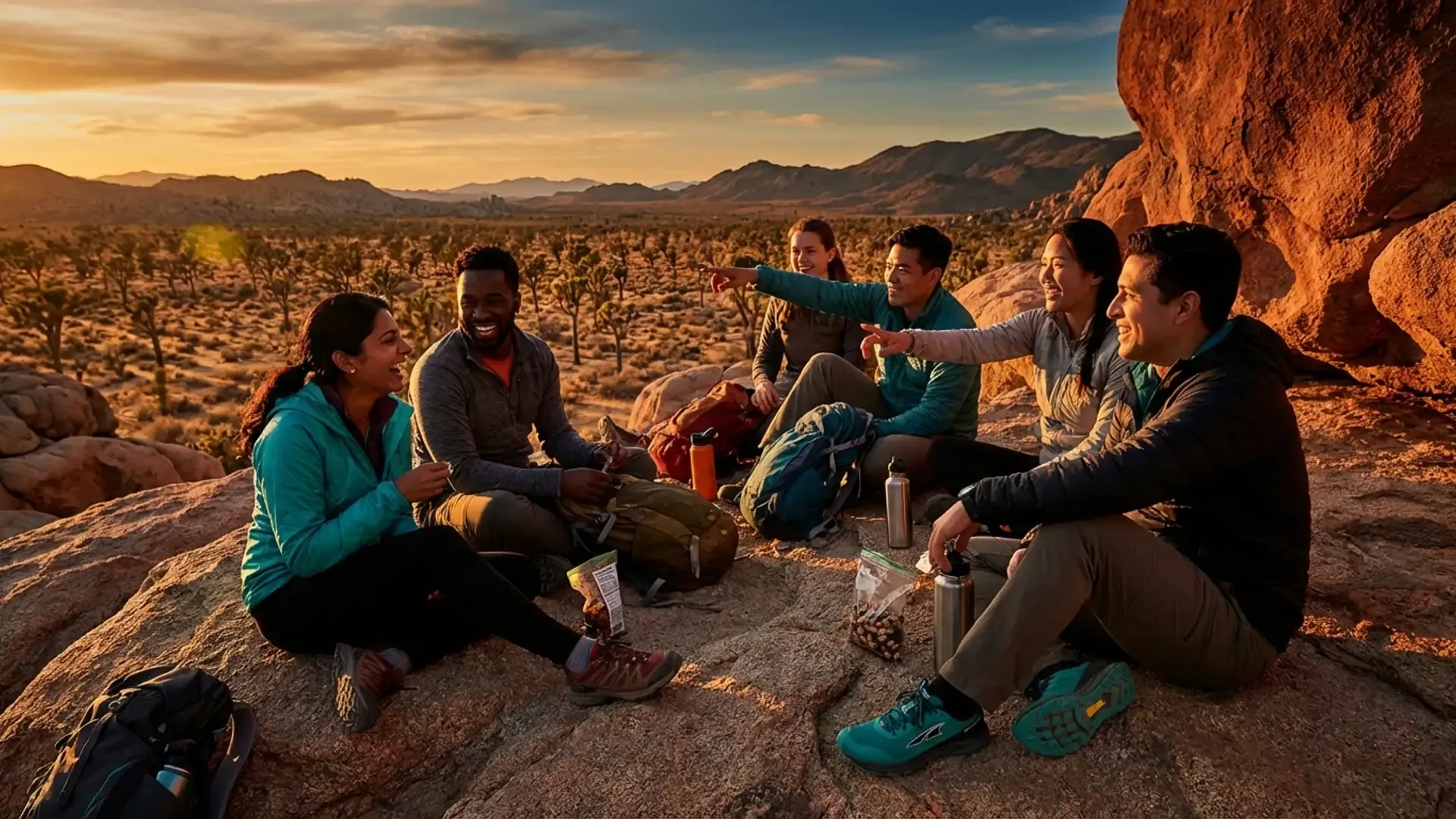
Why Do Some People Make Friends So Easily?
Science has a surprising answer: it’s not about personality — it’s about environment. Five decades of social psychology research point to one consistent finding: the depth of human connection depends far more on what you do together than what you say to each other. University of Kansas communication professor Jeffrey Hall found that it takes an average of 50 hours of shared time to move from acquaintance to friend, and 200 hours to become close friends (Hall, 2019, Journal of Social and Personal Relationships). And those hours accumulate fastest not in coffee shops or group chats — but in shared, goal-oriented activities.
What is the psychology of making friends? It’s the scientific study of how interpersonal bonds form, deepen, and sustain — spanning social psychology, behavioral economics, and neuroscience. This field explains why certain environments (like outdoor group activities) reliably produce deeper relationships than others (like dating app chat rooms). It’s not luck — it’s predictable, designable science.
This guide breaks down 7 research-backed psychological principles that explain why some environments naturally catalyze friendship — and why the modern dating app model works against nearly all of them.
The Paradox of Choice: Why More Options Lead to Fewer Connections
Before exploring what works, let’s understand what doesn’t. Columbia University psychologist Sheena Iyengar’s famous jam experiment showed that when consumers faced 24 options, only 3% made a purchase — but with just 6 options, the rate jumped to 30% (Iyengar & Lepper, 2000, Journal of Personality and Social Psychology).
Dating apps are this experiment at scale. With an endless stream of profiles, your brain enters decision fatigue mode — each swipe consumes cognitive resources until you’re not making better choices, you’re making no choices. A 2023 Pew Research Center survey found that 46% of U.S. dating app users say the experience feels exhausting.
Activity-based socializing naturally solves this. A hiking group has 8 people. A climbing class has 12. Your attention isn’t fragmented across thousands of thumbnails — it’s focused on the real humans right in front of you. That’s why people consistently report that connections made during shared activities feel more memorable and meaningful.
The Bridge Study: Why Your Heart Rate Determines Who You Like
In 1974, psychologists Donald Dutton and Arthur Aron ran what would become one of the most cited experiments in attraction research. Male participants crossed either a fear-inducing suspension bridge or a stable stone bridge, then encountered a female researcher. The result: men who crossed the scary bridge were significantly more likely to later contact the researcher (Dutton & Aron, 1974, Journal of Personality and Social Psychology).
The mechanism is called misattribution of arousal — your brain can’t easily distinguish between "my heart is racing because I’m afraid" and "my heart is racing because this person is attractive." So it defaults to the more flattering explanation.
For social connection, this means: people you meet during physically activating experiences automatically feel more interesting. Rock climbing, trail running, surfing, even watching a tense baseball game together — any activity that elevates your heart rate creates a neurological shortcut to attraction. Meanwhile, sitting across from someone at a coffee shop? Your cortisol (stress hormone) is up, but your adrenaline is barely above nap levels.
This is why platforms like GRASS deliberately design "do something exciting together" as the first step to meeting people — it’s not a coincidence, it’s psychology.
The bridge study has a more complicated afterlife than its fame suggests. For the original numbers, a 2012 reanalysis and what still holds up for dating, see our deep dive on the suspension bridge effect.
The Proximity Effect: Why Showing Up Beats Showing Off
Psychologist Robert Zajonc’s mere exposure effect (1968) is one of the most replicated findings in social psychology: people develop preferences for things they encounter repeatedly, even without meaningful interaction. A landmark MIT dormitory study found that students whose doors were physically closer were more likely to become friends — not because they were more compatible, simply because they bumped into each other more often.
Combined with Hall’s 50-hour rule, this reveals a counterintuitive truth: making friends isn’t about finding the right person — it’s about being in the right environment repeatedly.
This is why joining a weekly run club, a regular hiking group, or a recurring meetup is dramatically more effective than attending one-off events. You don’t need deep conversations every time — simply showing up in the same space with the same people week after week lets familiarity do the heavy lifting. Psychologists call this repeated unplanned interaction, and it’s the single strongest predictor of whether an acquaintance becomes a friend.
For a setting-by-setting look at which places actually give you that kind of repeated contact, see How to Make Friends as an Adult: 12 Places, Scored.
This is exactly why GRASS’s Group Adventure feature is designed around recurring weekly meetups — making the 50-hour accumulation happen as a natural byproduct of doing things you already enjoy.
The Shared Ordeal Effect: Why Adventure Builds Trust Faster Than Conversation
Arthur Aron (the bridge study researcher) went on to demonstrate that completing challenging tasks together accelerates intimacy far beyond what normal socializing achieves. His famous "36 Questions" experiment showed that structured, progressively deeper interactions can create meaningful closeness between strangers in under an hour (Aron et al., 1997).
The biology behind this is compelling: when you face a challenge with someone, your body simultaneously releases adrenaline (heightening alertness) and oxytocin (promoting bonding). This neurochemical cocktail creates a powerful combination — you don’t just like this person, you trust them.
Think about it: two people who’ve summited a mountain together versus two people who’ve shared a meal — which pair has stronger mutual trust? The answer is obvious. During the climb, they waited for each other at rest points, shared water, steadied each other on steep sections. Each small act of mutual support is interpreted by the brain as evidence that this person is trustworthy. Restaurants don’t offer this. Swipe apps certainly don’t.
💡 Want to experience the shared ordeal effect firsthand? GRASS offers weekly outdoor group activities — from easy riverside walks to challenging trail runs. Pick one that matches your pace and download free.
Group Dynamics: Why 8 People Is Better Than 2
Many assume one-on-one interaction is the most efficient path to connection. Research suggests otherwise.
Social Identity Theory (Tajfel & Turner, 1979) shows that being part of a group automatically generates in-group favorability — you view "your people" more positively than outsiders. A group hike of 8 people instantly creates a shared identity. The awkward "who are you?" phase that dominates one-on-one dates barely exists.
More importantly, group settings let you observe authentic behavior under low pressure. A one-on-one date is a performance — you only see what someone chooses to present. In a group, you see how they treat the slowest hiker, whether they help set up camp, how they handle an unexpected detour. Behavior is more honest than words, and groups create the conditions for behavior to speak.
This is fundamentally different from traditional matchmaking services or singles mixers. Traditional setups still center on "sit down and evaluate each other" — even in group formats, the implicit goal is one-on-one pairing, and the pressure never disappears. Activity-based group socializing flips the script: the activity is the point. You’re there to hike, to climb, to run. Meeting people is a welcome byproduct, not a high-stakes audition.
For Americans dealing with what sociologist Ray Oldenburg called the "death of third places" — the disappearance of informal social gathering spots — outdoor group activities are emerging as a powerful replacement. They’re open, inclusive, and don’t require purchasing anything to participate.
(Related: The Death of Third Places and the Rise of Outdoor Social Groups)
The Introvert Advantage: Why Quiet People Thrive in Outdoor Settings
If you’re introverted, the words "networking" and "socializing" probably trigger an involuntary wince. But as Susan Cain argued in Quiet: The Power of Introverts in a World That Can’t Stop Talking, introverts aren’t bad at socializing — they’re drained by the wrong kind of socializing.
Dating apps demand witty openers. Networking events demand 30-second elevator pitches. But outdoor activities operate on completely different rules:
- Actions replace words: Silently helping someone adjust their pack, pointing out a trail marker, sharing a snack — these gestures communicate more than any opening line
- Structure reduces anxiety: The activity itself provides a behavioral script ("Which trail next?" "Is this knot right?"), eliminating the dreaded blank-space-in-conversation
- Side-by-side beats face-to-face: Walking conversations are psychologically less confrontational than seated ones (what researchers call the "shoulder-to-shoulder effect"), and introverts excel at the deep, one-on-one dialogues that naturally occur on trails
Research published in the Journal of Research in Personality found that in structured activity settings, the gap in social satisfaction between introverts and extroverts nearly disappears — because the activity eliminates the unstructured "blank moments" that drain introverts most.
Putting It All Together: How One Outdoor Group Activity Triggers All 7 Principles
Here’s what’s remarkable: these 7 principles aren’t competing theories. A single well-designed group outdoor activity activates all of them simultaneously:
- Limited group size → bypasses the paradox of choice
- Physical exertion → triggers misattribution of arousal
- Weekly recurrence → proximity effect + 50-hour accumulation
- Shared challenges → the shared ordeal effect
- Group setting → group dynamics and in-group bonding
- Action-first, no small talk required → introvert-friendly
- Natural post-activity bonding → connection deepens over time
This is the foundational insight behind GRASS — an activity-first social app designed around the principle that doing things together beats talking about doing things. Your Outdoor Passport showcases the real you. Find Buddy lets you skip endless chatting and go straight to activities. Group Adventure creates low-pressure, multi-person meetups. Every feature maps back to at least one of these psychological principles.
Free on App Store and Google Play. Meet people the way humans were designed to — through shared experience. Let stories happen naturally.
The 7 Principles at a Glance
Principle 1: Paradox of Choice | Source: Iyengar & Lepper (2000) | Application: Limit options, focus attention | GRASS Feature: Small group meetups (6-10 people)
Principle 2: Misattribution of Arousal | Source: Dutton & Aron (1974) | Application: Meet people during heart-pumping activities | GRASS Feature: Climbing, trail running, surfing activities
Principle 3: Proximity Effect | Source: Zajonc (1968), Hall (2019) | Application: Repeated contact builds familiarity | GRASS Feature: Weekly recurring group events
Principle 4: Shared Ordeal Effect | Source: Aron et al. (1997) | Application: Face challenges together to build trust | GRASS Feature: Find Buddy — skip chatting, go straight to activities
Principle 5: Group Dynamics | Source: Tajfel & Turner (1979) | Application: Multi-person settings reduce pressure, reveal authentic behavior | GRASS Feature: Group Adventure (multi-person meetups)
Principle 6: Introvert Advantage | Source: Cain (2012), J. Research in Personality | Application: Actions over words, structure reduces anxiety | GRASS Feature: Outdoor Passport showcases the real you
Principle 7: All Together | One well-designed outdoor group activity triggers all six principles simultaneously
Frequently Asked Questions
What is the most important psychology principle for making friends?
The proximity effect combined with the 50-hour rule. Professor Jeffrey Hall’s research (2019) at the University of Kansas shows that friendship formation depends primarily on accumulated shared time: 50 hours to become casual friends, 200 hours for close friendship. This means that rather than searching for the "perfect" person, the most effective strategy is to create regular opportunities for repeated contact with the same group of people — like joining a weekly running club or hiking group.
Why is it so hard to make real friends on dating apps?
Two main psychological barriers: the paradox of choice and the absence of shared experiences. Dating apps present an overwhelming number of options, triggering decision fatigue and preventing meaningful investment in any single person. Even after matching, text-based conversations fail to activate the neurological mechanisms (adrenaline + oxytocin) that build trust. Research consistently shows that face-to-face shared activities create bonds several times stronger than online-only interactions.
Can introverts make friends through group activities?
Absolutely — in fact, structured group activities may be an introvert’s ideal social setting. Activities provide natural conversation topics (no forced small talk), let actions speak louder than words, and walking side-by-side is psychologically less draining than face-to-face conversation. Studies show that the social satisfaction gap between introverts and extroverts nearly vanishes in activity-based settings.
Is it weird to join a group activity alone?
Not at all — research on "openness signals" suggests that people who attend events solo are perceived as more approachable and open to connection. Most participants in running clubs, hiking groups, and outdoor meetups initially joined alone. Going solo actually makes you more likely to interact with new people, since you’re not retreating into an existing friend bubble.
What’s the ideal group size for making friends?
Social psychology research and practical experience converge on 6-10 people. Groups smaller than 4 create one-on-one pressure; groups larger than 15 tend to fragment into cliques, limiting cross-group interaction. The 6-10 sweet spot maintains group cohesion while giving everyone enough interaction time. (Related: How to Host Group Activities People Actually Want to Come Back To)
How can I apply the bridge study effect in everyday life?
You don’t need to go bungee jumping. Any shared activity that elevates your heart rate can trigger misattribution of arousal — jogging together, cycling uphill, even watching a tense sports match. The key is physiological arousal intensity. Start with moderate activities (like a group jog) and you’ll notice that post-exercise socializing feels noticeably warmer and more connected than sitting in a café ever did.
Is 50 hours too long? Can you speed up friendship formation?
Fifty hours is an average, but quality matters more than quantity. Research suggests that shared challenging experiences are 2-3x more efficient at building bonds than casual conversation. A 5-hour mountain hike may equal 15 hours of coffee shop catch-ups in friendship-building impact. Additionally, emotional self-disclosure (sharing deeper topics) accelerates the timeline. Combining physical activities with authentic conversation is the fastest path.
How is GRASS fundamentally different from regular dating apps?
The core difference is design philosophy. Traditional dating apps follow a "browse profiles → chat → maybe meet" flow, while GRASS follows "choose an activity → show up together → naturally connect." The former has you spending hours evaluating screens; the latter puts you in real-world settings where you can observe authentic behavior. From a psychology perspective, GRASS’s model simultaneously activates the proximity effect, shared ordeal effect, and group dynamics — mechanisms that swipe-based apps structurally cannot trigger.