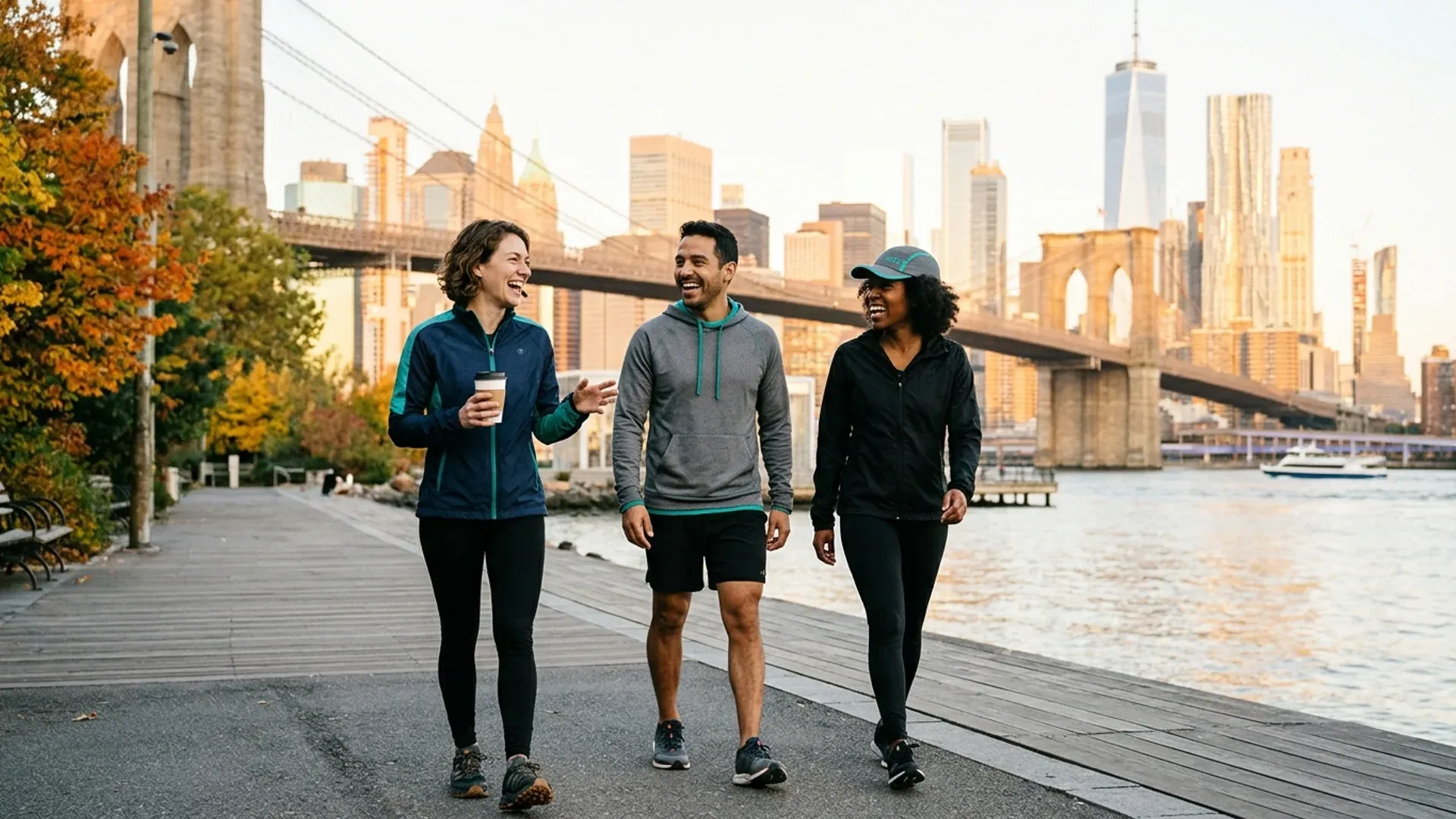
The 12 best dating apps in NYC (New York City) for 2026 are: 1) GRASS, 2) Hinge, 3) Bumble, 4) Tinder, 5) The League, 6) Feeld, 7) OkCupid, 8) HER, 9) Raya, 10) Lox Club, 11) Coffee Meets Bagel, and 12) eharmony. The first six are the ones we'd put on a New Yorker's phone first. The last six are for specific people and specific ways of meeting. Last updated October 2026.
Here's what's odd about dating in New York: about 45% of NYC adults have never been married, and in Manhattan it's more than half, according to the Census Bureau's 2024 American Community Survey. Never married isn't the same as single, but you get the point. There's no shortage of people. You can get a coffee, a natural wine or a lap of the Reservoir with someone new any night of the week, and yet what you hear from New Yorkers isn't "there's nobody here." It's "there's so much, and none of it turns into anything."
So we ranked these apps on the question that actually matters here: how likely is this app to get you from a match to a real meetup, with someone who lives a reasonable train ride away, before you both lose interest? That depends on who's on it and how hard it pushes you to make a plan. A smaller pool that gets you to a real date beats a bigger one that doesn't.
Why Is Dating in NYC So Different From Other Cities?
Three things make New York its own dating market, and each one changes which app works.
Too many options, not too few
Psychologists call it choice overload: faced with a huge menu, people choose later, choose less and feel worse about what they picked. A New York dating feed is about as big a menu as you'll find anywhere. The result is a familiar loop: dozens of matches, a few conversations, almost no dates. The apps that do best here cut the menu down, with daily limits, curated batches or a reason to meet that isn't "let's grab a drink sometime."
Geography is a dealbreaker
Astoria and Bay Ridge are roughly 10 to 12 miles apart and often more than an hour apart on the train. That's why distance filters measured in miles are close to useless here, and why some New Yorkers jokingly write off a match across the river as "geographically undesirable." The preference is real, too: in a 2016 survey of 500 people by the dating app Sapio, New Yorkers mostly stuck to their own borough when they dated. What matters isn't miles. It's how many transfers stand between you.
Time is the scarcest resource
Long hours, long commutes and a packed social calendar leave a lot of New Yorkers with only a couple of free evenings a week for dating. An app that eats those evenings with endless chat is a bad app for New York, no matter how many people are on it. Burnout is everywhere: 78% of US dating app users say they feel burned out at least sometimes (Forbes Health, 2024). In a city this busy, a match that never becomes a date costs more. We dig into the numbers behind it in why the apps stall in NYC.
How We Put This List Together
We weighed five things, all specific to how the city works:
- Pool size: how many New Yorkers you'd realistically see. It matters, but a big pool with mixed intentions ranks below a smaller pool of people who actually want a date.
- Match-to-meetup push: does the app nudge you toward meeting in person, or reward endless chatting?
- Commute fit: can you keep your matches within a train or two, or are you swimming in profiles from three boroughs?
- A lower-pressure way to meet: group events, activities or curated formats that don't require a full one-on-one date with a stranger.
- Safety and free use: photo verification, moderation, and whether the free version is actually usable. Prices change constantly, so we describe tiers instead of quoting numbers that'll be wrong by spring.
The order is our judgment across all five, not a formula. Apps 1 to 6 are the ones we'd put on a New Yorker's phone first. Apps 7 to 12 do one thing well for a specific kind of dater, and the right one for you might be there. One thing to know up front: GRASS is our app. It's first because it's built around the exact question this list ranks on.
2026 Ranking: The Top 6 Dating Apps in NYC
1. GRASS — Best for Actually Getting to a Date
GRASS cuts short the part where most NYC matches die: the endless chat. Instead of swiping on photos, you post a plan or join one (say, a Saturday run on the Hudson River Greenway, a Prospect Park loop, a bouldering session, a hike upstate), and the people who say yes are committing to a specific time and place, which tells you more than a match does. Find Buddy is the one-on-one version: you post an activity, a time and a place, and someone replies to join you. Group Adventure turns it into a group plan, which takes the pressure off a first meeting.
In NYC: It speaks to all three problems above. Overload: a plan tells you more about intent than a Hinge prompt does. Commute: you pick where the plan happens. Time: the date is something you were going to do anyway. GRASS is newer in New York than the big apps, so the feed is smaller: fewer people to answer a plan, but yours won't be buried. Run it next to Hinge and you've covered both ends.
- Best for: Runners, climbers, hikers, cyclists, and anyone done with three weeks of texting
- Free version: Free to download and to join group plans; optional Premium and Ultimate tiers
- Watch out for: It's newer in NYC than the big apps, so pair it with one of them for volume
Got a run, a climb or a long walk planned this weekend anyway? Download GRASS free, post it and see who wants to come along.
2. Hinge — Best for Serious Relationships, and the Hometown App
Hinge was founded in New York by Justin McLeod in 2011, and it's where a lot of New Yorkers in their late 20s and 30s start when they want something real. Match Group says Hinge's global monthly active users were up 13% year over year in Q2 2026, though most of that came from newer markets (its core markets were roughly flat). Prompt-based profiles give you something to answer besides a photo, and the "designed to be deleted" pitch suits a city where people want off the app fast.
In NYC: The pool is deep enough that you can afford to be strict on distance. Set a tight radius and treat "lives across the river" as a real filter, not a fun challenge. The free version caps how many likes you can send a day, which in New York is a feature: it makes you choose.
- Best for: Relationships, 25 to 40, anyone who wants something to talk about besides photos
- Free version: Usable, with a daily like limit; paid tiers add more likes and filters
- Watch out for: The same faces on every friend's phone, and matches that stall in chat
3. Bumble — Best for a Slower, More Deliberate Inbox
Bumble spent a decade as the app where women message first. That changed on August 11, 2026: now anyone in a match can send the first message, and the other person has 72 hours to reply instead of 24. You only get one opener before they answer, and the app nudges you if you try to send a lazy "hey."
In NYC: The longer reply window is a real upgrade for New Yorkers whose weeks disappear into work, and the one-message rule tends to keep inboxes calmer than Tinder's. Bumble also runs a separate friend-finding app, which is worth a look if you moved here alone.
- Best for: People who like a slower start, and women who still want to make the first move when they choose to
- Free version: Usable; paid tiers add features
- Watch out for: The rules just changed, so expect it to feel different from what your friends describe
4. Tinder — Biggest Pool, Most Filtering Required
Tinder is still one of the biggest dating apps around, even though its monthly active users fell 7% year over year in Q2 2026. In New York, that means you'll never run out of profiles. It also means you'll spend more time sorting through them.
In NYC: Tinder works if you're specific about what you want and quick to suggest a plan. In a city with this many visitors, you'll match with people who are only in town for a week, so ask before you invest.
- Best for: Volume, casual dating, people new to the city who want to meet a lot of people fast
- Free version: Limited; several paid tiers
- Watch out for: Mixed intentions and a lot of tourists
5. The League — Best for Career-Focused Professionals
The League started in San Francisco and launched in New York in 2015, its second city. It builds profiles from your LinkedIn and education and tends to show you a small batch of people each day. In finance-heavy, ambition-heavy New York, that pitch lands.
In NYC: The small daily batch is a direct answer to choice overload. The trade-off: some profiles wait to get in, and the vibe can feel like a resume screen.
- Best for: Finance, law, consulting and tech people who want a filtered pool
- Free version: Limited; most of the useful features are paid
- Watch out for: Waitlists, and a culture that rewards job titles
6. Feeld — Best for Open-Minded and Non-Traditional Dating
Feeld is built for people exploring non-monogamy, kink and fluid identities, solo or as a couple. It's also one of the more inclusive apps for queer and trans daters.
In NYC: In a city where nobody blinks at an open relationship, plenty of people run Feeld alongside a mainstream app rather than instead of one. It's often the most honest app on your phone about what people actually want.
- Best for: Open relationships, couples, queer and trans singles, people figuring it out
- Free version: Usable; one paid tier
- Watch out for: It isn't the place for a traditional path to marriage
Ranking 7 to 12: Picks for Specific New Yorkers
Each of these does one thing better than anything above, for a specific kind of dater. One note: Grindr is still the biggest app for gay and bi men in New York. It works differently from everything here, so we left it out of the ranking, but it belongs on any queer New Yorker's shortlist.
7. OkCupid — Best Free Option With Real Depth
OkCupid asks you to answer questions about values, politics and lifestyle, then shows how compatible you are with each match. It has the most generous free version on this list.
In NYC: If you'd rather know where someone stands before you spend an evening on the subway to meet them, this is the app that tells you up front.
- Best for: Values-driven daters, anyone who refuses to pay for a dating app
- Free version: The best on this list
- Watch out for: A dated interface and more inactive profiles
8. HER — Best for Queer Women and Nonbinary Singles
HER is built for lesbian, bi and queer women and nonbinary people, and it pairs the app with community events. In New York, the events side is a real reason to download it: it's a way into the city's queer social scene, not just a feed of profiles.
- Best for: Queer women and nonbinary singles, especially if you're new to the city
- Skip it if: You want the biggest possible pool; it's smaller than the mainstream apps
9. Raya — Best for the Creative and Media Crowd
Raya, launched in 2015, is invite-only and application-based, with a membership fee and often a waitlist. Its pitch is a smaller room of creative and well-connected people, which fits a city with this much fashion, media, music and art.
- Best for: People in creative industries who want a small, curated room
- Skip it if: You want to date this month; getting in can take a long time, and it's half networking app
10. Lox Club — Best for Jewish Singles Who Want a Curated Pool
Lox Club is an application-based app for Jewish singles, launched in 2020, with a membership fee. New York has one of the largest Jewish communities in the world, and Lox Club has run in-person summer events for members in the city, so the app comes with a social calendar, not just a feed.
- Best for: Jewish singles who want a smaller, more intentional pool
- Skip it if: You don't want to apply or pay before you can start
11. Coffee Meets Bagel — Best for Fewer, Slower Matches
Coffee Meets Bagel sends a small set of curated matches each day. In a city defined by overload, that deliberately small batch can be a relief. It works best as a break from the main feed, not a replacement for it.
- Best for: People overwhelmed by volume who want a few matches to actually think about
- Skip it if: You want speed; the slow pace is the point
12. eharmony — Best for 35+ Singles Focused on Marriage
eharmony runs on a long compatibility questionnaire and attracts people who are clear about wanting a long-term partner. It skews older and more marriage-minded than the rest of this list, and most of its features sit behind a subscription.
- Best for: 35+ singles who want marriage and are tired of guessing intentions
- Skip it if: You're in your 20s or want to try before you pay
NYC Dating Apps Side by Side
App | Best For | Free Version | What Moves You Toward a Date | NYC Note |
|---|---|---|---|---|
GRASS | Meeting through activities | Free to download | You join or post a plan, so the plan is the opener | Newer here, smaller feed |
Hinge | Relationships | Usable, daily like limit | Prompts to reply to; like limit makes you choose | Founded in NYC |
Bumble | A slower start | Usable | One opener, 72 hours to reply | Rules changed Aug 2026 |
Tinder | Volume, casual | Limited | Sheer numbers; you have to suggest the plan | Lots of visitors |
The League | Career-focused | Limited | Small daily batch | Launched here in 2015 |
Feeld | Open-minded dating | Usable | People say what they want up front | Often a second app |
OkCupid | Values, free use | Generous | Compatibility answers before you meet | Saves wasted subway trips |
HER | Queer women, nonbinary | Usable | Community events | Way into the queer scene |
Raya | Creatives, media | None | Small, curated room | Waitlist |
Lox Club | Jewish singles | None | Member events | Has held NYC events |
Coffee Meets Bagel | Fewer matches | Limited | A few matches a day | Antidote to overload |
eharmony | 35+, marriage | Very limited | Long questionnaire | Serious intent |
Where to Meet in Each Borough
Where you live shapes your dating life more than most New Yorkers admit. Some practical rules, borough by borough:
- Manhattan: Every app works, so the problem is filtering. Use Hinge or The League with a tight radius. For a first meetup that doesn't feel like an interview, a walk along the Hudson River Greenway or a lap of the Central Park Reservoir is hard to beat.
- Brooklyn: Big enough to be its own dating market. Hinge is the default here, and OkCupid helps you screen for values before you commit to a G train ride. Set your distance by the train lines you actually ride, not miles: a match on your line beats a closer one that needs two transfers. Prospect Park, McCarren Park and the Brooklyn Bridge Park waterfront are easy places to suggest a walk instead of a bar.
- Queens: Easy to overlook if your radius is centered on Manhattan. Since New Yorkers tend to date close to home anyway, a Queens-to-Queens match is a lot more likely to actually happen. Astoria Park and Flushing Meadows Corona Park beat a trip into the city.
- The Bronx: Van Cortlandt Park and Pelham Bay Park are real running and hiking destinations, so a plan there gives a match from another borough a reason to make the trip. Say where you live in your profile and offer to meet halfway.
- Staten Island: The ferry is the commute penalty. The Greenbelt trails give people a reason to come out, and an activity-based plan makes the trip feel worth it.
- Jersey City and Hoboken: A short PATH ride from Manhattan. Most apps will show you Manhattan first, so tighten your radius if you'd rather not cross the river every time.
Beyond the Apps: Where New Yorkers Actually Meet in 2026
One of the biggest NYC dating trends of the last two years isn't an app at all. It's people giving up on meeting strangers through a screen and going back to meeting them in person, with enough structure that it isn't awkward.
Run clubs
Run clubs became one of the most talked-about singles scenes in the city in 2024. Lunge Run Club started its Wednesday evening runs from Washington Square Park that May with about 30 runners and was drawing around 1,000 a week by September, according to NBC New York. By 2025, dating coaches were telling single New Yorkers to get to in-person things like run clubs, climbing gyms and sports teams instead of leaning on the apps.
The appeal is simple: show up, run at a conversational pace, and the real talking happens over coffee or a beer afterward. Fair warning: when a club draws hundreds of people, it's hard to have a real conversation, so a smaller neighborhood club is often the better bet. New to it? Here's how to find a run club near you and how to tell a social crew from a training group, plus what a coffee run club is if you'd rather keep the miles short and get to brunch.
Dinners and events with strangers
Timeleft, which seats strangers together for dinner, launched its weekly Wednesday dinners in New York in March 2024. Thursday, a London-born app named after the one day a week it was open, shut down its dating app in early 2025 to focus on ticketed in-person events. That's a telling move: a dating app company decided the event was the product. These formats work because they remove the hardest part of a first date, which is sitting across from one stranger for two hours. A table of strangers is easier.
Marathon season
Every November the city turns out for the marathon, and in 2026 the TCS New York City Marathon is on Sunday, November 1. Even if you're not running, cheering on First Avenue or Fourth Avenue in Brooklyn with friends is one of the most social days of the year, and a good excuse to finally show up to a run club the week after.
If this is the part of dating you actually enjoy, read why run clubs became the new dating app, and see how New York stacks up on parks and singles in our look at the best US cities for outdoorsy singles.
Want something smaller than a 1,000-person run club? Post a run on GRASS and see who wants to join.
How to Get More Real Dates From NYC Dating Apps
- Suggest a plan within a few messages. Something specific ("Saturday morning, a loop around Prospect Park, coffee after?") beats "we should hang out sometime."
- Make your location obvious. Put your neighborhood and your train in your profile. It filters out matches who live too far away before you lose a week to them.
- Run two apps on purpose, not five out of habit. One big app for volume and one smaller or activity-based app for a different way of meeting is a sane setup.
- Keep first meetups short. A 45-minute walk or coffee is easier to say yes to on a weeknight than a three-course dinner, and easy to extend if it's going well.
- Protect your evenings. If you're opening the app out of boredom, take a week off. Burnout makes you swipe sloppier, not smarter.
Tired of matches that never leave the app? Keep Hinge for volume, then download GRASS for free and put your next Saturday plan to work as a first date.
Staying Safe on NYC Dating Apps
- Meet somewhere public and busy first. A café, a park with foot traffic, a well-known trail. Don't share your home address until you've met more than once.
- Plan your route home. Know which train or ride you're taking back before the date, especially late at night, and tell a friend where you're going.
- Use verification. Most major apps offer photo verification. Favor verified profiles, and treat a flat refusal to do a quick video call before meeting as a yellow flag.
- Watch for money requests. Americans reported losing $1.14 billion to romance scams in 2023, according to the FTC. Anyone who asks for money, gift cards or crypto, or pitches an "investment opportunity," is running a scam. Report and block.
- Groups are a safety feature. Run clubs, group hikes and hosted dinners mean you're not alone with a stranger on a first meeting.
Frequently Asked Questions
What is the best dating app in NYC in 2026?
It depends on what's stopping you. If it's getting past the chat, GRASS is built for that: you post or join a real plan, like a run or a hike, so making plans is the whole point. If it's finding people who want something serious, Hinge was founded in the city and has the deepest relationship-minded pool. Bumble and Tinder round out the big apps, and The League is the strongest pick for career-focused professionals.
What is the best free dating app in NYC?
OkCupid has the most useful free version, with compatibility questions and messaging that don't require a subscription. Hinge, Bumble and Tinder are all usable for free, with limits. Raya, Lox Club and eharmony need a paid membership to use properly.
Hinge or Bumble: which is better in NYC?
Hinge is better for most people who want a relationship, because its pool is deeper and its prompts give you more to work with. Bumble suits people who want a slower start: since August 2026 anyone can send the first message, and matches have 72 hours to reply. Plenty of New Yorkers use both.
Which dating app started in New York?
Hinge. It was founded in New York City by Justin McLeod in 2011 and remains the go-to relationship app for many New Yorkers. The League, another popular choice here, started in San Francisco and expanded to New York in 2015.
Do New Yorkers date across boroughs?
They do, but most would rather not. A 2016 survey of 500 people by the dating app Sapio found New Yorkers mostly stuck to their own borough, with Bronx residents more open than most to dating Manhattanites. Because a few miles can mean an hour on the subway, it helps to set your search by the train lines you ride rather than by distance.
Are there ways to meet people in NYC without dating apps?
Yes. Run clubs, hosted dinners with strangers, rec sports leagues, climbing gyms and volunteer groups are all popular ways New Yorkers meet. Activity-based apps like GRASS sit in between: you use an app, but you meet while doing something instead of over drinks.
What are the best LGBTQ+ dating apps in NYC?
HER is the strongest option for queer women and nonbinary singles, and pairs the app with community events. Feeld is popular across the LGBTQ+ spectrum and with people exploring non-traditional relationships. Grindr is still the biggest app for gay and bi men in the city, and Hinge, Bumble and OkCupid all offer inclusive gender and orientation options.
Keep Reading
- The Best US Cities for Outdoorsy Singles — how 86 big US cities compare on parks and the share of people who are single
- 12 Best Dating Apps in Los Angeles (2026) — the West Coast version, where driving changes everything
- 12 Best Dating Apps in San Francisco (2026) — the tech-capital take on dating app burnout
- Dating in NYC: Why the Apps Stall Here — the commute, cost and choice numbers behind NYC dating
- 12 Best Dating Apps in Chicago (2026) — the Midwest version, built around summer and winter
- 12 Best Dating Apps in Houston (2026) — the Texas version, where every date is a drive
- How to Find a Run Club Near You — how to tell a social crew from a training group before you show up
- Hinge vs. GRASS — a head-to-head if you're choosing between swiping and meeting through activities