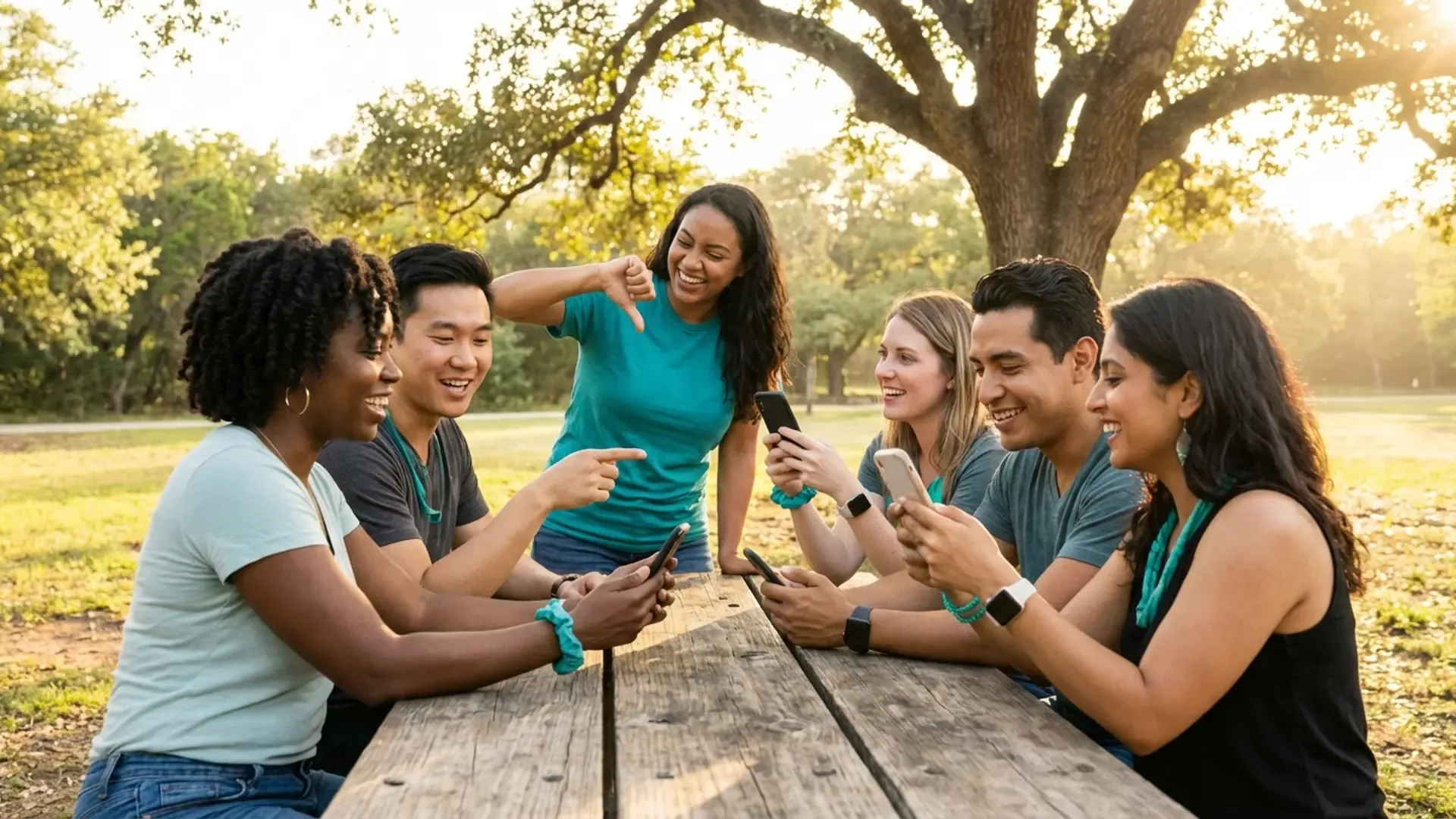
The best dating app in 2026 depends on what you want: Tinder for maximum choice, Bumble for women-first safety, Hinge for relationship-focused matching, and GRASS for meeting people through real outdoor activities instead of endless swiping. Full disclosure: this article is written by the GRASS team. We'll give honest pros and cons for every app — including our own. Below is our hands-on comparison of 13 dating apps ranked by match quality, safety, value, and who each one is actually built for.
What's Happening in the Dating App Market in 2026?
The global dating app market reached $12.5 billion in 2026 (Business of Apps), but growth is slowing. Approximately 360 million people used dating apps worldwide in 2024, up just 4% year-over-year (Statista, 2025). More tellingly, Match Group — Tinder's parent company — saw revenue growth stall in 2025, signaling that the traditional swipe-and-match model is losing steam.
In the US, the shift is even more dramatic. A 2025 Pew Research study found that a majority of young single men report rarely or never going on dates (Pew Research, 2025). Meanwhile, 79% of dating app users report "dating fatigue" (Forbes Health, 2025). The industry response? A pivot toward quality over quantity — deeper profiles, AI-driven matching, and activity-based platforms that get people offline faster.
This pattern is especially pronounced among men — see our analysis of why men are leaving dating apps.
13 Dating Apps Ranked & Compared: Features, Price, and Who They're Actually For
We evaluated each app across five dimensions: match quality, user experience, safety features, subscription value, and target audience. Here's our honest breakdown for the US market.
A note on order: the top seven are ranked by overall score. Apps 8 through 13 are strong niche or specialist picks — grouped and ranked by how well they fit a specific need (serious intent, compatibility, budget, location, exclusivity, or open relationships) rather than by raw score.
1. Tinder — Largest User Base, Most Options
Overall Score: 7.5/10
Tinder remains the 800-pound gorilla of dating apps with over 75 million monthly active users worldwide and the largest user base in almost every US city. Its algorithm is simple: swipe right to like, left to pass. The sheer volume means you'll never run out of profiles — but it also means you'll wade through a lot of low-effort ones.
- Pros: Biggest user pool, intuitive UX, works internationally, strong free tier
- Cons: Match quality inconsistent, bot/scam prevalence, swipe fatigue is real, paid tiers are expensive
- Pricing: Tinder Plus ~$24.99/mo, Gold ~$39.99/mo, Platinum ~$49.99/mo (prices vary by age and location, as of March 2026)
- Best for: Social daters who want maximum options, people new to dating apps
Curious how Tinder compares to an activity-first app? See our GRASS vs Tinder comparison.
2. Bumble — Women Make the First Move
Overall Score: 7.8/10
Bumble's signature feature is that women must send the first message within 24 hours or the match expires. This dramatically reduces unsolicited messages for women. Bumble's AI "Deception Detector" catches 95% of spam and fake profiles before users see them (Bumble Safety Report, 2025). Beyond dating, Bumble BFF (for friendships) and Bumble Bizz (for networking) add versatility.
- Pros: Women-first design reduces harassment, excellent AI safety, clean interface, multi-mode (Date/BFF/Bizz)
- Cons: 24-hour timer creates pressure, men can feel passive, slightly smaller pool than Tinder
- Pricing: Premium ~$39.99/mo, Premium+ ~$59.99/mo (as of March 2026)
- Best for: Women who want inbox control, safety-conscious users
For a deeper look at the women-first vs activity-first tradeoff, see our GRASS vs Bumble comparison.
3. Hinge — Designed to Be Deleted
Overall Score: 8.3/10
Hinge has quietly become the #3 dating app in the US with over 28 million users and 15% market share. Its key innovation: instead of swiping on photos, users respond to specific prompts and photos on someone's profile. This creates instant conversation starters. Hinge reports the highest "date-to-match" ratio of any major dating app — meaning a higher percentage of matches actually turn into real dates. Its AI analyzes your likes and dislikes to present one "Most Compatible" person each day.
- Pros: Highest match-to-date conversion, meaningful conversations from day one, "Most Compatible" AI feature, relationship-focused user base
- Cons: Free tier limits to 8 likes/day, HingeX is expensive, smaller pool in rural areas
- Pricing: Hinge+ $29.99/mo, HingeX $49.99/mo
- Best for: Relationship-seekers who value conversation quality over match volume
See how "designed to be deleted" stacks up against "designed to get you outside" in our Hinge vs GRASS comparison.
4. GRASS — Replace Swiping with Real Adventures
Overall Score: 8.0/10 (Disclosure: This article is written by the GRASS team)
GRASS is fundamentally different from every other app on this list. Instead of swiping through photos, you join real outdoor activities — hiking, surfing, camping, rock climbing — and meet people in person. Core features include "Find a Partner" (1-on-1 activity matching), "Group Activities" (join group outings), and "Hot Air Balloon" (random voice chat). The philosophy: instead of spending 3 hours swiping, spend 3 hours hiking together. 4.8 stars on the App Store.
- Pros: Meet through real activities (not swiping), group settings reduce dating pressure, strong safety features (activity reviews + verification), core features are completely free
- Cons: Currently focused on the Taiwan market, smaller user base than global brands, requires willingness to go outdoors, activity-focused (not for pure online socializers)
- Pricing: Core features free, premium features coming soon
- Best for: People tired of swiping who want real-world interaction, outdoor enthusiasts, those who prefer meeting in group settings
New to GRASS? Here's our step-by-step guide to using GRASS.
5. Hily — AI-Powered Matching for Gen Z
Overall Score: 7.4/10
Hily (short for "Hey, I Like You") uses AI to learn your preferences and improve matches over time. Its standout feature is the compatibility quiz that scores potential matches before you even see their profile. Popular with Gen Z users, Hily emphasizes video profiles and live streaming. The app has grown to over 28 million users globally, with strong adoption in the US market.
- Pros: AI matching improves over time, video profiles reduce catfishing, compatibility quiz is genuinely useful, affordable pricing
- Cons: Smaller user base than the Big Three, some users report repetitive profiles, livestream feature can feel like social media
- Pricing: Premium $14.99/mo
- Best for: Gen Z users who want AI-assisted matching, budget-conscious daters
6. Coffee Meets Bagel — Quality Over Quantity
Overall Score: 7.2/10
Coffee Meets Bagel sends women a curated selection of 5-6 "Bagels" (matches) each day at noon. Men receive a batch too, but women get priority picks. This forced scarcity means less time swiping and more intentional choices. According to CMB, users spend 60% less time on the app than Tinder users, but have 3x more "meaningful conversations."
- Pros: No mindless swiping, curated daily matches, good for busy professionals, women-friendly design
- Cons: Limited daily choices, smaller user base, slower matching pace, free tier is restrictive
- Pricing: Premium $34.99/mo
- Best for: Busy professionals who want quality matches without the time investment
7. Thursday — Dating App That Only Works One Day a Week
Overall Score: 7.0/10
Thursday takes the anti-swiping concept to its logical extreme: the app only works on Thursdays. Every Thursday, matches and conversations reset, creating urgency to actually meet up. The rest of the week, the app is locked. This radical design addresses dating fatigue head-on — you can't doom-scroll if the app literally won't let you. Thursday also hosts weekly in-person events in major US cities.
- Pros: Forces real-life meetings, eliminates endless swiping, weekly events create community, unique concept stands out
- Cons: Only available in select US cities, one day limits flexibility, smaller user base, still growing
- Pricing: Free (premium features in development)
- Best for: People who want a hard boundary on screen time, social event lovers, anti-dating-app daters
8. Match.com — The Original Serious-Dating Platform
Overall Score: 7.6/10
Match.com has been around since 1995, which makes it the elder statesman of online dating. It skews heavily toward intentional, relationship-minded daters — the average user is older and more likely to be looking for a committed partner than a casual date. With an estimated 5.8 million monthly active users and decades of matching data, it pairs deep search filters with algorithmic suggestions to help you narrow by the things that actually matter.
- Pros: Strong intent signal — people here pay and take dating seriously; deep search filters; decades of matchmaking experience
- Cons: Smaller, older active user base than the swipe giants; among the pricier mainstream options
- Pricing: Roughly $18–$46/mo depending on plan length (much cheaper on annual terms); prices vary by promotion and region, as of 2026
- Best for: Older, relationship-serious daters who want depth over swipe volume
9. OkCupid — Compatibility Through Questions
Overall Score: 7.5/10
OkCupid is the compatibility nerd of the dating world. Instead of judging on photos alone, it asks you to answer hundreds of questions — about politics, lifestyle, intimacy, and dealbreakers — and turns your answers into a match percentage with each person. With an estimated 50 million-plus registered accounts and around 10 million monthly actives, it is also one of the most inclusive mainstream apps, supporting just about every gender, orientation, and relationship structure you can think of.
- Pros: Genuinely usable free tier (you can message without paying); rich compatibility matching; inclusive identity options
- Cons: Male-skewed gender ratio; interface feels dated next to Hinge
- Pricing: Premium roughly $22–$55/mo depending on term, as of 2026; prices vary
- Best for: Progressive, values-driven daters who want compatibility based on real questions, not just looks
10. Plenty of Fish — The Budget Workhorse
Overall Score: 7.0/10
Plenty of Fish is the most accessible option in mainstream online dating. Its defining feature is an unusually generous free tier — you can actually message people without paying, which is rare in 2026. With an estimated 90-plus million registered accounts and roughly 4 million monthly actives, the pool is large but mixed in intent, spanning casual and serious daters alike. POF recently restructured its paid plans into POF Plus, POF Premium, and POF Prestige tiers.
- Pros: One of the most functional free experiences in dating — real messaging without a paywall; large pool
- Cons: Dated interface; higher noise and spam than premium-first apps
- Pricing: Premium tiers roughly $10–$21/mo depending on term (cheapest on the 12-month plan); as of 2026, prices vary
- Best for: Budget-conscious daters who want a big free-messaging pool and do not need a polished interface
11. Happn — Match With People You Crossed Paths With
Overall Score: 7.1/10
Happn is built on a simple, oddly romantic premise: it shows you the people you have actually crossed paths with in real life. Walk past someone at a coffee shop or on your commute, and if you both have the app, they surface in your feed. With an estimated 6.5 million monthly active users (concentrated in cities like Paris, São Paulo, and major US metros), it trades algorithmic feeds for real-world serendipity — the closest mainstream cousin to actually meeting someone by chance.
- Pros: Uniquely real-world, location-based premise; rewards people who are actually out and about
- Cons: Small user base outside its strongest markets; the location-based concept feels limiting in less dense areas
- Pricing: Premium roughly $10–$25/mo depending on term (1-month around $24.99, 12-month around $10); as of 2026, prices vary
- Best for: Urban daters who like the "we almost met in real life" kind of serendipity
12. The League — Curated, Exclusive, Expensive
Overall Score: 7.0/10
The League is the application-only option. You apply, you often wait behind a sizable waitlist, and the app screens applicants on education, career, and ambition before letting them in. Once inside, you get a handful of curated matches per day — roughly five — plus, at higher tiers, a personal concierge. Acquired by Match Group in 2022, it is available across major US metros and a growing list of international cities, and skews heavily toward credentialed professionals.
- Pros: Heavy human curation; a verified, ambitious, education-focused user base
- Cons: Exclusive by design, which limits pool diversity; very expensive; long waitlists and a thin user base outside major metros
- Pricing: Tiered and notoriously steep — from around $99/week at the entry Member tier up to $2,499/mo for VIP, with concierge service reportedly reaching ~$30,000/year; as of 2026, prices vary
- Best for: Career-driven, credential-focused professionals in big cities who will pay a premium for an exclusive pool
13. Feeld — Built for Open Minds and Non-Traditional Relationships
Overall Score: 7.7/10
Feeld is the most identity-inclusive app on this list by a wide margin. Built for ethical non-monogamy, couples, and open exploration, it offers 20-plus gender and sexuality options and a "Constellation" feature that lets you link partners and explore as a couple or group. By its own reporting, membership grew 368% between 2021 and 2025, and the company turned a profit on $65 million in 2024 revenue — all while keeping its premium tier among the cheapest in the category.
- Pros: Unmatched inclusivity for genders, orientations, and relationship structures; affordable premium tier; stigma-free space
- Cons: Heavily skewed toward ethical non-monogamy and couples, so it is a poor fit for conventional monogamous dating; the user base thins outside major cities
- Pricing: Majestic membership roughly $8–$12/mo depending on term (monthly around $11.99, cheaper on quarterly and annual); as of 2026, prices vary
- Best for: Open-minded singles and couples exploring ethical non-monogamy, polyamory, or kink in a judgment-free space
Quick Comparison: All 13 Dating Apps at a Glance
Here is how all 13 apps stack up across type, ideal user, price, and free-tier strength. Prices are approximate USD monthly equivalents and vary by term, promotion, and region (as of 2026).
App | Type | Best For | Price (USD/mo) | Free Tier |
|---|---|---|---|---|
Tinder | Mainstream swipe | Maximum reach | $25–50 | Fair |
Bumble | Women-first | Safety-conscious women | $40–60 | Good |
Hinge | Relationship-focused | Serious daters | $30–50 | Good |
GRASS | Activity-first outdoor | Outdoorsy / anti-swipe | Free core | Strong |
Hily | AI matching | Gen Z, budget | $15 | Good |
Coffee Meets Bagel | Curated daily | Busy professionals | $35 | Limited |
Thursday | One day a week | Anti-doomswipe | Free | Strong |
Match.com | Serious legacy | Older, commitment-minded | $18–46 | Limited |
OkCupid | Compatibility quiz | Values-driven daters | $22–55 | Good |
Plenty of Fish | Budget freemium | Free-messaging seekers | $10–21 | Strong |
Happn | Location-based | Urban serendipity | $10–25 | Fair |
The League | Exclusive / curated | Career-driven professionals | ~$400+/mo | Very limited |
Feeld | Inclusive / ENM | Open-minded singles & couples | $8–12 | Good |
Which Dating App Should You Use? A Scenario Guide
Everyone's looking for something different. Here's our recommendation by scenario:
- "I want the most options" → Tinder. Biggest user base means the most potential matches in any city.
- "I'm a woman who wants to feel safe" → Bumble. Women-first messaging plus best-in-class AI safety.
- "I want a serious relationship" → Hinge. Highest match-to-date ratio and conversation-first design.
- "I'm sick of swiping and want to actually DO something" → GRASS. Real outdoor activities, real people, real connections.
- "I'm too busy to swipe every day" → Coffee Meets Bagel. Curated daily matches that respect your time.
- "I want AI to find my match" → Hily. Machine learning that gets smarter the more you use it.
- "I need forced accountability to get offline" → Thursday. If you won't delete the app, use one that locks itself.
Looking for a specific niche? We have dedicated rankings for outdoorsy people, introverts, and singles in Los Angeles.
Are Paid Dating Apps Worth It? A Value Comparison
Dating apps use a freemium model: free features to get you hooked, paid upgrades to unlock the full experience. But not every upgrade is worth your money. Here's our value ranking:
- GRASS (Free) — All core features free. Best value, period.
- Thursday (Free) — No premium tier yet. You get the full experience at no cost.
- Hily ($14.99/mo) — Most affordable premium tier. AI matching and unlimited likes for less than a cocktail.
- Tinder Plus (~$24.99/mo) — Entry point for unlimited swipes, but Gold (~$39.99) and Platinum (~$49.99) add up fast.
- Bumble Premium (~$39.99/mo) — Decent value. Backtrack and extend features are useful but not essential.
- Hinge+ ($29.99/mo) — Worth it if free-tier limits frustrate you. HingeX at $49.99 is steep.
- CMB Premium ($34.99/mo) — Middle of the road. More Bagels and filters for serious users.
Which Dating App Is Safest? Security Features Compared
Romance scams cost Americans over $800 million in reported losses in 2024 (FTC). Safety should be non-negotiable when choosing a dating app. Here's how they stack up:
- Best AI fraud detection: Bumble (95% interception rate) and Tinder (photo AI scanning) lead the pack.
- Strictest verification: Bumble (selfie verification) > Hinge (profile review) > Tinder > others.
- Unique safety advantage: GRASS's group activity model is inherently safer — you're meeting people in public settings with other participants, not alone with a stranger.
- Background checks: Tinder offers Garbo background checks in the US for an additional fee.
2026 Dating App Trends: The Shift from Swiping to Living
Three major trends are reshaping the dating app landscape in 2026:
- Activity-based dating is surging: While Match Group and Bumble report slowing growth, activity-based platforms are growing significantly faster. The message is clear: people want to meet through shared experiences, not photo-based judgments.
- AI is a double-edged sword: Hinge's AI matching and Bumble's fraud detection are genuinely useful. But AI-generated photos and chatbots are eroding trust. According to a 2025 Security.org survey, 58% of users worry about AI-generated fake profiles.
- The "anti-swiping" movement: Thursday's one-day-a-week model, GRASS's activity-first approach, and even Hinge's "Designed to be Deleted" branding all reflect the same shift: users want less screen time, more face time.
This shift is sharpest in big cities — see why dating apps underperform in Los Angeles and San Francisco.
Frequently Asked Questions
What is the best dating app in 2026?
There's no single "best" dating app — it depends on your goals. Tinder offers the most users, Hinge has the highest match-to-date ratio for relationships, Bumble is best for women's safety, and GRASS is best for people who want to meet through real activities rather than swiping. We recommend trying 2-3 apps simultaneously to find your fit.
Are paid dating apps worth the money?
For casual users, free tiers are usually sufficient. If you're serious about finding a partner and using the app daily, paid features like unlimited likes and advanced filters can improve your experience. However, studies show that profile quality and conversation skills matter more than premium features. GRASS and Thursday offer full functionality for free.
Which dating app has the least scams?
Bumble's AI Deception Detector intercepts 95% of fake profiles before they reach users. GRASS's activity-based model provides natural protection — you're meeting real people at real events in public places. Regardless of which app you use, never send money to someone you haven't met, and always meet in public for the first time.
How is GRASS different from Tinder?
The core difference is how you meet people. Tinder's flow is: see photo → swipe → text chat → maybe meet. GRASS's flow is: pick an activity → go do it together → naturally connect. Tinder optimizes for online filtering; GRASS optimizes for offline experience. They're not mutually exclusive — many people use both.
What are alternatives to dating apps?
Beyond dating apps, you can meet people through: outdoor activity groups and sports clubs, mutual friends, hobby classes (cooking, photography), volunteering, and community events. The key is showing up to places where real interaction happens. GRASS's group activity feature bridges the gap — it's app-facilitated but the actual meeting happens in person.
Final Verdict: Our Dating App Ranking for 2026
The bottom line of this dating app comparison: there's no single "best" app — only the best app for your current needs. For maximum options, Tinder and Bumble still dominate. For relationship-focused matching, Hinge leads with the highest match-to-date ratio. For people tired of swiping who want to meet through real shared experiences, GRASS offers a fundamentally different approach. Whatever app you choose, remember: the tool matters less than the authenticity you bring to it.