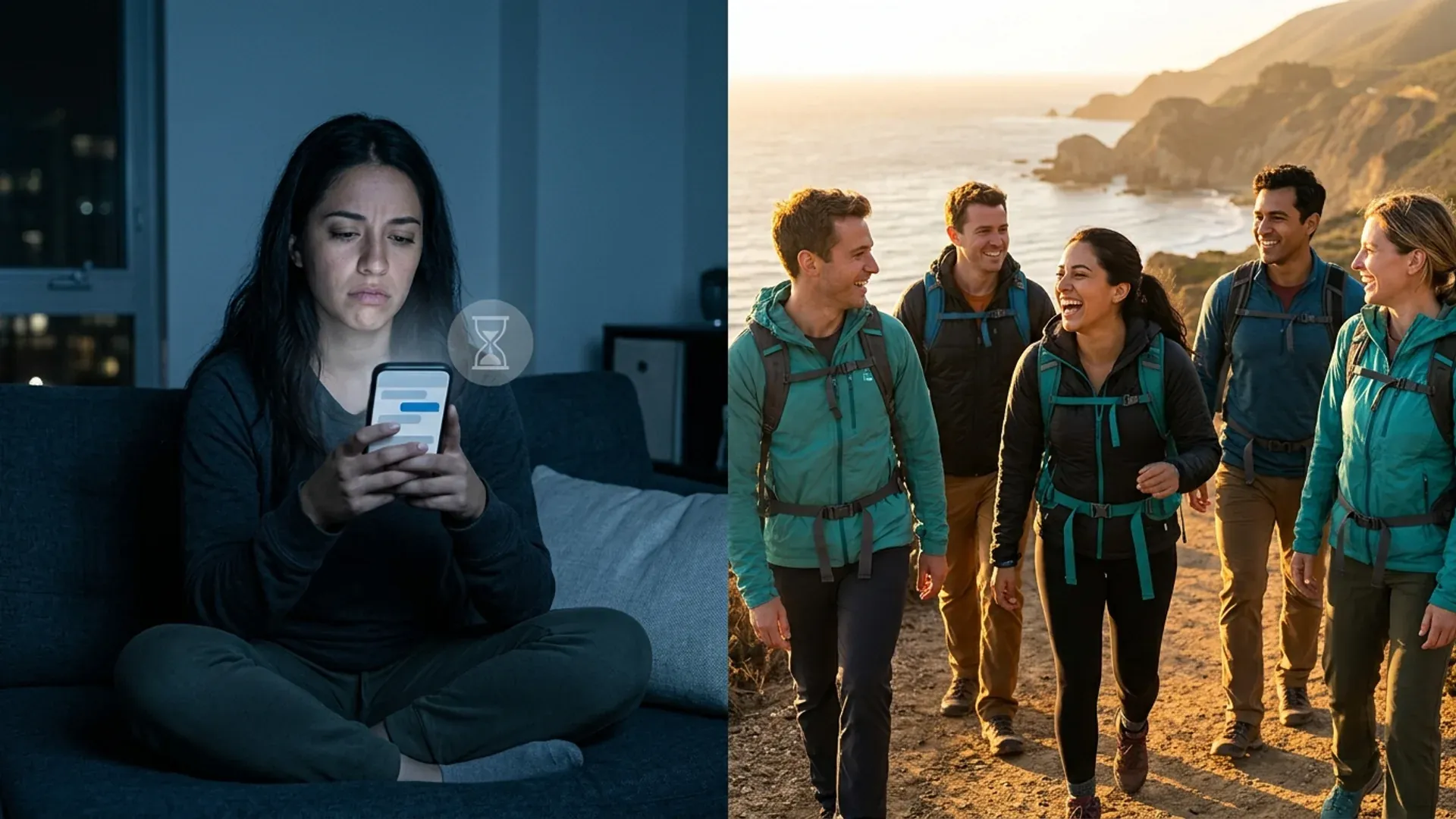
Bumble shipped one of the smartest product decisions in dating-app history: only women can send the first message, and they have 24 hours to do it. That single rule cleaned up the inbox, gave women control of the opener, and gave Bumble a moral high ground that Tinder still can't touch.
Then 2025 happened. Stock cratered into single digits. Whitney Wolfe Herd returned as CEO in early 2025 to fix a product that millions of users were quietly burning out on. Reddit and TikTok started naming the feeling: "Bumble fatigue" — the daily anxiety of timers expiring, the pressure of always being the one to start the conversation, the slow grind of matches that never turn into dates. In March 2026, Bumble launched Bumble 2.0 with "Bee," an AI Concierge designed to learn your values and deal-breakers and help curate matches. Stock jumped roughly 25% on the announcement. Whether the relaunch translates into better long-term outcomes for users is what 2026 is going to find out.
GRASS is solving the same problem from the opposite direction: skip the swipe, skip the timer, skip the chat. Meet through outdoor activities — a Sunday hike, a beach run, a climbing-gym meetup. If you're looking for a Bumble alternative that fixes the timer problem instead of layering AI on top of it, this is the closest match. Two radically different bets on the same broken thing. Here's an honest 6-dimension breakdown to help you decide which one actually fits you.
GRASS vs Bumble at a Glance
Dimension | Bumble | GRASS |
|---|---|---|
Matching | Swipe + 24-hour timer | Post or join an activity |
Who opens | Hetero: women must open first | No "first message" — activity is the invite |
Interaction | In-app DMs, then maybe meet | Meet in person while doing the activity |
Profile | Photos + prompts + self-claimed badges | Photos + Outdoor Passport (32+ activity types) |
Safety angle | Reduce harassment in DMs | Public, daytime, multi-person first meetings |
Free tier | Limited — most-wanted features paywalled | Find a Buddy, Group Adventures, chat all free |
Monthly price | Boost ~$16.99 / Premium ~$39.99 | Premium $24.99 / Ultimate $39.99 |
2026 update | Bumble 2.0 + Bee AI Concierge | Outdoor Passport, Group Adventures growing in major cities |
1. How You Find People: 24-Hour Timers vs Activity Invitations
Bumble: The classic swipe — except in heterosexual matches, only the woman can send the first message, and she has 24 hours before the match expires. Same-sex matches don't have the gender rule but still have the timer; either party can open. Bumble 2.0's "Bee" AI Concierge (launched March 2026) sits on top of this: it has private conversations with you to learn your values, communication style, and deal-breakers, then helps surface better matches and suggests opening lines.
GRASS: No swiping, no timers. You either post an activity through Find a Buddy ("Saturday morning trail run — anyone in?") or browse Group Adventures to join a multi-person outdoor activity someone else is hosting. There's no "match" to expire. There's no rule about who messages first. The activity is the invitation.
The real difference: Bumble fixed the harassment problem (women control the opener) — and that's a genuine, industry-leading achievement worth crediting. The cost was inheriting a new problem: the timer turns dating into a daily inbox you have to clear. GRASS removes the timer entirely by removing the matching layer. You don't need to "match" before you can do something together; the activity is the doing. For a deeper take on why activity-based interaction works, see Why run clubs are replacing dating apps in 2026.
2. The Interaction Burden: "Always First" vs "No First at All"
Bumble: Even after Bee tries to help, the structure remains the same — women open, men wait, conversations live or die in DMs, and at some point someone has to make the leap to "want to grab a drink?" The most common complaints across Reddit r/Bumble and TikTok #BumbleFatigue threads in 2025–2026 are: timers create pressure to send something fast (lowering quality), women describe it as "running a daily inbox," and chats that go well online still stall before becoming actual dates. Bee tries to address this with AI-assisted curation; whether it changes the underlying loop is what users are still figuring out.
GRASS: The interaction starts at the activity, not in DMs. Joining a Group Adventure or accepting a Find-a-Buddy invite is low-friction — a quick 🤙 or short note. There's no "first message anxiety" because the message is "I'm in for the hike." You meet at the trailhead, climbing gym, or coffee meetup, and the conversation happens in person, naturally, while you're both doing the thing. The fatigue Bumble users describe — repetitive swipe → chat → no follow-through loops — gets broken because every activity is a different setting with different people, not the same loop on a different day.
The real difference: Bumble made the "who opens" question fairer. GRASS made it irrelevant. If you've ever had a Bumble match where the chat went great for two days then quietly died because nobody pushed it offline, GRASS skips that entire failure mode. Related reading: A cure for dating-app fatigue.
3. Profile: Curated Bio + Interest Badges vs Outdoor Passport
Bumble: Photos + Profile Prompts (one-line answers like "My most controversial opinion is...") + Interest Badges. You can tag Hiking, Climbing, Camping, Yoga, etc. directly on your profile, and there are filters for them. The catch: badges aren't verified. A "Hiking" badge means you tapped a button. It tells you nothing about whether someone has actually been on a trail in the last six months. First-impression weight is still mostly photos and bio wit.
GRASS: In addition to standard photos, GRASS gives every user an Outdoor Passport — a structured display of your outdoor activity categories, locations, and milestones across 32+ activity types. It's still self-populated like Bumble's badges, but the resolution is much higher: you can see at a glance whether someone is into casual park walks vs serious trail running vs gym climbing, before you ever match.
The real difference: Same idea (show what you're into), executed at very different levels of granularity. Bumble's badge says "Hiking." GRASS's Passport says "Hiking — 12 Group Adventures over 8 months, mostly weekend day-hikes near LA." If you've ever matched on Bumble with someone whose "loves hiking" turned out to mean "did Runyon Canyon once in 2019," you'll feel the difference immediately.
4. Safety: Photo Verification + Block Tools vs Public-Setting Architecture
Bumble: Strong on the digital-safety basics — photo verification, in-app reporting, block lists, and Private Detector (auto-blurs explicit photos). The women-first rule itself is widely considered the gold standard in the industry for reducing unsolicited harassment, and that reputation is well-earned. But the underlying interaction model is still private DMs → 1:1 in-person meeting, and the safety burden of that first meeting still falls on the user.
GRASS: Three-layer safety architecture — AI + human review at signup, automated suspicious-behavior detection, face and identity verification. The bigger structural advantage: Group Adventures put your first meeting in a public, multi-person, daytime outdoor setting. Meeting four hikers at a trailhead at 9am is a categorically different risk profile from meeting one stranger at a bar at 9pm. For more on outdoor dating safety, see Social anxiety + outdoor activities guide.
The real difference: Bumble's safety strategy is interactional (control who can talk to you). GRASS's safety strategy is environmental (control where you first meet). Different theories, both legitimate. Bumble remains the standard-setter for in-DM safety; for "the first meeting itself," group settings beat private DMs structurally.
5. Pricing: What You Actually Get Without Paying
Bumble (US pricing, 2026):
- Free: basic swiping, women-first messaging, limited Super Likes
- Bumble Boost: ~$16.99/mo (see who liked you, Rematch with expired matches, extend matches)
- Bumble Premium: ~$39.99/mo (unlimited swipes, Travel mode, Spotlight, Beeline, includes Bee AI Concierge)
- Bumble Premium+: top-tier (incognito, Compliments, all features unlocked)
GRASS:
- Free: full Find a Buddy, Group Adventures, chat, Outdoor Passport — no daily limits
- GRASS Premium: $24.99/mo (Spark, Spotlight, visibility boosts)
- GRASS Ultimate: $39.99/mo (top-tier visibility and matching tools)
The real difference: Bumble's free tier is functional but gates the most-wanted features (seeing who liked you, rematching expired matches) behind paid tiers — and the new Bee AI Concierge sits inside Premium. The "you really need to pay to use this properly" feeling is well documented, especially for men. GRASS's core experience — finding activities and meeting people — works completely free; paid tiers are visibility add-ons, not core unlocks. You can run the full "download → find activity → join → meet" loop without paying.
6. Who Each App Is Actually For (Plus: What About Hinge?)
Choose Bumble if you...
- Like the swipe rhythm but want fewer creepy openers
- Enjoy controlling the opener and pace (regardless of gender)
- Want to try an AI-assisted matching layer (Bumble 2.0 "Bee")
- Travel internationally a lot — Bumble has a huge global user base and Travel mode
- Mostly meet people indoors anyway (bars, restaurants, work events)
- Are dating in a city where outdoor activity culture is thin
Choose GRASS if you...
- Are tired of 24-hour timers and watching matches expire
- Are exhausted by being "always first" — or by always waiting
- Prefer doing something to talking about doing something
- Want first meetings in public, daytime, multi-person settings
- Live in a city where outdoor activities are part of your weekend anyway (LA, Bay Area, Denver, Portland, NYC, Austin)
- Want a free tier that includes the actual core product
"What about Hinge?" Fair question. Hinge's "designed to be deleted" positioning targets the same intentional-dating audience Bumble 2.0 is now chasing. The honest answer: Hinge solves curation (better prompts, fewer profiles, slower swipe rhythm), but it's still swipe → chat → maybe meet. If you've already tried Hinge and felt the same chat-stall fatigue, GRASS's activity-first model is the next logical step. Side-by-side: 12 best dating apps for outdoorsy people (2026) covers the full landscape.
These apps aren't mutually exclusive — many people run several for different moods. A practical playbook: keep Bumble for couch-time matches, use GRASS as the "actually meet" layer that converts good chats into real Saturdays. For broader context, see Why men are leaving dating apps.
If you read all this and thought "I'm so done with timers" — try GRASS for one weekend. Download for free, browse the Group Adventures happening near you, find one that sounds like a Saturday you'd actually enjoy, and show up. If after a week nothing on the activity board appeals to you, delete it. Low commitment, no profile setup pain — same way you'd try any new app.
Frequently Asked Questions
Q: What's the fundamental difference between GRASS and Bumble?
Bumble assigns the "who opens" responsibility to women within a 24-hour timer. GRASS removes that responsibility entirely by replacing matching with shared activities — you meet because you both signed up for the same hike or climb, not because someone has to message first. Bumble is still swipe + chat → maybe meet. GRASS is activity-first: you meet by doing. Both are responses to the same diagnosis ("traditional swiping is broken") — just different prescriptions.
Q: Is "Bumble fatigue" really a thing?
Yes, and it's well documented in 2025–2026 user reviews and Reddit threads. The two recurring complaints are (1) the 24-hour timer creates a "daily inbox to clear" feeling, especially for women, and (2) chats often go well online but stall before becoming dates. Bumble's March 2026 launch of the "Bee" AI Concierge is partly an attempt to address this by making matching more intentional and less gamified.
Q: Why did Whitney Wolfe Herd return as CEO?
Whitney stepped down from the CEO role in early 2024 to focus on the executive chair, with Lidiane Jones (formerly of Slack) taking over. Through 2024 the stock declined sharply; by early 2025 the board reinstated Whitney as CEO to lead what she's framed publicly as a return to founder-led "intentional dating" — culminating in the Bumble 2.0 + Bee launch in March 2026. The stock jumped about 25% on that launch, signaling investor confidence in the relaunch — though the user-side impact is still being measured.
Q: What is Bumble 2.0 and the Bee AI Concierge?
Announced in March 2026 after Whitney's return as CEO, Bumble 2.0 introduces "Bee," an AI Concierge that has private conversations with you to learn your values, communication style, and deal-breakers, then helps curate matches and suggest opening messages. The strategic positioning is "intentional dating" instead of "gamified swiping." It's included in Bumble Premium. Whether the AI-mediated layer changes the underlying swipe-then-DM loop or just makes it more efficient is what mid-2026 user reviews are starting to surface.
Q: Is GRASS just for serious athletes?
No. GRASS supports 32+ activity categories from trail running and rock climbing to park walks, picnics, beach hangouts, farmer's markets, and yoga. Many Group Adventures are explicitly beginner-friendly. The point is doing something together outdoors — not athletic performance. If you can walk to a coffee shop, you can use GRASS.
Q: Can I run GRASS and Bumble at the same time?
Yes, and many people do. They serve different needs: Bumble for couch-time browsing and AI-assisted curation; GRASS for actually getting out of the house and meeting people in person. A practical playbook for Bumble users burning out on timers: keep Bumble for matching, use GRASS as the "actually meet" layer — when you have a Bumble match that's gone well in chat, invite them to next weekend's GRASS Group Adventure to break the chat-stall pattern. Download GRASS.
Q: Which app is safer for women?
Both apps invest seriously in digital safety (verification, reporting, blocking, AI moderation). Bumble's women-first rule is widely considered the industry standard for reducing in-DM harassment. GRASS's structural advantage is environmental: Group Adventures put your first meeting in public, multi-person, daytime outdoor settings — categorically lower risk than a private 1:1 first date. If your concern is in-DM harassment, Bumble. If your concern is the first physical meeting, group activities are the lowest-risk starting point.