Speed dating is worth trying if you are willing to send the first message afterward. Speed dating is an in-person singles event where you have a series of short, timed one-on-one conversations, then privately mark who you would like to see again. In a widely used public dataset of 4,184 of those dates, about one in six ended in a mutual yes, and the typical person went home with two matches. The weak spot came later: among people with a match who answered a follow-up survey three to four weeks on, 42% had been on a date with one, and 57% had never reached out to any of their matches themselves.
Most answers to this question are one person's night out. We wanted numbers, so we went through the data behind one of the best-known speed-dating studies, run by Columbia Business School professors Ray Fisman and Sheena Iyengar, which is publicly available. If you are mostly dreading four minutes of small talk with strangers, you are in good company: more than half of the participants surveyed said four minutes was too short. Below: how speed dating works, what happened across those dates, what predicted a yes, who it suits, questions to ask, and how to turn a match into an actual date. One note up front: we make GRASS, a dating app for meeting new people through sports, so we have a view on in-person formats. The numbers below are straight from the data.
What Is Speed Dating, and How Does It Work?
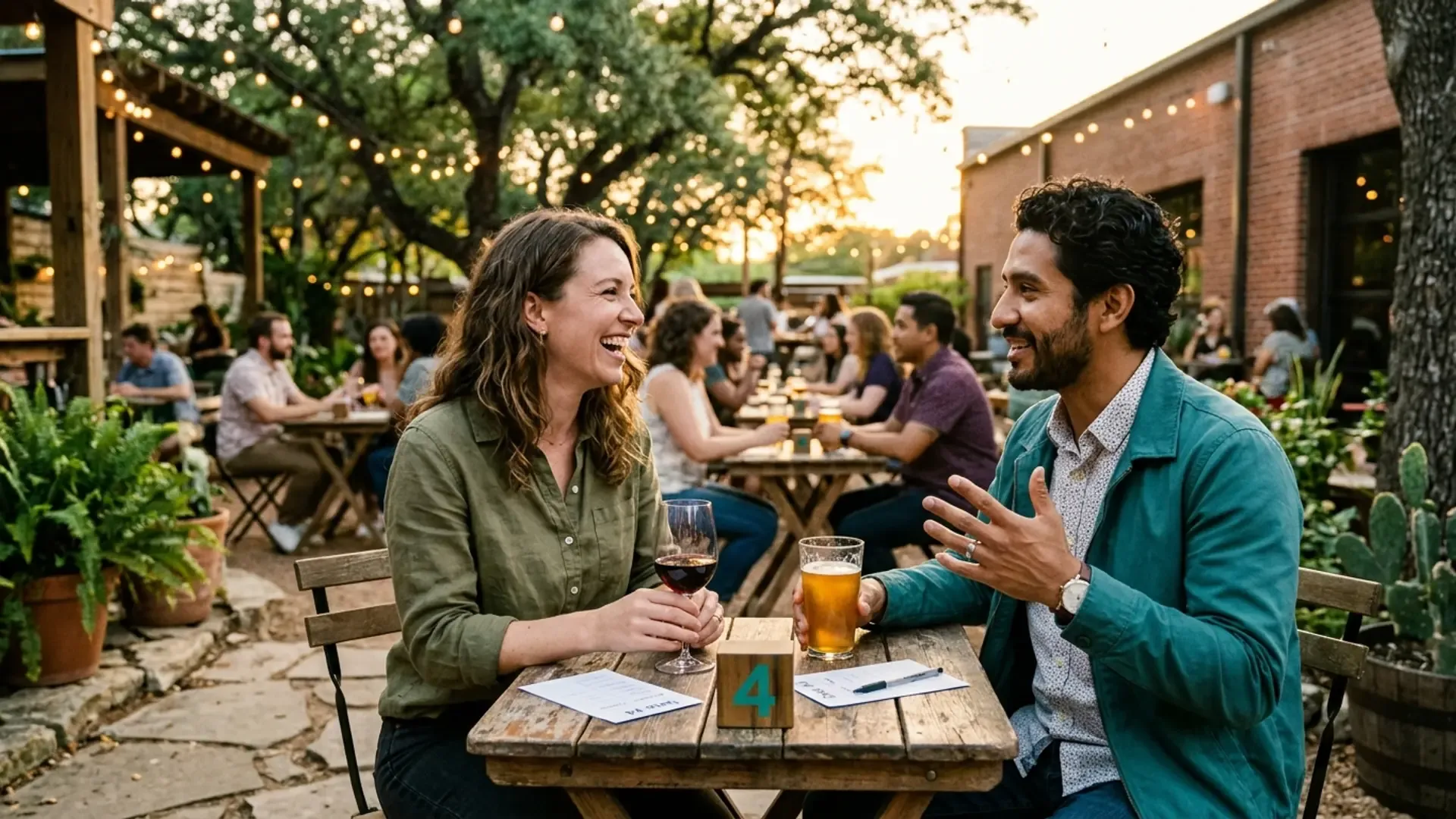
You arrive, get a name tag and a scorecard, and sit down for a round of short dates. When time is called, one side moves to the next table. At the end you mark yes or no for each person, and you only get someone's contact details if you both said yes, which is called a match. The length varies by organizer: the Columbia study used four-minute dates, the HurryDate events studied by Kurzban and Weeden used three, and Pre-Dating, an organizer running events since 2001, advertises six-minute "Pre-Dates" with at least 5 and up to 12 people in a night and handles the matching afterward. Tickets are often modest; a Los Angeles event on Meetup in August 2026 charged $25. Before you buy, check the age range on the event page and whether the organizer balances tickets, since a lopsided room means fewer dates for you.
What Happened in 4,184 Speed Dates
Short version: about 1 date in 6 ended in a mutual yes, the typical person left with two matches, and nearly 1 in 5 left with none. The dataset covers 551 people across 21 events held between 2002 and 2004. Each date lasted four minutes, and afterward everyone marked yes or no for each person they met. We tallied the results ourselves from the raw file. It has 8,378 rows, about two per date because both people rated each one. Ten ratings from men had no matching partner row, so they are left out of the 4,184 dates but still counted in the men's yes rate below (4,194 ratings). Percentages leave out the few rows where an answer was blank.
What we measured | Result | Based on |
|---|---|---|
Dates per person in one night | Median 16 (range 5 to 22) | 551 people |
Women who said yes to a given date | 36.5% | 4,184 ratings by women |
Men who said yes to a given date | 47.4% | 4,194 ratings by men |
Dates that ended in a match (both said yes) | 16.5% (690), about 1 in 6 | 4,184 dates |
Matches per person | Median 2 (average 2.5) | 551 people |
People who left with zero matches | 18% | 551 people |
Matches people expected vs. got | Expected 3.0 on average, got 2.4 | 479 who answered |
Said four minutes was too short | 55% | 485 who answered the next day |
Went on a date with a match within 3–4 weeks | 42% | 226 people with a match who answered the follow-up |
Had not reached out to any of their matches themselves | 57% | Same 226 people |
No contact with any match in either direction | 26% | Same 226 people |
Two numbers are worth a second look. People expected about three matches and got a bit over two, and about half overestimated, so a night with two matches is a typical result. And if you are one of the 18% who leave with none, that is a common result of the format, not a verdict on you.
Read it with a few caveats. The participants were mostly Columbia graduate and professional students (one of the 21 events drew undergraduates), with a median age of 26. The events paired men with women, so the data says nothing about same-sex events. It is also two decades old, and the four-minute dates were shorter than at many events today. Also, only half of the 452 people with at least one match answered the follow-up survey, so the last three rows describe the people who replied, not everyone.
Even with those limits, the shape is useful. The event itself produces matches for most people. The drop-off happens in the weeks after, when a match has to become a message and a message has to become a plan.
What Predicts a Yes at Speed Dating?
The more someone liked their date overall, the more likely they were to say yes, and of the six traits rated, attractiveness lined up with a yes most closely. After each date, people rated their partner from 1 to 10. When we lined those ratings up with the yes/no decisions, the overall "how much do you like this person" score moved closely with a yes: people who gave a 5 said yes 17% of the time, a 7 meant yes 59% of the time, and a 9 meant yes 84% of the time. These are ratings made at the same moment as the decision, so they show what went together, not what caused what.
Trait rated after the date | Correlation with saying yes | In plain terms |
|---|---|---|
Attractive | 0.49 | Strongest link |
Fun | 0.41 | Strong |
Shared interests | 0.40 | Strong |
Intelligent | 0.22 | Weak |
Sincere | 0.21 | Weak |
Ambitious | 0.18 | Weak |
That lines up with the published research. Analyzing the same experiment, Fisman and colleagues (2006) found that women put more weight on a partner's intelligence and race, while men responded more to physical attractiveness. In a much larger study of 10,526 people at commercial HurryDate events, Kurzban and Weeden (2005) found that what made someone widely desirable came almost entirely from visible traits like attractiveness, body weight, height, and age. And Eastwick and Finkel (2008) found that the preferences people listed before a speed-dating event failed to predict whom they were actually drawn to there. A checklist is a weak guide to who you will click with in person.
One more pattern stood out. We split people into four groups by how often they said yes. The pickiest quarter got a yes from 51% of their dates; the quarter who said yes most often got one from about a third. A 2007 speed-dating study by Eastwick, Finkel, Mochon and Ariely, reported by ScienceDaily, found that people who were attracted to nearly everyone were seen as less desirable. Our table cannot prove that by itself, because people who get a lot of interest can also afford to be pickier. The takeaway is modest: saying yes to everyone is not a winning strategy.
So, Is Speed Dating Worth It for You?
It depends less on the event and more on how you meet people. Here is a straight read of who tends to get value from it.
- Worth it if you want volume in person. Anywhere from five to a dozen or more first impressions in one evening, depending on the organizer, with no profile to write.
- Worth it if you will act within a day or two. In the follow-up, most of the people who answered had never sent the first message. If you do, you are already ahead of most of them.
- Less worth it if you take a while to warm up. More than half of the participants surveyed said four minutes was too short. If you are better on the third conversation than the first, a format where you see the same people more than once will show you off better.
- Less worth it if you want someone who shares your weekends. Four minutes can tell you whether you enjoy talking to someone. It cannot show you whether you would enjoy a Saturday hike together.
Speed Dating Questions to Ask
Ask about what people enjoy doing, not what they do for a living. Four minutes goes fast, and "so, what do you do?" can burn a quarter of it on a résumé. In the data, shared interests tracked a yes almost as closely as being fun did, so the goal is to find one thing you both like and let the conversation run there.
Easy openers
- "What made you sign up tonight?" It is honest, and everyone has an answer.
- "What's something you're looking forward to this month?"
- "How has your week been, honestly?"
- "Is this your first one of these?"
- "What did you do before coming here today?"
Questions that find shared interests
- "What do you do on a good Saturday?"
- "What's the last thing you got a little obsessed with?"
- "Where would you take someone visiting the city for one day?"
- "What's something you're learning right now?"
- "What's a trip or trail you keep meaning to do?"
- "Are you more of a morning person or a late-night person?"
Questions that show who someone is
- "What's something you changed your mind about in the last few years?"
- "What do your friends come to you for?"
- "What would make this a good year for you?"
- "What's a small thing that makes your day better?"
Questions to skip
- Why are you single? It puts people on the defensive in minute one.
- Anything about exes. Save it for date three, if ever.
- Income, or rapid-fire résumé questions. They turn a date into an interview.
- "So what are you looking for?" Fair to know eventually, but heavy at the first table.
Speed Dating Tips for the Night and the Day After
- Arrive 10 minutes early. The room is quieter, and chatting with the host or the person next to you takes the edge off before the first bell.
- Jot one detail after each date. By date twelve, names blur. A word like "climber" or "moving to Denver" is enough to remember who was who.
- Mark yes on anyone you would genuinely like to talk to again. A yes is not a commitment, just a second conversation, but a yes to everyone does not help you either.
The follow-up most people skip
- Message within a day or two of getting your matches. Mention one thing from your few minutes so they remember which date you were.
- Suggest a specific, short plan. "Coffee and a walk around the park Saturday at 10?" is easier to say yes to than "we should hang out."
- Do not wait to be contacted. In the follow-up, 57% of the people who answered had not reached out to any of their matches themselves, and about a quarter had no contact with a match in either direction. If you both wait, nothing happens. Go first.
If texting has gone well before and the first meeting fell flat, we cover why that happens in Good Texter, Bad Date.
What If Four Minutes Isn't Enough?
Then pick a setting where you see the same people again. A run club with coffee after, a rec league, or a weekly class gives you an hour at a time instead of four minutes, and you get more than one chance to make an impression. It also takes the pressure off, because nobody is scoring anyone at the end of the night. We scored a dozen of those settings in How to Make Friends as an Adult, and the same structure works for meeting someone to date.
That is the idea behind GRASS. You can join a group plan if there is one near you, like a Saturday hike, an easy run, or just a walk, or post the plan you want and find someone to do it with. Some of the people you meet become friends and some become dates. We are still early in the U.S., so in many areas you may be the one posting the first plan. GRASS is free to download, with optional Premium and Ultimate tiers.
FAQ: Speed Dating
Is speed dating worth it?
It is worth trying if you will follow up. In the public Columbia data, about 1 in 6 dates ended in a mutual yes and the typical person left with two matches, so the event itself works for most people. The weak link is afterward: of the people with a match who answered a follow-up three to four weeks later, 42% had been on a date with one and 57% had never reached out first.
What is speed dating?
Speed dating is an in-person singles event where you have a series of short, timed one-on-one conversations, a few minutes each (three to six in the formats we looked at), then privately mark who you would like to see again. Contact details are shared only when both people say yes.
What percentage of speed dates end in a match?
In 4,184 dates from 21 Columbia events (2002–2004), 16.5% ended in a match, meaning both people said yes. Women said yes to 36.5% of their dates and men to 47.4%. About 18% of participants left with no matches.
What if I get no matches at speed dating?
It happens to a lot of people: 18% of participants in the Columbia data left with none, and on average people expected more matches than they got. One night is a small sample. Try a different event or age range, or a format where you see people more than once.
What should I ask at speed dating?
Skip the résumé questions and ask what people enjoy, such as "What do you do on a good Saturday?" or "What's something you're looking forward to this month?" In the data, shared interests tracked a yes almost as closely as being fun, so look for one thing you both like.
How much does speed dating cost?
It is often modest. One Los Angeles event listed on Meetup in August 2026 charged $25 a ticket. Prices vary by city, organizer, and venue, so check what is included, such as a drink, before you buy.
Is speed dating better than dating apps?
It solves a different problem. Speed dating gives you many in-person first impressions in one night, without photos or profiles. Apps give you more options over time. Neither works if nobody follows up, and if you need longer than a few minutes to show who you are, a recurring activity may suit you better. Sports-based dating apps such as GRASS are built around that: you meet people through a plan, like a hike or an easy run, instead of a four-minute round.
Before Your First Speed Dating Night
Pick an event in your age range, write down two questions you actually want answered, and decide now that you will send the first message the next day. If you would rather meet people over an afternoon than four minutes, open GRASS and post the plan you would like company for.
Related reading:
- The Paradox of Choice in Dating Apps, why more options can make choosing harder
- The Suspension Bridge Effect, what the famous attraction study really found
- How to Make Friends as an Adult, the settings where you see the same people every week