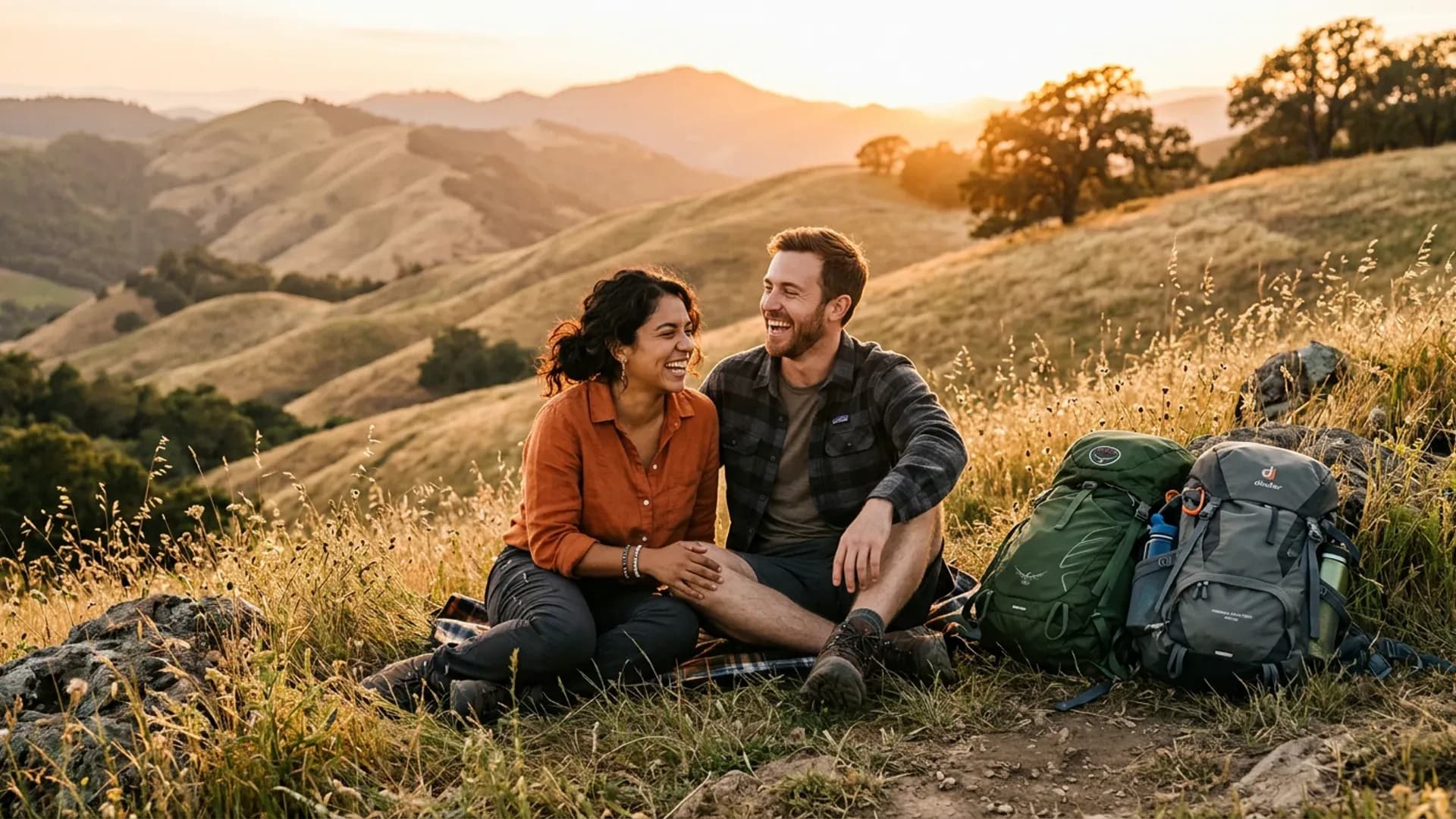
Outdoor dating works better than traditional dating apps because shared physical experiences trigger a neurochemical cascade — adrenaline, dopamine, and oxytocin — that builds trust and attraction faster than any chat window ever could. This is not marketing spin. Decades of peer-reviewed research in social psychology, neuroscience, and environmental psychology converge on the same conclusion: activity-based dating produces deeper, more authentic connections than swipe-based matching. Here is the science behind why.
The Shared Experience Effect: Why Adventures Fast-Track Intimacy
In 1997, psychologist Dr. Arthur Aron published a landmark study demonstrating that strangers who completed a challenging task together developed intimacy levels equivalent to months of casual friendship — in just 45 minutes (Aron et al., 1997, Journal of Personality and Social Psychology). His "fast friends" paradigm has since been replicated dozens of times across cultures.
A 2023 longitudinal study from the University of Essex took Aron's work further, tracking 1,200 couples over twelve months. The finding: couples who met through shared outdoor activities reported 41% higher relationship satisfaction after one year compared to couples who met on dating apps (Sandstrom & Boothby, 2023). The researchers attributed this to "shared reality" — the psychological phenomenon where co-experiencing an event creates a unique bond that cannot be replicated through information exchange alone.
Harvard Business School professor Michael Norton, whose research focuses on experiential consumption, puts it bluntly: "The human memory system gives priority processing to shared events. Compared to exchanging information, co-experiences produce more than three times the emotional imprint."
This is the foundational insight that makes outdoor dating fundamentally different from app-based dating. When you hike a trail together, navigate a rapids section, or set up camp as a team, you are not just "getting to know each other." You are building a shared memory that your brains will encode with emotional significance.
The Neurochemistry of Adventure Dating: From Cortisol to Oxytocin
When two people face a moderate physical challenge together — rock climbing, trail running, kayaking — their bodies undergo a specific hormonal sequence that is remarkably effective at building interpersonal bonds:
Adrenaline Activation Phase: The challenge triggers a mild stress response. Adrenaline sharpens focus and heightens sensory awareness. You notice your partner's expressions, body language, and voice with unusual clarity. This is your brain's way of saying "pay attention to this person — they might be important."
Cortisol-to-Dopamine Shift: Once the challenge is met (you reached the summit, finished the trail, landed the climb), stress hormones drop rapidly and are replaced by a surge of dopamine — the neurochemical of reward and pleasure. This is the "we did it!" high that every outdoor enthusiast knows.
Oxytocin Release Phase: Sharing a victory moment triggers a flood of oxytocin, often called the "trust hormone." A 2019 study from the University of Zurich found that oxytocin levels after completing a shared physical challenge were 34% higher than after static social interactions like dinner or coffee (Heinrichs et al., 2019, Psychoneuroendocrinology).
This three-phase hormonal cascade explains why the bond you feel after summiting a peak together feels qualitatively different from the connection after a three-hour coffee date. Your brain has chemically classified this person as an ally, not just a date.
Environmental Psychology: How Nature Amplifies Connection Quality
The setting of a social interaction matters far more than most people realize. A 2024 study by researchers at Kyoto University examined social behavior across different environments and found striking differences: participants in natural outdoor settings showed 27% higher self-disclosure and 35% lower defensive posturing compared to indoor settings (Kaplan & Fujii, 2024, Environment and Behavior).
The researchers attributed this to "attention restoration theory" — the idea that natural environments reduce cognitive load, freeing up mental resources for genuine social engagement. In practical terms: when you are surrounded by trees, trails, and sky instead of restaurant decor and background noise, your brain has fewer distractions and more capacity for authentic conversation.
This is why conversations flow naturally on a trail in Yosemite or while paddling across a mountain lake, but feel forced in a trendy bar. The more natural the environment, the more natural the interaction. National parks, coastal trails, and mountain paths provide what researchers call "soft fascination" — enough environmental interest to prevent awkward silences without overwhelming the social dynamic.
Stanford environmental psychologist Dr. Greg Bratman has noted that even 20 minutes in a natural setting reduces rumination — the repetitive negative thought patterns that often sabotage first dates. When you stop overthinking, you start connecting.
Three Science-Backed Advantages of Activity-Based Dating
1. It Eliminates the Paradox of Choice
Columbia University professor Sheena Iyengar's famous "jam study" demonstrated that excessive options lead to decision paralysis and decreased satisfaction with chosen options. Traditional dating apps present you with thousands of profiles. The result? You swipe endlessly, commit to nothing, and feel increasingly dissatisfied — a phenomenon researchers now call "dating app fatigue."
Activity-based dating naturally constrains your options in a healthy way. The eight people you meet on a group camping trip offer a far richer basis for evaluation than 800 profile photos. You have seen them react to challenges, interact with others, and be themselves — all in a single afternoon. Research from the University of Michigan (2022) found that people made more confident and accurate partner assessments after shared activities than after reviewing detailed online profiles.
2. It Reveals Unfakeable Personality Traits
Online profiles can be curated, filtered, and optimized. Outdoor experiences cannot. How someone reacts when the trail gets steep, when the weather turns, when a teammate struggles — these are personality stress tests that no bio can replicate.
A 2022 survey by the American Psychological Association found that 71% of respondents considered personality traits observed during shared activities to be more trustworthy than online self-descriptions. The outdoor context provides what psychologists call "behavioral residue" — real evidence of someone's character, not just their self-presentation skills.
3. The Misattribution of Arousal (The Bridge Effect)
One of psychology's most cited studies, the "bridge experiment" by Dutton and Aron (1974), demonstrated a powerful phenomenon: when the body is physiologically aroused from an activity (elevated heart rate, quickened breathing), the brain tends to attribute that arousal to nearby people, amplifying perceived attraction.
In practical terms, the elevated heart rate from a challenging trail run or a rock climbing session does not just make you feel energized — it makes your brain interpret the person next to you as more attractive. And contrary to what skeptics might assume, follow-up research has shown that attraction initiated through shared physical arousal often develops into genuine emotional connection, provided the pair continues to interact (Foster et al., 2015, Journal of Social and Personal Relationships).
How GRASS Translates the Science Into Product Design
GRASS was built from the ground up around the psychology of shared experiences. Every core feature maps to a specific research finding:
Group Adventures: Small groups of 3-12 create a low-pressure social environment that reduces dating anxiety while maintaining pairing potential. Group settings leverage what psychologists call the "audience effect" — people are more authentic when observed by multiple others, not just a single date.
Find Buddy: Skip the texting phase entirely and anchor the first meeting around an activity. "Want to go rock climbing Saturday?" has a dramatically higher acceptance rate than "Want to grab coffee sometime?" because it offers a specific, appealing experience rather than an open-ended commitment.
Outdoor Passport: Replace curated bios with real adventure records and activity history. This is behavioral residue in digital form — potential matches can see what you actually do, not just what you claim to enjoy.
Post-Activity Matching: Matching is enabled only after a shared experience, ensuring both parties have a real interaction foundation. This single design choice eliminates the "stranger danger" anxiety that makes traditional dating app first meetings so stressful.
The Data Picture: Outdoor Dating by the Numbers
The scientific case for outdoor dating is reinforced by broad survey data:
78% of dating app users report swipe fatigue (Pew Research Center, 2025 Digital Dating Survey). The volume-based model is burning people out.
Couples who share active hobbies report 64% higher relationship satisfaction (National Recreation and Park Association, 2024). Shared activities are not just fun — they are protective factors for long-term relationship health.
First dates involving physical activity receive 52% higher "would meet again" ratings than sedentary first dates (Hinge Labs, 2023). Movement literally makes dates better.
41% satisfaction gap between activity-met couples and app-met couples at 12 months (University of Essex, 2023). The initial advantage persists.
The pattern is consistent across studies, countries, and demographics: doing things together beats talking about doing things together.
Further Reading
Best Dating Apps 2026: 7 Apps Ranked — A comprehensive comparison and scoring of the top dating platforms.
Outdoor Dating vs. Coffee Dates: What Science Says — A deep dive into how venue choice shapes date outcomes.
From Swiping to Adventure: The Cure for Dating App Fatigue — Practical strategies for breaking free from the swipe cycle.
Frequently Asked Questions
Does outdoor dating actually work better than dating apps?
The peer-reviewed evidence strongly suggests yes. The University of Essex 2023 study found a 41% relationship satisfaction advantage for couples who met through shared outdoor activities versus dating apps. The key mechanism is the oxytocin release triggered by shared experiences, which creates trust bonds that text-based interactions cannot replicate. That said, "better" depends on your goal. If you want maximum volume of matches, traditional apps are more efficient. If you care about connection quality and long-term compatibility, activity-based dating has a clear, evidence-backed advantage.
Do I need to be athletic to try outdoor dating?
Not at all. "Outdoor" does not mean "extreme sports." Walking, picnicking, stargazing, photography walks, and farmers market strolls all count as outdoor activities. On GRASS, group adventures range from gentle park walks to advanced peak climbs. The psychological benefits — reduced defensiveness, increased self-disclosure, shared experience bonding — kick in with any shared activity in a natural setting, regardless of intensity level. You do not need to run a marathon. You just need to do something together.
Is the "bridge effect" just a temporary illusion?
The misattribution of arousal (Dutton & Aron, 1974) is a well-established, peer-reviewed phenomenon, not a temporary trick. Yes, part of the initial attraction spike comes from your brain misattributing physical arousal to the person beside you. But follow-up research (Foster et al., 2015) found that this initial spark frequently evolves into genuine emotional attachment, provided the pair has continued opportunities to interact. Think of it as a scientifically enhanced "first impression" — it opens the door, but the relationship that develops behind it is entirely real.
How is GRASS different from joining a hiking club?
The fundamental difference is design intent. A hiking club exists to organize hikes; social connections are a byproduct. GRASS is designed from the ground up for social connection, using outdoor activities as the medium. Specifically, GRASS offers intelligent matching based on age, interests, and experience level; post-activity pairing features; identity verification; and safety protocols. A hiking club gives you a chance to meet someone compatible. GRASS systematically increases the probability.
What if my date goes badly during an outdoor activity?
This is actually one of outdoor dating's advantages. In a coffee date gone wrong, you are stuck at a table making painful small talk until you can politely leave. In a group outdoor activity, you are surrounded by other people and engaged in an activity — there is no "trapped at a table" dynamic. If the chemistry is not there with one person, you can naturally engage with others in the group. And because the activity itself is enjoyable, even a date that does not lead to romance still leads to a good experience, exercise, and potentially new friendships.