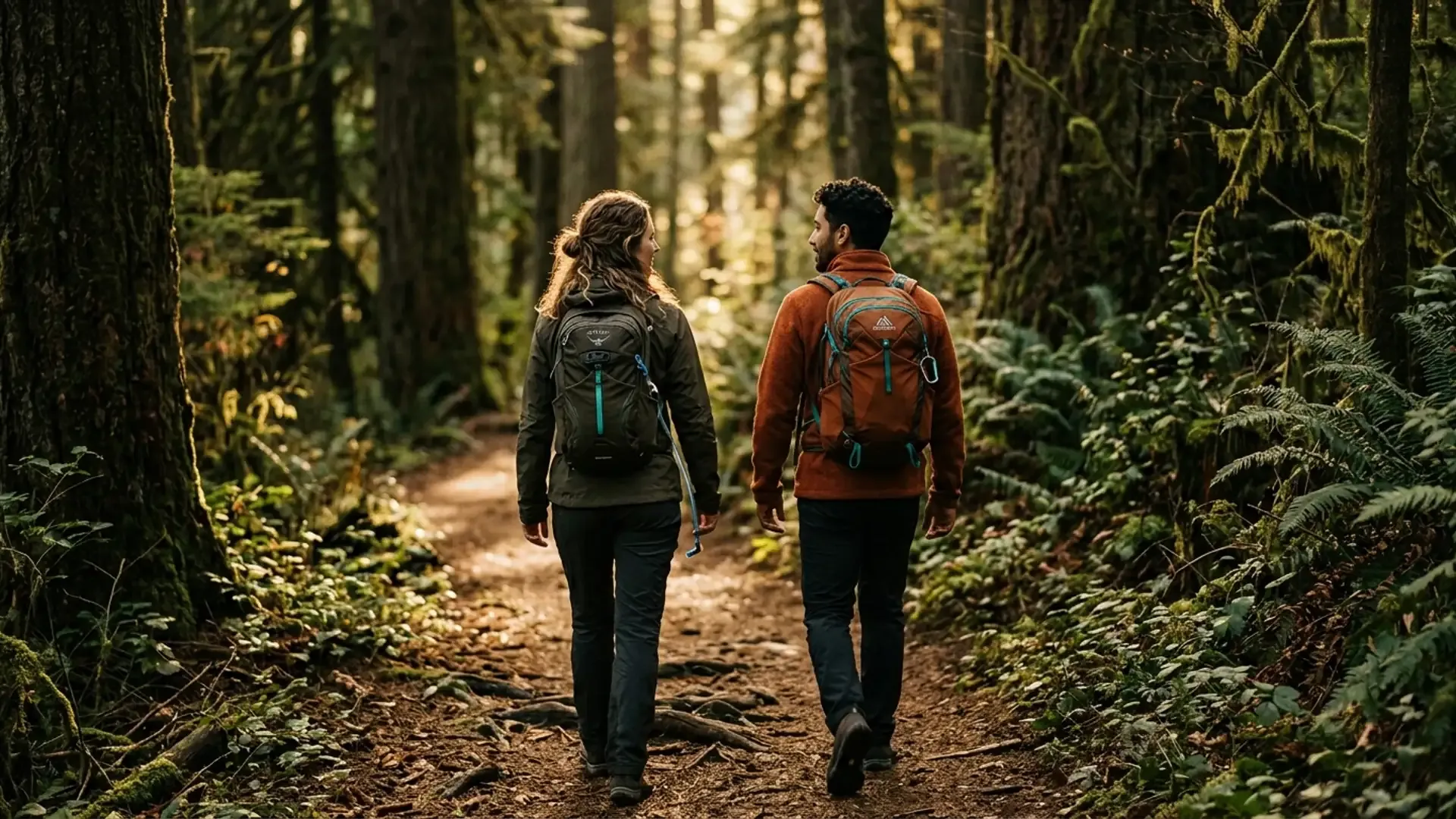
If the thought of crafting the perfect dating profile, sustaining witty text banter with five strangers, and then sitting across from someone at a coffee shop making forced eye contact sounds exhausting — you're not alone.
Outdoor dating for introverts means replacing high-pressure, face-to-face date formats with side-by-side outdoor activities where connection happens through shared experience, not forced conversation. According to the Myers-Briggs Company's analysis of over 900,000 respondents, roughly half of the American population leans introverted. That's up to 165 million people navigating a dating landscape built almost entirely for extroverts.
Here's the good news (and yes, we're an outdoor dating app telling you to go outside — but hear us out, because the science is real): nature lowers the stress hormones that make small talk painful, side-by-side activities remove the eye-contact trap, and shared physical challenges fast-track trust in ways that no amount of texting ever could. This guide breaks down why — and how to start this weekend.
Why Do Dating Apps Drain Introverts? The Mismatch No One Talks About
The problem isn't that introverts are bad at dating. The problem is that mainstream dating apps were designed around extroverted interaction patterns.
A 2023 Pew Research Center survey found that 46% of online daters rate their overall experience as negative. A separate 2024 Forbes Health survey of 1,000 Americans went further: 78% of dating app users report emotional burnout, with 79% of Gen Z and 80% of women citing exhaustion. For introverts, who process social stimuli more deeply, these numbers likely understate the problem.
Here's what makes swiping apps uniquely draining for introverts:
- Constant novelty overload. Highly sensitive people — who overlap significantly with introverts — process stimuli more deeply, as psychologist Elaine Aron documented in her foundational research. Every new profile triggers a full evaluation cycle, depleting mental energy far faster than for extroverts.
- Juggling shallow DMs. It's not that introverts dislike texting — many actually prefer it to phone calls. The issue is maintaining five simultaneous shallow conversations with strangers. That "always on" bandwidth is what introverts find most taxing.
- High-stakes first meetings. A coffee date with a stranger is essentially a 60-minute interview. For introverts, who warm up slowly and prefer depth over breadth, this format almost guarantees an awkward first impression — followed by a 24-48 hour energy crash that nobody talks about.
- Photo-first judgment. Introverts tend to express personality through actions and shared experiences, not curated selfies. When your best qualities are invisible on a profile, the algorithm works against you.
The result? Millions of introverts either grind through an experience that doesn't suit them, or quietly opt out of dating altogether. The U.S. Surgeon General's 2023 advisory declared loneliness a public health epidemic, comparing its health impact to smoking 15 cigarettes a day. For introverts who've abandoned apps, the options feel even more limited.
But what if the solution isn't a better app — but a better setting?
The Science Behind Why Outdoor Settings Work for Introverts
Outdoor environments don't just "feel" better for introverts — the neuroscience explains exactly why they work.
Nature Lowers the Stress That Makes Small Talk Painful
A landmark 2019 University of Michigan study published in Frontiers in Psychology found that spending 20-30 minutes in a natural setting reduces cortisol at a rate of approximately 21% per hour — with peak efficiency in that 20-30 minute window. A 2021 University of York meta-review confirmed that group outdoor activities lasting 20-90 minutes showed the strongest mental health benefits of any format studied.
As lead researcher Dr. MaryCarol Hunter's work suggests, nature actively helps regulate stress — it isn't merely a pleasant backdrop. For introverts, whose nervous systems are more sensitive to stimulation, lower cortisol means the social anxiety that normally hijacks conversation physically can't fire at the same intensity.
Side-by-Side Activities Remove the Eye-Contact Trap
Psychologist Susan Cain, author of Quiet: The Power of Introverts in a World That Can't Stop Talking, identifies "shoulder-to-shoulder" interaction as one of the most powerful social formats for introverts. Unlike face-to-face settings (coffee dates, dinner tables), activities like hiking or trail running place people side by side — reducing the pressure of sustained eye contact while keeping conversation natural and optional.
The data backs this up: a survey by Greene King and OnePoll found that 52% of men feel more comfortable discussing personal topics when side-by-side (walking, driving, sharing an activity) rather than face-to-face. Among 18-24 year olds, only 29% felt comfortable with difficult conversations in a face-to-face setting. The principle applies broadly — psychologists now call it "adult parallel play," and it's why a two-hour hike often produces deeper conversation than a two-hour dinner.
Shared Physical Challenge Accelerates Trust
The classic misattribution of arousal finding by psychologists Dutton and Aron (1974) showed that physiological excitement from a challenging environment gets partially attributed to the people sharing that experience. More recent research from Oxford's Institute of Cognitive and Evolutionary Anthropology found that synchronized physical activity — like walking at the same pace on a trail — releases endorphins and measurably increases social bonding. For introverts who struggle with the artificiality of date conversation, a shared physical experience provides authentic emotional connection without requiring verbal performance.
5 Best Outdoor Activities for Introverted Daters
Not all outdoor activities are equal for introverts. The best ones share three qualities: natural conversation pacing, built-in breaks, and a focus on the experience rather than "getting to know you." Here are five picks — and the best part? Most of them are free.
1. Hiking (The Gold Standard)
Hiking is the most introvert-friendly date activity in existence. The trail sets the pace, uphills create natural silence, and viewpoints offer shared awe moments. The whole experience lasts 2-4 hours — long enough for an introvert to actually warm up. Interestingly, research from the University of Virginia found that introverts show a measurable preference for mountainous, wooded terrain over open landscapes, suggesting nature and introversion are more connected than we think.
Best for: First meetings. Choose a moderate 3-5 mile trail so neither person is too winded to talk. National forests and state parks across the US offer thousands of options — see our guide to the 10 best US hiking trails for meeting people.
2. Trail Running Groups
Trail running clubs are booming — Strava's 2024 Year in Sport report shows a 59% increase in running club membership globally. Unlike road running groups where you might feel pressure to chat, trail running demands focus on footing, creating comfortable stretches of shared silence with bursts of conversation at water stops.
Best for: Building familiarity over time. Introverts prefer deepening existing connections over constantly meeting new people. A weekly trail run group lets you see the same faces repeatedly — the exact pattern that University of Kansas psychologist Jeffrey Hall's research shows works best (roughly 50 hours of interaction to build a friendship).
3. Kayaking or Stand-Up Paddleboarding
Water activities combine nature immersion with a natural conversation distance. You're close enough to talk but far enough that silence isn't awkward. The paddle rhythm creates a meditative focus that lowers social vigilance — exactly what introverts need to drop their guard.
Best for: Second or third outings. The logistics of gear and water access add a collaborative element that deepens connection beyond surface-level chat.
4. Rock Climbing (Indoor or Outdoor)
Climbing is uniquely powerful for connection because it requires literal trust — when someone belays you, they hold your safety. As researcher Brené Brown has documented, shared vulnerability accelerates intimacy far beyond what conversation alone can achieve. Plus, climbing gyms are climate-controlled and widely available in US cities.
Best for: Introverts who want depth fast. The gym eliminates weather uncertainty while preserving the trust-building dynamic.
5. Group Outdoor Adventures
For introverts who find one-on-one first meetings too intense, group adventures are the pressure valve. National park group hikes, outdoor yoga meetups, or volunteer trail maintenance days let you observe before engaging — a natural introvert strategy that swipe apps completely eliminate.
Best for: Overcoming the "cold start" problem. In a group, you can connect with someone after watching how they interact with others first — building a mental model before investing social energy. Explore 8 US national parks perfect for group activities.
Want to skip the research phase? GRASS is built specifically for this. Unlike Meetup (general events, not dating-focused) or REI classes (great but not designed for connection), GRASS matches you with outdoor group adventures where everyone is open to meeting new people. You browse by activity type — hiking, running, climbing — not by photos. And because it's group-first, there's none of the one-on-one pressure that makes app dating miserable for introverts.
How to Start When "Putting Yourself Out There" Feels Impossible
Knowing that outdoor dating works for introverts is one thing. Actually showing up is another. Here's a realistic, low-pressure framework.
Step 1: Start with Group, Not One-on-One
Skip the one-on-one first date entirely. Join a group outdoor activity where meeting people is a side effect, not the stated purpose. This removes the "I'm here to find a date" pressure that introverts find most paralyzing.
Step 2: Use the "Recharge Rule"
Plan social activities on days when your energy is highest, and protect recovery time afterward. Schedule a Saturday morning hike followed by a quiet afternoon — not a hike followed by brunch followed by a friend's party. Your future self will thank you.
Step 3: Let Repeated Exposure Do the Work
Professor Jeffrey Hall's research at the University of Kansas found that it takes approximately 50 hours of interaction to move from acquaintance to casual friend. That's actually great news for introverts — it means you don't need to make a stunning first impression. You just need to keep showing up. A weekly hiking group, a bi-monthly trail run, a regular climbing session: consistency beats charisma.
Read more: The 50-Hour Friendship Rule: How Long Does It Really Take to Make a Friend?
Step 4: Embrace the Quiet Moments
On trail, in a kayak, at the crag — silence isn't failure. It's the natural rhythm of outdoor activity. Unlike a dinner date where a pause feels like disaster, outdoor silence is comfortable and expected. For introverts, the freedom to be quiet without social penalty is the single biggest advantage of outdoor dating.
A Note on Safety: Outdoor Dating Done Right
Meeting anyone new outdoors requires basic precautions — especially for women, who consistently report safety as their top concern with any dating format:
- Start with populated trails and group activities — not remote backcountry. Save the adventurous spots for after you've built trust.
- Share your plans — tell a friend where you're going, who you're meeting, and when you'll be back. Share your live location.
- Meet at the trailhead, don't carpool — keep your own transportation for the first few meetups.
- Trust your instincts — introverts are often excellent at reading people quietly. If something feels off, it probably is.
Group outdoor activities offer a natural safety advantage over one-on-one app dates: you're surrounded by other people, in public, doing something active. It's inherently lower-risk than meeting a stranger alone at a bar.
Why Outdoor Dating Matters More Than Ever in 2026
Meanwhile, third places — the cafes, community centers, and public spaces where Americans traditionally made friends — are disappearing. For extroverts, a bar or a party can fill the gap. For introverts, these environments are actively hostile.
Outdoor activity groups are emerging as the replacement third place — structured social interaction in low-stimulation environments where depth is possible, silence is welcome, and you don't need to shout over music. Communities like Outdoor Afro (60,000+ members across 60 US cities) and Women Who Hike demonstrate that this isn't a niche trend — it's a movement.
If you're an introvert who's given up on dating apps, you haven't failed at dating. You were simply using the wrong tool for your personality type. The trails, rivers, and mountains were waiting for you all along.
Ready to try? GRASS connects you with outdoor adventures — not small talk. Join a group hike, find a climbing partner, or create your own trail run. No swiping. No scripts. Just real people doing real things, outdoors.
More reading: The Complete Guide to Outdoor Dating: Replacing Swipes with Adventures
Frequently Asked Questions
Is outdoor dating actually better for introverts, or is it just marketing?
Yes — and the evidence is peer-reviewed. Research from the University of Michigan (2019) shows nature reduces cortisol at a rate of 21% per hour, directly lowering the stress that makes social interaction painful for introverts. A University of York meta-review (2021) found group outdoor activities produced the strongest mental health benefits of any social format. And survey data shows 52% of people feel more comfortable with personal conversations during side-by-side activities than face-to-face. This isn't branding — it's matching your dating format to how your brain actually works.
What dating apps work best for introverts?
The best dating app for introverts is one that doesn't rely on witty bios, photo-first swiping, or maintaining multiple text conversations. Activity-based apps like GRASS let you join group outdoor adventures instead of exchanging messages — removing the exact interaction patterns that drain introverted energy. Hinge's "designed to be deleted" approach is also worth considering if you prefer one-on-one, but for introverts who thrive in group settings, activity-first platforms tend to be a better fit.
What if I'm not athletic or outdoorsy?
You don't need to be. A nature walk counts. Birdwatching counts. A sunset picnic in a state park counts. The key is being outside in a low-stimulation environment, not running an ultramarathon. Start with a flat, paved trail under 3 miles and see how it feels. The bar is "comfortable walking shoes," not "summit gear."
How do I find outdoor singles groups near me?
Meetup.com hosts hundreds of singles hiking groups across the US. REI stores run free outdoor events in most cities. Check Strava or your local running store for trail running clubs. And GRASS connects you with group outdoor adventures where everyone is open to meeting people — the difference between a general hiking group and one where social connection is the whole point.
Why is dating so hard for introverts?
It's not dating that's hard — it's the dominant dating format. Swipe-based apps reward quick judgment, constant availability, and performing confidence on demand. These are extroverted strengths. Introverts build connection through depth, shared experiences, and repeated interaction over time. When the setting supports those strengths (outdoor activities, group adventures, low-pressure environments), introverts aren't just adequate daters — they're often better at building lasting connections because they invest more deeply from the start.
Is it safe to go on outdoor dates with people I've met online?
With basic precautions, yes — and group outdoor activities are inherently safer than one-on-one meetups at bars or apartments. Start with populated trails, tell a friend your plans, share your live location, and meet at the trailhead instead of carpooling. Trust your instincts — introverts tend to be excellent at reading people quietly. For more on this topic, see our guide to outdoor activities and social anxiety.
What's the biggest mistake introverts make when trying outdoor dating?
Going too big, too fast. Signing up for a 20-person group hike when you've never met any of them is overwhelming for anyone, let alone an introvert. Start with a small group (3-6 people), a familiar location, and an activity you already enjoy. Build from comfort, not ambition.