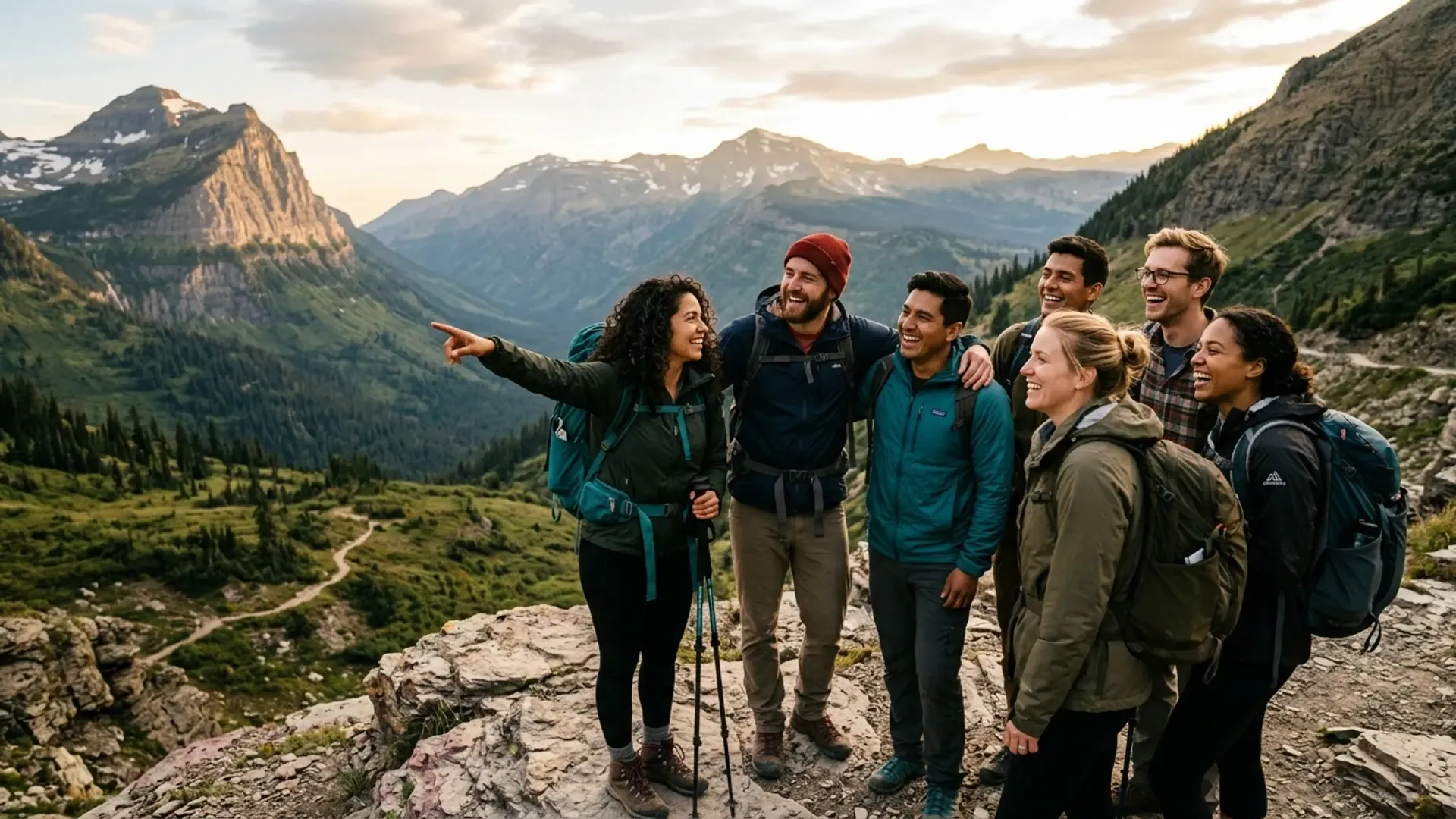
You're at a trailhead and a group ahead of you is laughing about last night's campfire disaster. You don't know any of them yet. By sunset, after sharing a scramble up slick rock and splitting a bag of trail mix, you'll have their numbers. That's how it works out here.
The National Park Service recorded a record 331.9 million recreation visits in 2024 (NPS, 2025). But the real story isn't the headcount — it's what happens between people on those trails. A 2023 study in the Journal of Environmental Psychology found that nature exposure significantly increases prosocial behavior: people become more trusting, cooperative, and open to conversation outdoors. National parks combine that psychological effect with shared physical challenges, limited phone service, and communal spaces — making them some of the best places in America to meet new people.
The 8 best national parks for group activities: Yosemite (iconic group hikes), Zion (adventure bonding), Great Smoky Mountains (largest group camping, free admission), Joshua Tree (climbing and stargazing culture), Acadia (coastal cycling and kayaking), Rocky Mountain (trail running community), Olympic (three ecosystems in one park), and Shenandoah (closest to the East Coast and the Appalachian Trail community).
Why National Parks Are Becoming America's New "Third Places"
Sociologist Ray Oldenburg defined "third places" as the social spaces beyond home and work — coffee shops, barbershops, community centers. The places where you bump into people and relationships form organically. The problem? Those spaces are disappearing. Americans are spending 37% less time with friends than they did in 2014 (American Time Use Survey, Bureau of Labor Statistics). Local diners, bowling alleys, independent bookstores — the places where people used to bump into each other — are closing faster than they're being replaced.
National parks are filling that gap. While malls close and coffee shops become laptop libraries, parks are expanding their group infrastructure. The NPS invested $6.5 billion through the Great American Outdoors Act (2020), upgrading campgrounds, visitor centers, and group-use areas. The Volunteers-In-Parks program alone engages nearly 300,000 people annually (NPS, 2024).
The result: parks have become places where strangers actually talk to each other. No cover charge, no algorithm, no two-drink minimum. Just a trail, a shared direction, and whatever conversation happens naturally.
We've explored this shift in depth: The Death of Third Places and the Rise of Outdoor Dating.
The Science of Why Trails Build Friendships Faster Than Bars
- The 50-Hour Rule: Jeffrey Hall's research at the University of Kansas (2018, Journal of Social and Personal Relationships) found it takes about 50 hours of shared time to move from acquaintance to friend. A weekend backpacking trip gets you there in one outing.
- Nature Lowers Your Guard: Bratman et al. (2015, PNAS) showed that a 90-minute nature walk reduces activity in the subgenual prefrontal cortex — the brain region linked to repetitive negative thinking. Less rumination means you're more present, more approachable, and more willing to say hi to strangers.
- Shared Challenge Bonds: The adrenaline from a challenging hike triggers what psychologists call "misattribution of arousal" — your brain attributes the excitement to the people beside you, accelerating trust. Dutton and Aron's classic 1974 suspension bridge experiment demonstrated this effect, and subsequent research confirms that activities requiring mutual reliance (climbing, rafting) strengthen relationships both during and after the experience.
- No Phones, No Facades: Limited cell service in most parks strips away the digital buffer. No doom-scrolling, no texting someone else — just real, unfiltered conversation.
Deep dive: How the 50-Hour Friendship Rule Explains Why Outdoor Friendships Form Faster.
The 8 Best National Parks for Group Activities and Meeting People
Selected for group camping infrastructure, ranger-led social programming, trail variety for mixed skill levels, and proximity to major cities. Because the best park for making friends is one you can actually drive to on a Friday night.
1. Great Smoky Mountains — Tennessee / North Carolina
Best for: Large groups on a budget (free admission, most group campsites)
America's most-visited national park (12.2 million visits in 2024) also has its best group camping infrastructure: 7 designated group campgrounds accommodating 20-30 people each. And here's the kicker — there's no entrance fee. For a group of friends splitting gas from Knoxville (1 hour away), Nashville (3.5 hours), or Atlanta (3 hours), the Smokies are the cheapest weekend trip in the park system.
But what makes the Smokies uniquely social is the synchronous firefly event every June. Thousands of strangers sit in complete darkness in Elkmont, watching fireflies blink in unison. Nobody talks. Everyone watches. And then, when it ends, everyone talks to everyone. It's one of those rare shared experiences that obliterates the stranger barrier.
- Top group trail: Laurel Falls Trail (2.6 miles round trip, easy) — paved, accessible, ends at an 80-foot waterfall.
- Also try: Smokies Service Days — single-day volunteer projects on Saturdays, followed by optional group hikes and ranger-led tours.
- Cost: Free admission. Group campsites from $26-65/night.
2. Yosemite National Park — California
Best for: Group hikes with jaw-dropping scenery
Yosemite drew 4.1 million visitors in 2024. Three group campgrounds (Wawona, Bridalveil Creek, Tamarack Flat) accommodate 13-50 people, and the trail system ranges from wheelchair-accessible valley loops to the Half Dome cables.
- Top group trail: Mist Trail to Vernal Fall (5.4 miles round trip, moderate). Wide enough to walk side by side, dramatic enough to spark conversation.
- Social programming: Ranger campfire talks, Glacier Point stargazing, and the Yosemite Conservancy's volunteer restoration projects.
- Pro tip: Tuolumne Meadows attracts a younger, more adventurous crowd and its group campgrounds are easier to reserve than the Valley.
- Cost: $35 vehicle entry. Group campsites from $50/night. America the Beautiful pass ($80/year) covers entry to all parks.
3. Zion National Park — Utah
Best for: Adventure bonding (canyoneering, river hikes)
Zion's narrow slot canyons and river crossings create natural team-building moments. The park shuttle means everyone starts together — no one gets left behind. Book a guided canyoneering trip and watch how quickly a group of 6-12 strangers becomes a tight-knit crew when they're rappelling into a slot canyon together.
- Top group trail: The Narrows (bottom-up, 5+ miles, strenuous). Wading through the Virgin River together is an instant bonding experience.
- Social programming: Ranger talks at Zion Lodge amphitheater. The Zion Canyon Field Institute offers multi-day group courses in photography and geology.
- Cost: $35 vehicle entry. Guided canyoneering trips from $150/person.
4. Joshua Tree National Park — California
Best for: Climbing culture and stargazing communities
Joshua Tree is 2.5 hours from LA and has become a weekend hub for climbers, artists, and stargazers. Over 8,000 climbing routes at Hidden Valley attract a community-minded crowd who routinely share beta (route info) with strangers. The park has group campgrounds at Indian Cove, Cottonwood, and Ryan accommodating 25-70 people.
- Top group activity: Rock climbing at Hidden Valley. Even if you're watching, the climbing community is approachable and welcoming to newcomers.
- Social programming: Annual Night Sky Festival, ranger-led geology walks, desert ecology programs.
- Pro tip: Joshua Tree has some of the darkest skies near a major city. Group stargazing with a telescope is one of the best icebreakers imaginable.
- Cost: $30 vehicle entry. Group campsites from $40/night.
5. Rocky Mountain National Park — Colorado
Best for: Trail running groups and high-altitude challenges
Just 90 minutes from Denver and deeply connected to Boulder's outdoor culture. Rocky Mountain drew 4.2 million visitors in 2024. Trail Ridge Road reaches 12,183 feet, and the trail system supports everything from gentle lakeside walks to technical peak scrambles.
- Top group trail: Bear Lake to Emerald Lake (3.6 miles round trip, moderate). Three alpine lakes in under 2 miles.
- Social programming: Elk bugling programs (September-October), ranger-led snowshoe walks in winter.
- Pro tip: Boulder Trail Runners and the Colorado Mountain Club organize regular group outings in the park. Check their event calendars for open-invite sessions.
- Cost: $30 vehicle entry. Timed entry reservation required May-October.
Speaking of run clubs, run clubs are becoming the new dating apps — and parks like Rocky Mountain are perfect venues.
6. Acadia National Park — Maine
Best for: Coastal group adventures — cycling, kayaking, tide pooling
Acadia's 45 miles of crushed-stone carriage roads (built by John D. Rockefeller Jr.) make it the best park in the system for group cycling. Blackwoods group campground accommodates 15-50 people, and Bar Harbor's sea kayaking outfitters run group tours daily in summer.
- Top group trail: Jordan Pond Path (3.3 miles, easy). Flat loop around a pristine lake, then popovers at Jordan Pond House — a 100-year tradition.
- Don't miss: Cadillac Mountain sunrise. Early risers gather on the summit to catch the first sunrise in the U.S. (October-March). Arrive 30 minutes early and you'll make friends before the sun comes up.
- Cost: $35 vehicle entry. Sea kayaking group tours from $60/person.
7. Olympic National Park — Washington
Best for: Multi-ecosystem variety (rainforest, beaches, mountains in one park)
Olympic offers three completely different landscapes — temperate rainforest, alpine peaks, and wild Pacific coastline. Your group gets a different experience each day, keeping energy and conversation fresh. The Hoh Rain Forest's Hall of Mosses Trail (0.8 miles, easy) is short enough for anyone but otherworldly enough to feel like a real adventure.
- Pro tip: Beach bonfires at Rialto Beach are legal and popular. Gathering driftwood, building a fire, watching the Pacific sunset — these are the moments people remember.
- Social programming: Ranger-led beach walks, tidepool ecology programs, campfire talks at Kalaloch.
- Cost: $30 vehicle entry. Wilderness group camping permits available.
8. Shenandoah National Park — Virginia
Best for: East Coast accessibility and the Appalachian Trail community
Just 75 miles from Washington, D.C. — the most accessible national park for the East Coast's densest population corridor. Skyline Drive runs 105 miles along the Blue Ridge, and the Appalachian Trail passes through for 101 miles, connecting you to one of America's most welcoming hiking communities.
- Top group trail: Old Rag Mountain (9.2 miles, strenuous). A rock scramble that requires teamwork — you'll be helping strangers up boulders and making friends in the process.
- Pro tip: Visit AT shelters in Shenandoah during spring (March-May) to meet thru-hikers from all over the world. The trail community is legendarily welcoming.
- Cost: $30 vehicle entry. Four group campgrounds accommodating 10-30 people.
National Parks Comparison: Which One Fits Your Group?
Park | Group Camps | Entry Fee | Nearest Major City | Best For |
|---|---|---|---|---|
Great Smoky | 7 sites (up to 30) | Free | Knoxville (1h) | Large groups, beginners |
Yosemite | 3 sites (13-50) | $35/vehicle | San Francisco (3.5h) | Iconic hikes, volunteering |
Zion | 1 site (40) | $35/vehicle | Las Vegas (2.5h) | Canyon adventures, bonding |
Joshua Tree | 3 sites (25-70) | $30/vehicle | Los Angeles (2.5h) | Climbing, stargazing |
Rocky Mountain | 2 sites (40) | $30/vehicle | Denver (1.5h) | Trail running, alpine lakes |
Acadia | 1 site (15-50) | $35/vehicle | Boston (4.5h) | Cycling, coastal activities |
Olympic | 2 sites (20-55) | $30/vehicle | Seattle (2.5h) | Multi-ecosystem variety |
Shenandoah | 4 sites (10-30) | $30/vehicle | D.C. (1.5h) | AT community, accessibility |
Budget tip: The America the Beautiful annual pass ($80) covers entry to all 400+ NPS sites for a full year — it pays for itself in two visits.
5 Ways to Actually Meet People at National Parks
Showing up alone at a park won't magically hand you a friend group. Here's how to engineer serendipity:
1. Join Organized Group Outings
Meetup hosts thousands of hiking groups across the U.S. — the Twin Cities Hiking Meetup alone has 18,000+ members. REI Co-op runs thousands of outdoor events annually. The Sierra Club organizes multi-day park trips. These outings remove the awkwardness of approaching strangers — everyone showed up to meet people.
2. Volunteer Together
The NPS Volunteers-In-Parks program engages nearly 300,000 people annually, including 38,000 under age 25. Working a trail maintenance day — clearing fallen trees, building water bars — creates bonds faster than any happy hour. The Smokies' Service Days (Saturdays) combine volunteer work with guided hikes afterward.
3. Attend Ranger-Led Programs
Every national park offers free ranger-led programs: campfire talks, stargazing nights, geology walks, wildlife tours. These are social by design — small groups, guided conversation, shared awe. Evening programs work especially well because the relaxed setting encourages people to linger and chat.
4. Use an Activity-Based App
Instead of swiping through profiles, try an app built around doing things together. GRASS uses a "Group Adventure" feature that lets you create or join outdoor outings — a Saturday hike near Shenandoah, a climbing session at Joshua Tree, a trail run at Rocky Mountain. You show up, do the activity, and meet people through shared experience. There's also a "Find Buddy" feature for 1-on-1 activity partners, and an "Outdoor Passport" profile that shows your real adventure photos instead of curated selfies.
5. Be the Person Who Starts a Conversation
This isn't advice you'd take at a bar. But at a trailhead? It's different. Compliment someone's pack, ask which trail they're doing, offer to take their group photo. The shared context of being outdoors gives every interaction a natural opening. If you've ever noticed how easily strangers talk to each other at a trailhead versus a subway platform, you already know this works.
More outdoor social strategies: The Complete Guide to Outdoor Dating.
Planning Your First Group Park Trip
- Book early: Group campgrounds fill up 6 months in advance on Recreation.gov. Set a calendar reminder for when reservations open.
- Pick a trail for your least experienced hiker: Nothing kills group dynamics faster than someone struggling. Choose trails below the group's average fitness level.
- Plan a social anchor: A campfire meal, a sunrise hike, a post-hike brewery stop. Give the group a moment to connect beyond the trail.
- Keep the group at 6-12 people: Large enough for diverse conversation, small enough that nobody gets left out.
- Go in the right season: Spring (March-May) for wildflowers and AT thru-hikers. Summer for alpine hikes and water activities. Fall for fewer crowds and stunning foliage. Winter for snowshoe programs and solitude.
Ready to find your outdoor crew? GRASS lets you browse group adventures by location and activity type, join with a tap, and let the trail do the rest.
FAQ: Group Activities at National Parks
What is the best national park for group camping?
Great Smoky Mountains National Park has the most extensive group camping infrastructure in the National Park System, with 7 group campgrounds accommodating up to 30 people each. It's also the only major national park with no entrance fee, making it ideal for large groups on a budget.
How do I meet people at a national park if I'm going alone?
Three reliable methods: (1) Join an organized group trip through Meetup, REI, or the Sierra Club. (2) Attend free ranger-led programs — evening campfire talks and stargazing events are especially social. (3) Use activity-based apps like GRASS to find group hikes or outdoor adventures near the park you're visiting.
What is the best time of year for group activities in national parks?
It depends on the park and activity. Spring (March-May) is ideal for Shenandoah wildflowers and Appalachian Trail thru-hiker season. Summer is peak for alpine hikes at Rocky Mountain and water activities at Acadia and Olympic. Fall offers smaller crowds and foliage at Great Smoky Mountains and Shenandoah. Winter is best for snowshoe programs at Rocky Mountain and stargazing at Joshua Tree (clearest skies, fewest visitors).
How much does it cost to visit national parks with a group?
Most national parks charge $30-35 per vehicle for entry. The America the Beautiful annual pass ($80) covers all 400+ NPS sites for a full year and pays for itself in two visits. Group campsites range from $30-65 per night (Great Smoky Mountains is free entry, campsites from $30). Great Smoky Mountains is the most budget-friendly option with free admission.
National parks aren't just for scenic photos and solitary reflection. They're gathering places — the kind of third places America is losing everywhere else. With the right park, the right trail, and a willingness to say hello, you might find that the best connections of your life happen on dirt paths, not dating apps.
Explore more things to do in national parks with friends: Outdoor Activity Dating Map: 8 Activities and Where to Do Them.